



What is iPaaS for compliance-driven integration?
The Integration Platform as a Service (iPaaS) has traditionally been evaluated on speed, connectivity breadth, and developer experience. For organizations operating under regulatory frameworks, those criteria remain relevant, but they sit behind a harder set of requirements: data residency, audit logging, access controls, and the ability to demonstrate to an auditor that data moved where you said it moved, under the controls you said were in place.
Compliance-driven integration covers a wide range of regulatory contexts. HIPAA governs how health data moves between systems. SOX (Sarbanes-Oxley Act) governs financial reporting pipelines and the controls surrounding them. GDPR and its regional equivalents govern how personally identifiable data (PII) is collected, processed, and retained. FedRAMP and StateRAMP set the bar for government data handling. Each framework has specific technical requirements, and most organizations are subject to one or several simultaneously.
The evaluation criteria shift accordingly. Certifications, deployment flexibility, encryption controls, role-based access, data lineage, and the maturity of the vendor’s own security posture all carry significant weight. This post covers the major iPaaS vendors in the compliance space and what buyers should know before shortlisting them.
What makes an iPaaS viable for compliance-driven deployment?
Most iPaaS platforms were built to maximize connectivity speed and developer productivity. Compliance capabilities tend to be layered in as the platform matures and the customer base expands into regulated industries. That sequencing shapes what the architecture can do natively versus what requires configuration, third-party tooling, or manual process to close the gap.
A compliance-ready integration platform needs to support:
- Data residency controls that keep data within defined geographic or network boundaries
- Encryption in transit and at rest, with customer-managed key options for sensitive workloads
- Granular role-based access control at the pipeline, project, and tenant level
- Immutable audit logging that captures who ran what, when, with what data
- Certifications relevant to your regulatory context (SOC 2 Type II, HIPAA BAA availability, FedRAMP authorization, ISO 27001)
- Deployment models that support air-gapped, on-premise, or private cloud environments where required
These requirements expose real architectural differences between platforms. A platform that stores all data in a shared multi-tenant cloud environment will have structural difficulty supporting certain data residency requirements, regardless of what the configuration options say. Similarly, a platform that generates audit logs as a secondary feature rather than a core architectural output produces logs that are harder to defend under audit scrutiny.
The evaluation section at the end of this post provides questions designed to help you quickly identify these differences.
The major iPaaS vendors for compliance-driven integration
The iPaaS market includes platforms that range from cloud-native SaaS with compliance certifications layered on, to enterprise platforms with deployment flexibility built into the architecture. The options below represent the platforms most commonly evaluated by IT, security, and data teams in regulated industries.
MuleSoft (Salesforce)
MuleSoft offers standard enterprise compliance credentials (SOC 2 Type II, ISO 27001, HIPAA BAA) and supports private cloud or on-prem deployment via Runtime Manager and Mule agents for data residency needs. The catch for compliance-focused buyers is operational complexity. Anypoint’s flexibility comes with a configuration surface that demands constant, careful management to stay compliant at scale, which would realistically require dedicated integration engineering headcount.
Boomi
Boomi holds SOC 2 Type II certification and provides HIPAA-compliant deployment options. Its cloud-native architecture works well for organizations whose compliance requirements are met by a well-controlled SaaS environment. Organizations needing on-premise deployment or air-gapped environments should note the cloud-only runtime as a real constraint. Boomi’s partner network offers compliance-focused implementation services to help map the platform’s controls to specific framework requirements.
Workato
Workato holds SOC 2 Type II and ISO 27001 certifications, with HIPAA-compliant plans available for healthcare and adjacent regulated industries. Its accessibility for non-technical users is a double-edged sword: easy self-service automation means access governance has to be actively enforced, not assumed. Role-based access controls and workspace governance features are available, but for compliance programs focused on data access risk, they require deliberate setup and ongoing oversight rather than working out of the box.
IBM App Connect
IBM App Connect has a compliance-mature posture, backed by IBM’s broader security infrastructure. FedRAMP authorization, HIPAA BAA support, and a range of government and financial services certifications are part of its established profile. It’s a reasonable fit for organizations already in the IBM ecosystem or needing that specific certification set. Organizations outside that context should weigh the implementation footprint and licensing structure carefully against their actual compliance requirements. It is not a lightweight lift.
SnapLogic
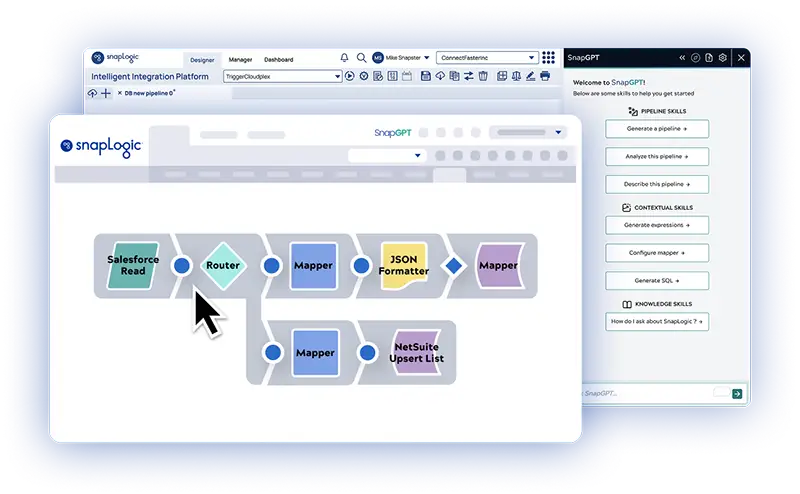
SnapLogic’s compliance posture is built around the architectural flexibility of the SnapPlex agent model, which supports cloud, on-premise, and hybrid deployment within the same platform. For organizations with data residency requirements that prevent data from leaving a specific network boundary, the ability to run the integration runtime on-premise while managing it through a cloud control plane addresses the requirement without sacrificing operational visibility.
The platform holds SOC 2 Type II certification and supports HIPAA BAA arrangements for healthcare data workloads. Audit logging is generated at the pipeline execution level, capturing the what, when, and who of every data movement in a form that maps directly to audit review requirements.
Role-based access control extends to the project and pipeline level, and the multi-tenant architecture supports tenant-level isolation for organizations that operate multiple business units or subsidiaries under a single platform instance. Encryption controls cover data in transit and at rest, with options for private key management in customer-controlled environments.
SnapLogic’s investment in AI pipeline capabilities is also relevant for compliance-sensitive organizations that are evaluating AI use cases. Governance requirements around AI data flows are evolving, and having integration and AI orchestration in the same platform with the same audit and access control infrastructure reduces the governance surface area.
How to structure your iPaaS compliance evaluation
Every iPaaS vendor in this space has a compliance page and a certification list. The meaningful differences emerge in how those certifications translate into the specific controls your framework requires, and whether the platform’s architecture supports those controls in production at scale.
Before running a proof of concept or engaging procurement, use these questions to qualify which vendors warrant deeper evaluation:
- What certifications do you hold, and what is the audit scope for each?
- How does the platform support data residency requirements, and what data leaves the customer’s network boundary during normal operation?
- What does the audit log capture, how is it stored, and how long is it retained?
- How are role-based access controls implemented at the pipeline and project level?
- What deployment models does the runtime support, and how is each one managed?
Pay attention to the specificity of the answers. A vendor with a mature compliance posture will answer with reference architecture documentation, certification scope descriptions, and specific configuration guidance for the frameworks you named. Answers that stay at the level of marketing certifications without getting into architectural specifics are an indicator that the compliance capability is shallower than the badge suggests.
These questions will identify structural limitations faster than any comparison matrix, and they will save you from discovering gaps after the platform is embedded in your data infrastructure.
Choosing the right fit
The right platform depends on the specific regulatory frameworks you operate under, your deployment constraints, and the maturity of your internal security governance program. The vendors listed here are all credible options for specific compliance contexts.
The evaluation criteria above tend to reveal the differences that matter in practice, and they are worth applying against your actual framework requirements rather than generic compliance checklists.
Ready to see how SnapLogic’s compliance architecture maps to your specific regulatory context? Take a self-guided platform tour or book a personalized conversation with our compliance and integration team.