

Engineering teams are facing a critical challenge: how to test features in production-like environments without compromising stability, escalating costs, or blocking other developers. The traditional shared staging environment model creates bottlenecks, introduces instability, and slows deployment velocity. At the same time, spinning up complete infrastructure clones for every developer is prohibitively expensive and operationally complex.
We built E-Pods (Ephemeral Pods) to address this problem: a GitOps-based framework that provides developers with on-demand, isolated, production-like environments through a simple pull request workflow. This post explores how E-Pods enable cost-aware and risk-aware development practices while accelerating innovation.
The shared environment problem
Every engineering organization that has scaled beyond a handful of developers knows the pain of shared staging environments. The conflict is fundamental: developers need stability to test their changes, but they also need to deploy potentially unstable code to validate those changes. When multiple teams share the same environment, chaos ensues.
Consider this scenario: Team A deploys a breaking change to test a new feature. Meanwhile, Team B is trying to demo their work to stakeholders. Team C’s critical bug fix verification is now blocked because the environment is unstable. Sound familiar?
The traditional solutions all have drawbacks:
- Shared staging environments: Create bottlenecks, instability, and finger-pointing when something breaks
- Long-lived development environments: Accumulate drift, become expensive, and still create scheduling conflicts
- Full infrastructure clones: Cost-prohibitive and operationally complex at scale
- Local development only: Insufficient for testing integrations, microservices interactions, and infrastructure-dependent features
Introducing E-Pods: GitOps-powered ephemeral environments
E-Pods take a different approach. Instead of managing complex environment provisioning workflows or deploying through multiple tools, developers simply open a GitHub pull request. That’s it. The framework handles everything else: provisioning infrastructure, deploying services, configuring networking, and providing access credentials.
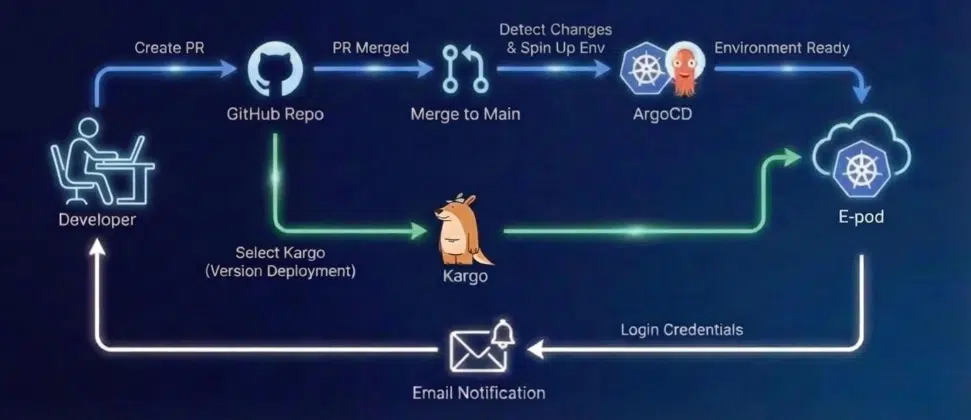
How E-Pods work
The E-Pods workflow is elegantly simple:
1. Open a pull request. Developers create a PR in our designated E-Pods repository, specifying which services they need and their desired versions. The PR becomes the single source of truth for the environment configuration.
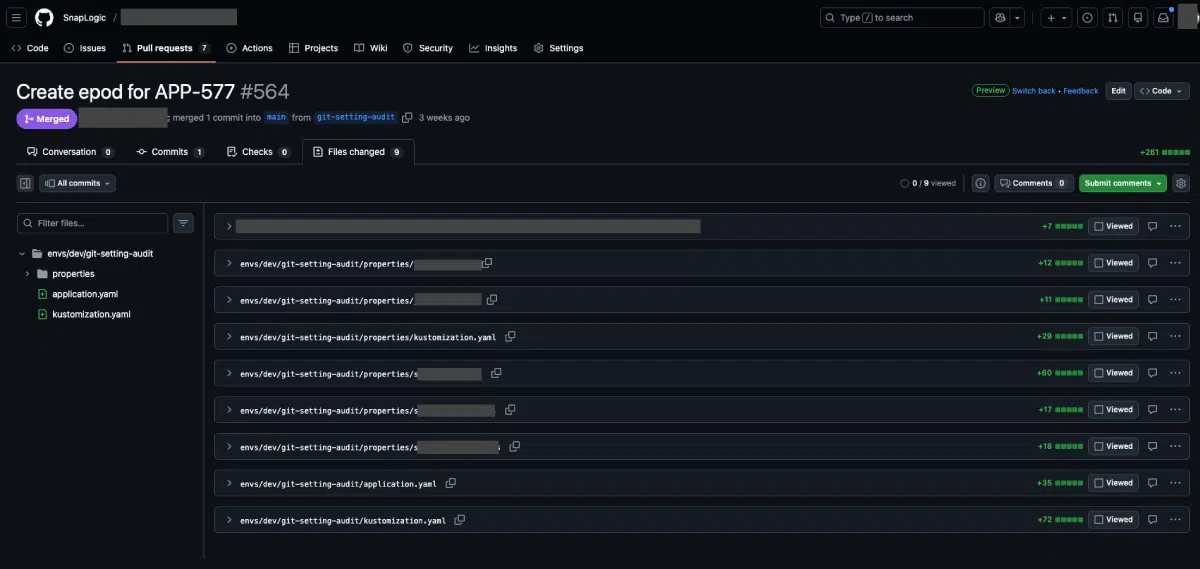
2. Merge and deploy. Once the PR is merged, our GitOps controller (powered by ArgoCD) detects the change and begins provisioning. The steps:
- Creates isolated Kubernetes namespaces
- Deploys specified service versions
- Configures networking and service mesh rules
- Sets up monitoring and observability
- Provision ephemeral databases
3. Receive environment credentials Within minutes, developers receive an email containing:
- Environment access URLs
- UI Login credentials
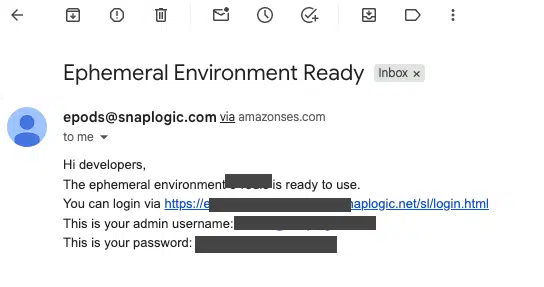
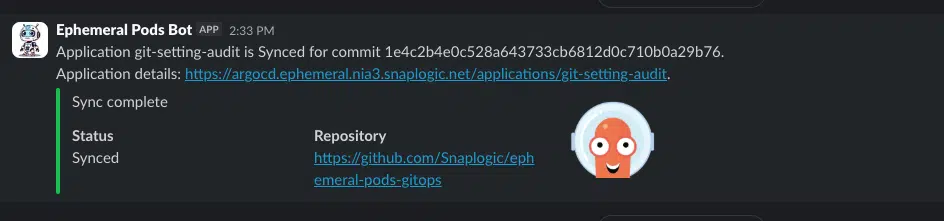
4. Monitor via Slack: Real-time status updates arrive in Slack, keeping developers informed about:
- Deployment progress
- Service health checks
- Environment readiness
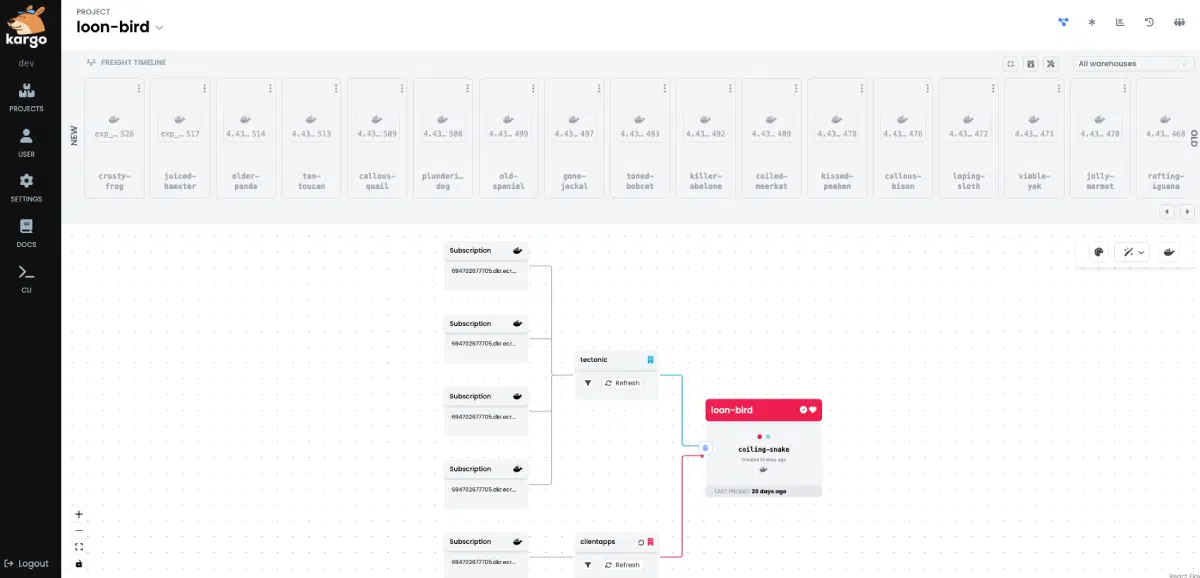
5. Version management through Kargo Here’s where E-Pods truly shine. We integrated Kargo, a continuous delivery tool that provides a visual interface for version management. Developers access a dedicated Kargo URL where they can:
- See all available service versions in the “warehouse”
- Upgrade or downgrade service versions with a single click
- Track promotion stages across services
- View deployment history and rollback if needed
Kargo syncs with our CI system (Travis CI in our case), automatically pulling in newly built container images. When a new feature branch build completes, developers immediately see it available in their E-Pods Kargo interface.
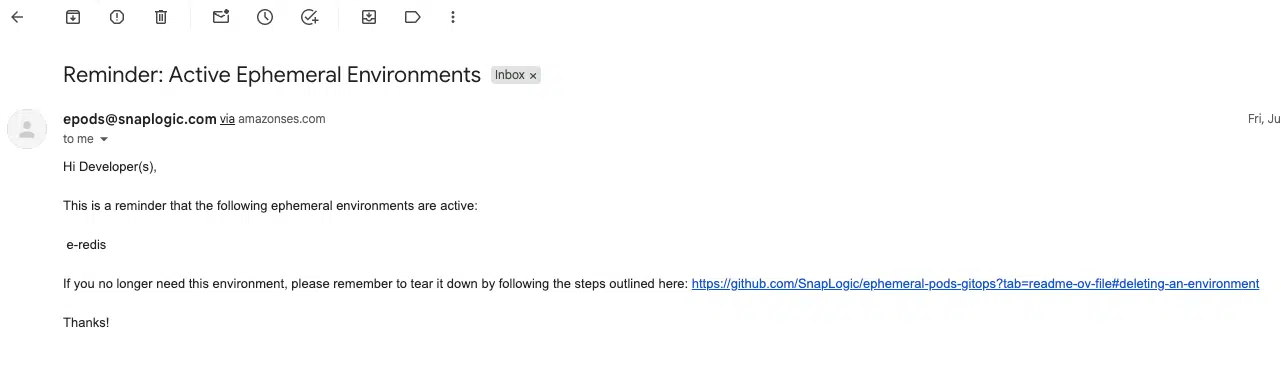
6. Automatic Cleanup E-Pods is cost-aware by design. Every environment has a fixed time-to-live. Before shutdown:
- Developers receive an email notification warning them of impending deletion
- They can extend the environment’s life
- Or manually destroy it via a GitHub PR when testing is complete
The GitOps advantage
Our implementation choice, GitOps, provides several compounding benefits.
Declarative configuration. Environment definitions live in Git, providing:
- Version history and audit trails
- Easy rollback to previous configurations
- Peer review through PR workflows
- Documentation that can’t drift from reality
Self-service without complexity. Developers don’t need to understand Kubernetes, Helm charts, or infrastructure as code. They work with familiar Git workflows and YAML configuration files.
Reconciliation and drift detection. The GitOps controller continuously reconciles desired state (in Git) with the actual state (in the cluster). If someone manually modifies an E-Pod, the controller automatically corrects it.
Integration with existing workflows. Since development teams already use GitHub for code review, adding environment provisioning to the same workflow creates zero cognitive overhead.
Real-world impact: developer experience transformation
Since deploying E-Pods, we’ve observed significant improvements across multiple dimensions:
Velocity improvements
Before E-Pods:
- Average time to get a test environment: 2-3 days (including requesting, provisioning, and waiting for shared environment availability)
- Environment conflicts: 3-5 per week requiring manual resolution
- Failed deployments due to environment instability: ~30% of initial attempts
After E-Pods:
- Average time to get a test environment: 3-5 minutes (from PR merge to ready)
- Environment conflicts: Zero (true isolation)
- Failed deployments due to environment issues: <5%
Cost efficiency
By implementing automatic cleanup and right-sized resource allocation, we achieved:
- Reduction in development infrastructure costs
- Decrease in idle resource consumption
- Elimination of long-lived, forgotten development environments
Developer satisfaction
Qualitative feedback has been overwhelmingly positive:
- Developers report spending less time on environment management and more time coding
- Reduced friction in cross-team collaboration (no more scheduling conflicts)
- Faster feature validation and stakeholder demos
- Reduced anxiety about breaking shared environments
Ephemeral environments as a competitive advantage
In the race toward faster innovation cycles and more reliable software delivery, ephemeral environments have become a competitive necessity. E-Pods demonstrates that, with the right architectural choices, GitOps, cost awareness, risk isolation, and developer-centric workflows, organizations can provide developers with powerful testing capabilities without incurring high costs or introducing operational complexity.
The future of development environments is ephemeral, isolated, and on-demand. By treating environment provisioning as code, integrating with existing developer workflows, and building cost awareness into the foundation, E-Pods enables our teams to move faster while maintaining the stability and reliability our business demands.
Turn AI potential into enterprise results. Join our two-hour deep dive into integrating agents with core business systems at AgentFest Virtual Summit 2026.