


Evaluating an integration platform isn’t a casual decision. You’re committing to infrastructure that will touch nearly every system in your stack. And you’ll be living with that choice for years. Analyst reports from firms like Gartner, IDC, and Aragon exist precisely to make that evaluation more rigorous: they pressure-test vendors across hundreds of criteria, talk to real customers, and benchmark capabilities against the broader market.
So what are they saying about SnapLogic?
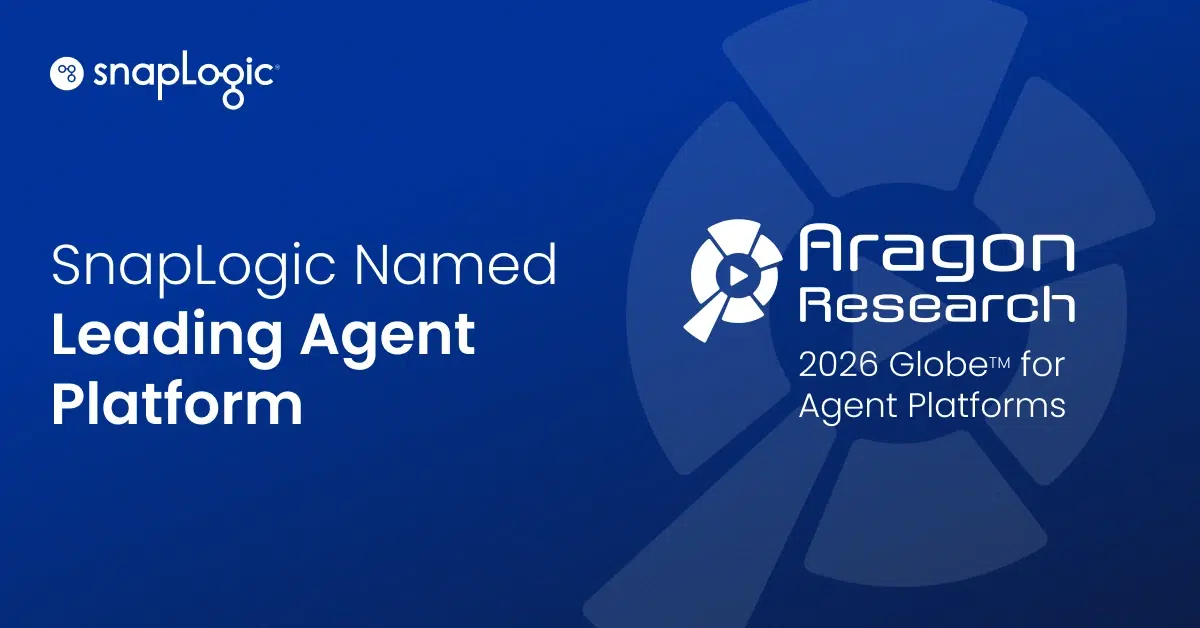
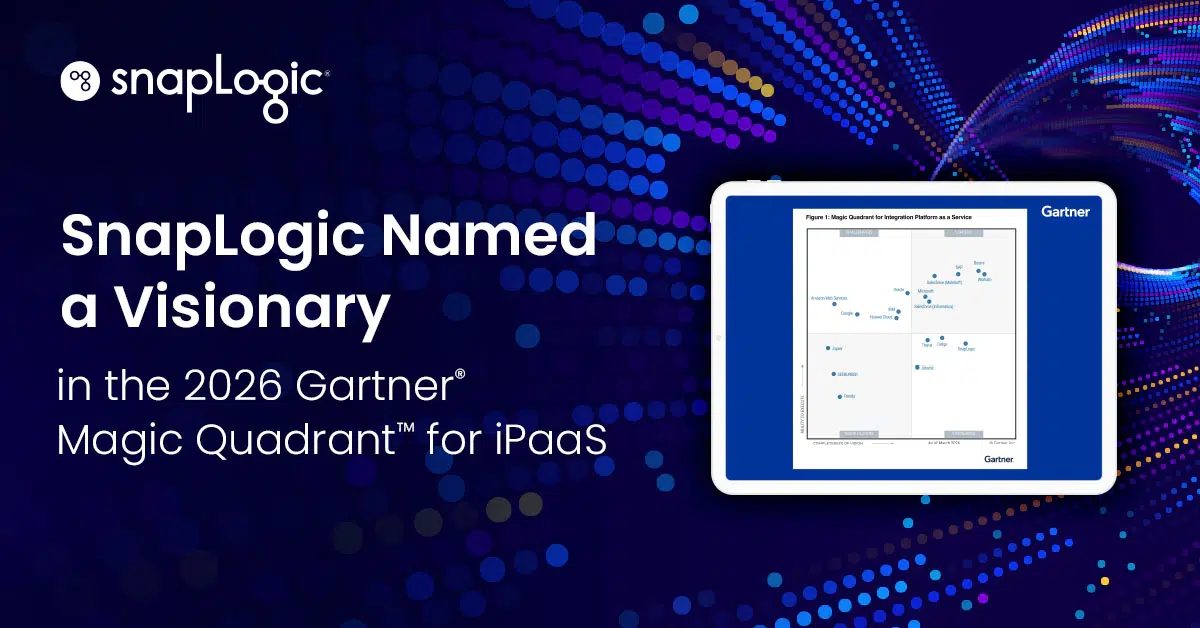
So far this year, SnapLogic has been recognized across three separate analyst reports: the Gartner Magic Quadrant for iPaaS, the IDC MarketScape for Data Integration, and the Aragon Research Globe for AI Agent Platforms. That last one is worth pausing on. It reflects something we think is increasingly important for enterprise architects: integration and agentic AI are no longer separate conversations. They’re the same conversation.
Rather than just hanging those badges on our wall, here’s what the analysts actually evaluated, and what it means if you’re designing integration and automation architecture for a complex enterprise environment.
Why analyst reports matter (and their limits)
Let’s be direct about something upfront: no analyst report is a perfect proxy for your environment. The Gartner Magic Quadrant, IDC MarketScape, and Aragon Research Globe each use different methodologies, weigh different criteria, and serve different evaluation purposes. A placement that looks strong in one context might not address your specific requirements around latency, connector coverage, or on-premises deployment, for example.
That said, appearing across all three, in the same year, across three distinct categories, is a meaningful signal. It suggests a vendor isn’t optimizing for one analyst’s rubric, but building something with genuine breadth.
Here’s how each report approaches its evaluation:
The Gartner Magic Quadrant is probably the most familiar. It plots vendors on two axes, the ability to execute and completeness of vision, and is most useful for assessing overall platform maturity and market standing. For iPaaS specifically, Gartner evaluates factors like integration capability breadth, ease of use, partner ecosystem, customer support, and pricing transparency.
The IDC MarketScape uses a different approach: it scores vendors on strategy and capabilities and positions them within a polygon rather than a quadrant. It tends to go deeper on customer evidence and vertical use cases, making it particularly useful when you’re evaluating fit for a specific industry or workload type.
The Aragon Research Globe is the newest of the three frameworks in terms of relevance to this conversation. Aragon evaluates vendors on strategy and performance, with a focus on how well a platform supports building, orchestrating, and governing AI agents across enterprise environments. This is an emerging category, and the fact that an integration vendor is being evaluated alongside purpose-built agent platforms says something about where the market is heading.
Three reports, three lenses
Gartner Magic Quadrant for iPaaS
SnapLogic’s placement in the Gartner Magic Quadrant reflects the platform’s standing as a mature, enterprise-grade iPaaS. For architects evaluating integration platforms, the Gartner evaluation is a useful starting filter. It surfaces whether a vendor has the connector ecosystem, governance controls, and operational reliability to hold up at enterprise scale.
What Gartner tends to reward in this category: breadth of pre-built connectors, support for hybrid deployment models, a strong developer and low-code experience that serves both IT teams and business users, and demonstrated customer success at scale. These are the capabilities that keep integration projects from becoming integration bottlenecks.
IDC MarketScape for Data Integration
The IDC recognition speaks more specifically to SnapLogic’s data integration capabilities, such as ETL/ELT pipelines, cloud data warehouse connectivity, and the ability to move and transform data reliably across complex, multi-cloud environments.
For architects responsible for data infrastructure, this is the report to pay attention to. IDC’s evaluation incorporates customer feedback on real-world performance, which means a strong showing here reflects production-grade reliability, not just feature completeness on a spec sheet.
Aragon Research Globe for AI Agent Platforms
This is the recognition that warrants the most explanation. And arguably the most attention.
Aragon evaluates AI agent platforms on their ability to support the full agent lifecycle: development, orchestration, and governance. The criteria include how well a platform enables teams to build agents, how it handles multi-agent coordination across enterprise systems, and whether it provides the governance guardrails that security and compliance teams require.
SnapLogic’s inclusion here, as a Leader, reflects the AgentCreator capability and the broader Agentic Integration Platform. The thesis, as SnapLogic’s CMO Dayle Hall put it in the announcement, “The real challenge for enterprises isn’t building an agent, it’s orchestrating it across enterprise systems.” That’s an integration problem. And it’s one that platforms built on enterprise-grade integration architecture are uniquely positioned to solve.
“The real challenge for enterprises isn’t building an agent, it’s orchestrating it across enterprise systems.”
Dayle Hall, SnapLogic CMO
The through-line: why analyst reports are converging
The most important takeaway from being recognized across all three reports is that the analyst categories themselves are converging.
For years, integration platforms, data platforms, and AI platforms were evaluated in separate buckets, by separate teams, under separate budget lines. That’s changing. Gartner, IDC, and Aragon are all, in different ways, starting to evaluate whether platforms can bridge these worlds.
- Can your integration layer feed your AI models with clean, governed data?
- Can your agent orchestration framework connect to your existing application and API infrastructure?
- Can you operationalize AI without rebuilding your integration architecture from scratch?
These are questions that didn’t appear prominently in analyst evaluations five years ago. They’re central now.
For enterprise architects, this convergence has a practical implication: the platform decisions you make today about integration infrastructure will either accelerate or constrain your AI initiatives. An integration platform that’s also recognized in the AI agent space is a signal about where capable teams are placing their long-term bets.
This doesn’t mean every integration platform needs to become an AI platform overnight. But it does mean that when you’re evaluating integration vendors, it’s worth asking:
- How does this platform fit into an agentic architecture?
- What’s the path from pipeline to agent?
- How does governance work when autonomous processes are involved?
Those questions now have analyst-backed frameworks to help you evaluate the answers.
How does this map to real architecture decisions?
Analyst criteria are useful, but they can feel abstract. Here’s how the dimensions these reports evaluate translate to the decisions architects actually face:
Connector ecosystem depth
Gartner weighs this heavily, and for good reason. An integration platform is only as useful as its ability to connect to the systems you actually run. For most enterprises, that means a mix of modern SaaS, legacy on-premises systems, cloud data warehouses, and custom APIs. More than 1,000 pre-built connectors (Snaps) reduce the time and risk of building and maintaining custom integrations.
Hybrid deployment flexibility
Most enterprise environments aren’t fully cloud-native, and won’t be for years. Analyst evaluations increasingly reward platforms that support cloud, on-premises, and hybrid deployment without forcing architectural compromises. If your environment includes systems that can’t move to the cloud, this criterion matters more than most marketing materials will acknowledge.
Governance and security at scale
This comes up in all three reports in different forms. For data integration, it means lineage, access controls, and auditability. For AI agents, it means the ability to define what agents can and can’t do, log their actions, and intervene when needed. The platforms that score well here are the ones that treat governance as a first-class feature, not an afterthought.
Low-code accessibility without sacrificing depth
The best integration platforms serve both the architects who need granular control and the developers or operations teams who need to move quickly. SnapLogic’s visual, low-code interface is part of why it scores well on usability in analyst evaluations. But the underlying platform supports the complexity that enterprise environments demand.
Agent orchestration and real-time execution
This is newer territory, but it’s becoming a meaningful differentiator. As enterprises begin deploying AI agents that must act on live data and interact with multiple systems simultaneously, the latency, reliability, and orchestration capabilities of the underlying integration layer become critical. This is where the Aragon recognition is most forward-looking.
What our customers made possible
Analyst evaluations don’t happen in a vacuum. Gartner, IDC, and Aragon all incorporate customer interviews, reference checks, and real-world usage data into their assessments. A strong showing across three reports in the same year is a reflection of what customers have built and what they’ve reported back.
To the teams running SnapLogic in production, the architects who designed the pipelines, the engineers who built the integrations, the IT leaders who made the platform decision and then had to defend it, this is your recognition as much as ours.
The use cases that tend to show up in analyst evaluations aren’t hypothetical. They’re the employee onboarding automations that actually ran. The data warehouse migrations that were actually completed. The AI agents that are actually operating inside governed business workflows at companies like Verizon, Siemens, and Dentsu.
That’s what these recognitions reflect.
How to use these reports in your own evaluation
If you’re actively evaluating integration platforms (or re-evaluating one you’re already using), here’s how to get the most out of these analyst reports:
1. Read the full reports, not just the placement graphics
The most valuable content in any analyst report is the detailed capability assessments and customer feedback, not the quadrant position or polygon. Look for the specific criteria where vendors score well and identify gaps. That’s where the actionable signal lives.
2. Weight criteria for your environment
A criterion that Gartner weights heavily may be irrelevant to your use case, and vice versa. Build your own weighting model based on what actually matters for your stack. Then use the analyst criteria as a checklist, not a verdict.
3. Ask vendors the hard questions that the reports surface
Analyst evaluations are useful for generating the right questions to ask in vendor conversations. If an IDC report surfaces data governance as a differentiator, ask every vendor on your shortlist to walk you through their lineage and access control capabilities in detail. If Aragon flags agent orchestration as a key dimension, ask how the platform handles multi-agent coordination when one agent fails.
4. Use peer review data as a complement
Analyst reports are one input. G2, TrustRadius, and similar platforms surface practitioner-level feedback that can fill in gaps the formal reports don’t cover, especially around implementation experience, support quality, and day-to-day usability.
Where to go from here
If you’re in the middle of an integration platform evaluation, these reports are a useful starting point. However, the real test is whether a platform solves your specific problems.
If you want to dig into how SnapLogic approaches a particular use case (whether that’s modernizing a legacy data pipeline, connecting a new SaaS application, or designing an agentic workflow that operates across your enterprise systems), our team is ready to help. Take a self-guided tour of the platform or book a personalized demo today.