




Every enterprise IT leader has lived this moment. A team is deep in a project, moving quickly, and then someone needs data from SAP or a mainframe feed to be pulled into a new workflow. The work stops. Someone has to file a request, wait for the integration team, or open a tool that has nothing to do with what they were building a minute ago. The context switch might look small on paper, but it’s expensive in practice. Those gaps between different tools and modes of thinking are where good project momentum goes to die.
Those gaps are also where shadow IT is born. Not from malice, but from developers trying to keep moving and reaching for whatever gets the job done fastest, sanctioned or not. Enterprise IT has spent years building governance around integration precisely because it’s a domain where shortcuts carry real risk. The tension between developer speed and IT control has never really been resolved. It has just been managed, department by department, request by request.
Building where developers already are
Many developers now spend a growing share of their day inside AI coding environments, such as Claude Code, describing what they want to build and reviewing the results that come back. That shift changes what it looks like to help a developer connect to enterprise systems and data. The most natural move is to bring integration capability into the environment they are already in.
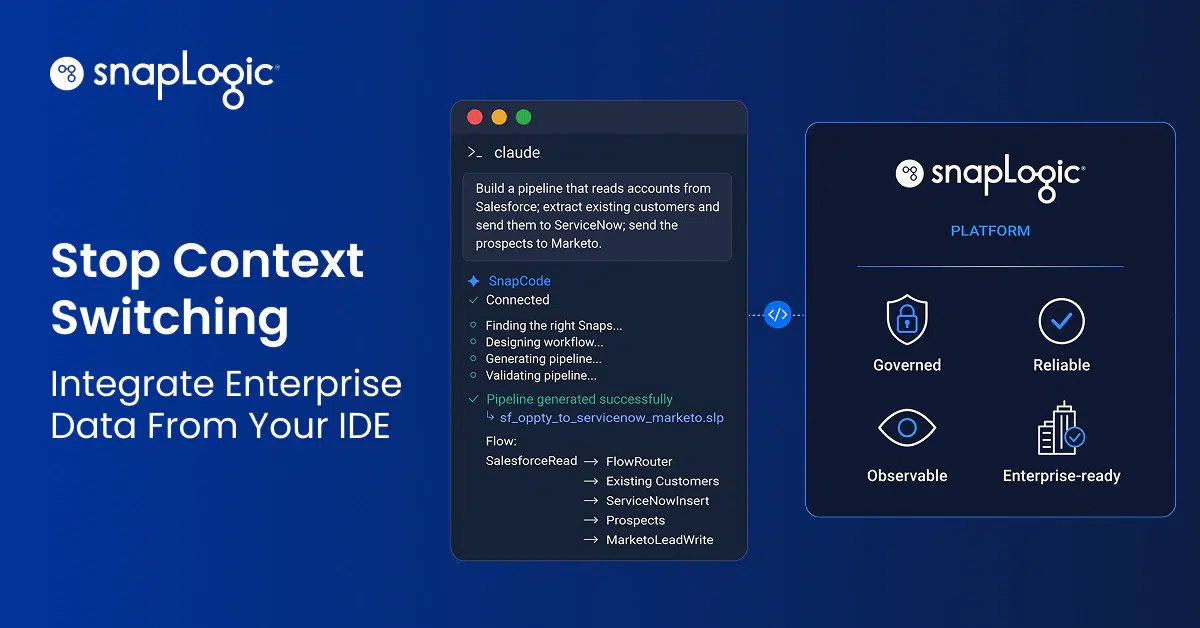
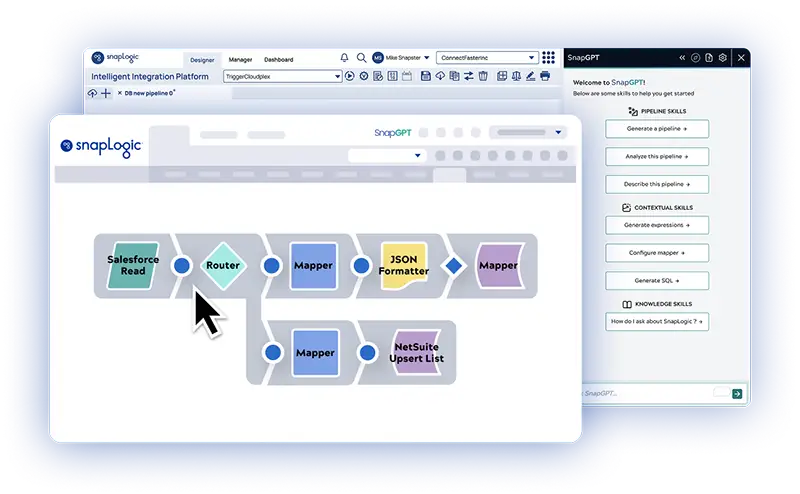
That is exactly what SnapCode does. It is an integration agent that lives inside your coding environment and turns a plain description of what you need into working pipeline code. A developer describes the integration in natural language, SnapCode generates the pipeline, and the result appears as code they can read, review, and commit like anything else they write. No separate canvas to open, no new tool to learn.
Reaching the systems that run the business
The systems enterprises depend on were never designed with AI coding agents in mind. SAP runs on RFC and BAPI. Mainframes speak CICS. EDI has its own decades-old conventions. None of that looks anything like a REST endpoint that a coding agent can just call. Getting to these systems has always required specialized connectors built and maintained by people who understand those protocols deeply — which is exactly the problem most AI development tools quietly skip past.
SnapCode draws on SnapLogic’s catalog of more than a thousand pre-built connectors, the same ones the rest of the platform runs on, so a developer working inside their coding environment can reach Oracle, SAP, mainframe systems, EDI, databases, and SaaS applications without having to become an integration specialist first. This gives direct access to SnapLogic’s deep connectivity into core enterprise systems.
Code your team owns, running the way IT already trusts
Here is the part that matters most to anyone responsible for what happens after launch day. The output of a session with SnapCode is real pipelines, sitting in your own Git repository, reviewed the way your team reviews everything else. Once those pipelines are deployed and live, they run on SnapLogic’s governed runtime at a fixed, predictable cost — with no LLM involved in execution. There is no variable token bill at the end of the month, and no mystery about what a pipeline is doing at 2 a.m.
That combination makes SnapCode useful far beyond one developer’s afternoon. Teams doing system migrations get a faster path through legacy connectivity work. Developers building AI-powered applications get enterprise access without having to become integration experts. IT organizations get visibility and governance over integration work that previously happened outside sanctioned channels, because the fast path and the approved path are now the same. And the great AI functionality that depends on that integration goes live right away, where users can take advantage of it to deliver real results.
Get started with SnapCode today
That tension between developer speed and IT control, which enterprise IT has been managing department by department for years, is exactly what SnapCode closes. It does not ask developers to slow down, and it does not ask IT to look away. The integration work happens in the same environment, the same review process, and the same governed runtime that everything else already runs on. The context switch that used to stall a project, and the shortcut that used to happen off the books instead, both disappear into the same workflow.
To learn more, visit the SnapCode product page, book a personalized demo with one of our experts, or contact your Customer Success Manager to get started.