



The market for AI agent development platforms is evolving fast, as signposted by Gartner’s inaugural Emerging Market Quadrant for AI Agent Development Platforms. SnapLogic is recognized as a Pace Setter in the report. Gartner clients can access the full report.
What does the “Emerging Market Quadrant” distinction mean?
It is becoming a truism that many people are experimenting with AI agents, but few are deploying them in production. The report calls this situation out explicitly, citing Gartner survey data:
49% of respondents said their organization is piloting agentic AI, while 25% are exploring agentic AI, and 13% had not yet started. Only 8% of organizations have agentic AI in production.
Some might say that it’s a market that is not yet mature enough for specialized tooling, but from our perspective, the opposite is true, depending on how we define the need. After all, this EMQ targets “AI Agent Development Platforms.” That last word is important here.
Let’s go back to the source once again, and cite the business challenges that Gartner has identified and which vendors are responding to:
- The need to automate complex, multistep processes that require reasoning and decision-making
- The demand for AI systems that can integrate deeply with existing enterprise architectures
- The requirement for a customizable, controllable AI implementation that meets specific security, compliance, and performance standards
The market’s relative immaturity is exactly why platforms are emerging as the answer. The challenges Gartner outlines already demand enterprise-grade reasoning, integration, and control, and those needs only grow as adoption matures.
Entry-level requirement for agent development
The first requirement is fundamental to the entire concept of AI agent development. The primary purpose of multi-agent frameworks is to orchestrate complex processes through autonomous decisions made by various specialized sub-agents, all working together to pursue a singular goal.
This is more of an absolute functional requirement than anything else: you can’t even begin “piloting” or “exploring” unless you can support this development pattern. It is novel in the sense that even a year ago, this was not really something people did much, and special-purpose tooling is indeed helping more people within the organization adopt these features.
There is a concrete benefit here. The lower the barrier to entry, the more accessible these capabilities become to those closest to the realities of the business processes that AI agents would support.
User-friendly tooling that makes these capabilities available outside the narrow domain of AI specialists. This extends its value by helping to ensure that the product of that development effort is fit for purpose and will actually be adopted by end-users, rather than languishing as a demonstrator of dead-end technology.
AI dies of data dehydration
The second requirement is home turf for readers of this blog, who know that “The Real Reason AI Agents Fail in Production Has Nothing to Do With the Model.” We have long asserted that the main barrier between a cool demo or a promising pilot and production deployment at scale is access to data.
Enterprise IT architectures are not open ground. There are already many applications, systems, and databases that run the organization’s day-to-day business. In the same way that a new employee will need to have their access provisioned to all of these systems before they can properly start work, AI agents will also need access to the organization’s core data and applications.
For a demo, you can export a snapshot of the data and work from that. For a pilot, you can vibe-code yourself access to one or two representative systems — and only the test instances, of course. But to deploy into production environments, something much more robust is required.
The average company now has 305 SaaS apps. This does not even account for on-premises apps that are still around. Nor does it include the flourishing field of “informal” app adoption, whether developed in-house or adopted quietly at the level of single teams or departments.
Even assuming you can get credentials, you don’t want to start trying to figure out how to access all of those — even with an AI coding copilot to help you. And that’s before we even get to the next point.
From spaghetti integrations to governed architecture
When people consider the need for controls on AI agents, they typically focus on the risk of hallucinations (also known as confabulations), where agents may return a response that is plausible but wrong. This is still a very young field, but best practices are beginning to emerge.
One of the most promising is the combination of probabilistic AI with traditional deterministic logic: sometimes what you want is a rigid equality check or a simple mathematical calculation, and there are proven ways of doing that without the complexity (and cost!) of AI agents. Another is, of course, good old human oversight; the “human in the lead” guiding the AI.
However, there is also a critical, additional layer of control that operates at the architectural level. At some point, to get sign-off to deploy your agents in production, you will need to answer some stringent questions from people who focus on architecture and compliance:
- How is your agent accessing data?
- What controls do you have in place regarding the data that can be accessed within each system?
- How can we audit what data your agent accessed in the past?
- How can we see which user requested what data via the agent?
- How can we determine which version of your agent was running at a particular point in time and what changes were made to it afterwards?
None of these are new questions; they are exactly the sort of questions that the developer of any application would have had to answer in past years.
The fact that these questions are being asked about AI agents is a sign of maturation, as the “piloting” and “exploring” phase comes to an end, and these projects start to encounter real-world concerns. This is The Control Layer Your AI Agents Are Missing.
Turning potential into production
The reason SnapLogic has been named a Pace Setter in this emerging domain of AI Agent Development Platforms is precisely that it has good, solid, proven answers to all of these questions around AI agents.
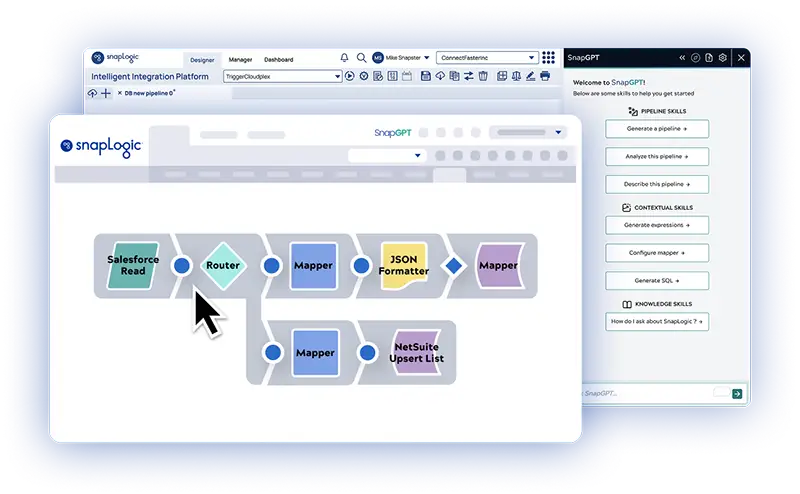
AgentCreator is designed to enable the development, evolution, and maintenance of multi-agent systems. The graphical low-code/no-code development environment and SnapGPT copilot make these powerful capabilities available to users without a formal programming background. With features such as Agent Visualizer, developers can see how AI agents communicate and cooperate.
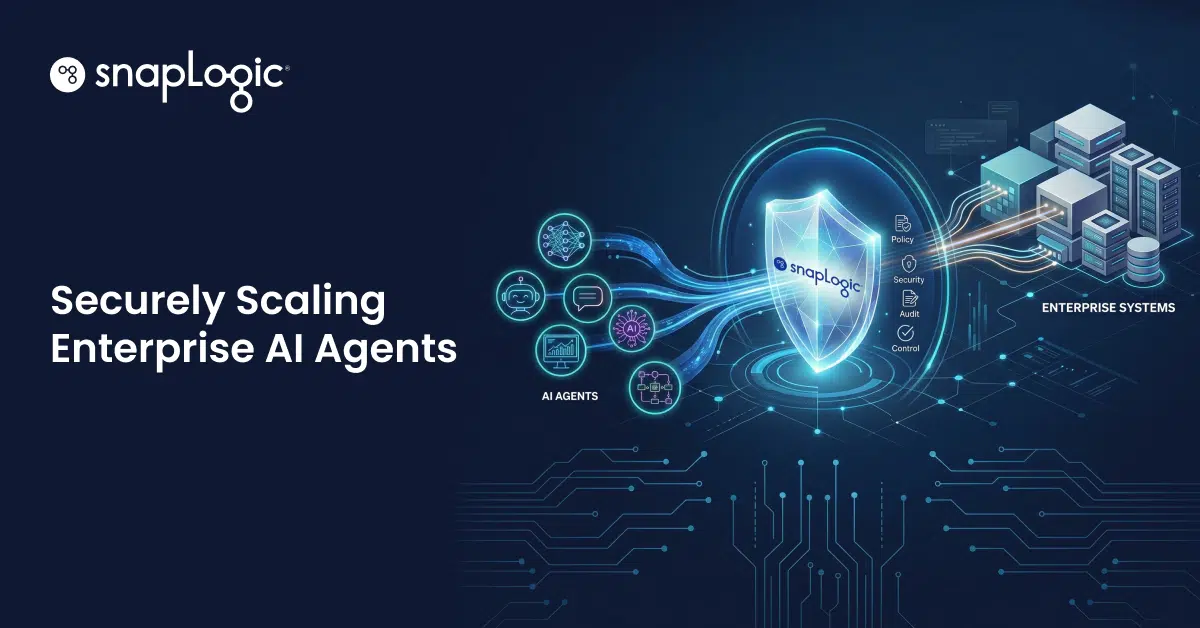
With MCP support, it is very easy to expose all of the enterprise systems already connected through SnapLogic’s 1000+ Snaps for use by agents, and to do so in a way that is secure and governed. For instance, with Trusted Agent Identity, the agent inherits the credentials of the triggering user, both to grant (or deny) granular access and to audit that interaction after the fact.
Finally, an agentic data fabric means that there is a single point of connection and governance for all the interactions with core business systems and data. Instead of the so-called “spaghetti integrations” that result from unmanaged point-to-point connections, there is a clean and straightforward architecture.
That abstraction also avoids the vendor lock-in that comes with vertically-integrated agent stacks, preserving the freedom to change and evolve the architecture at the pace that the evolution of the agentic AI domain demands.
Ready to see how these capabilities work in practice? Explore our platform with a self-guided product tour or request a personalized demo to discuss your specific enterprise needs with our team.