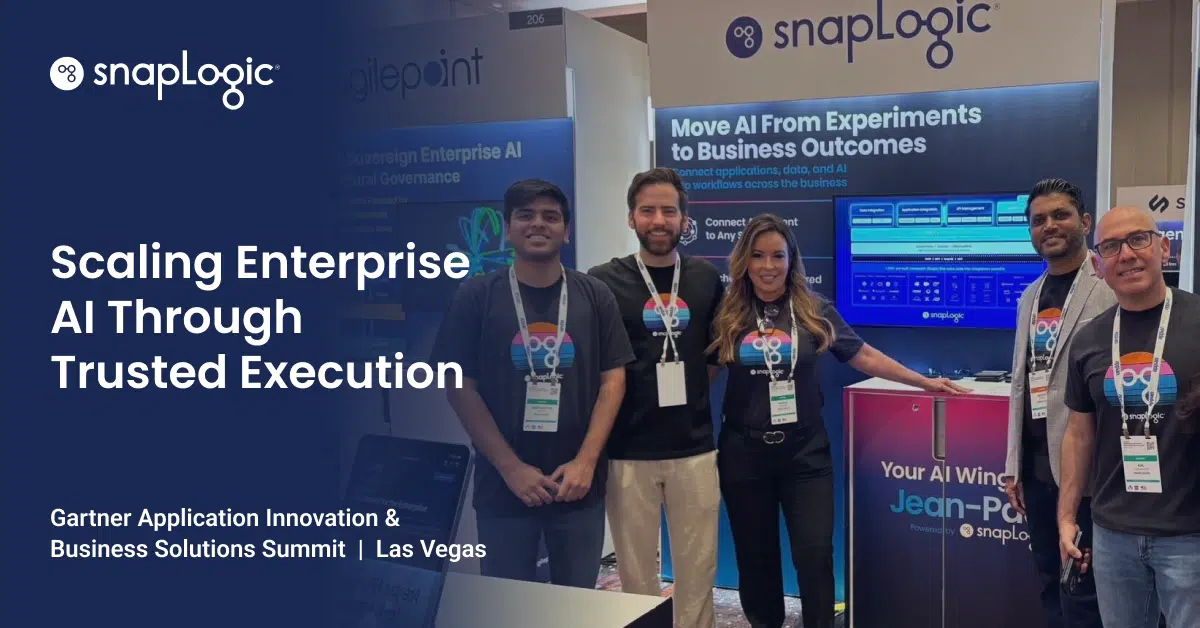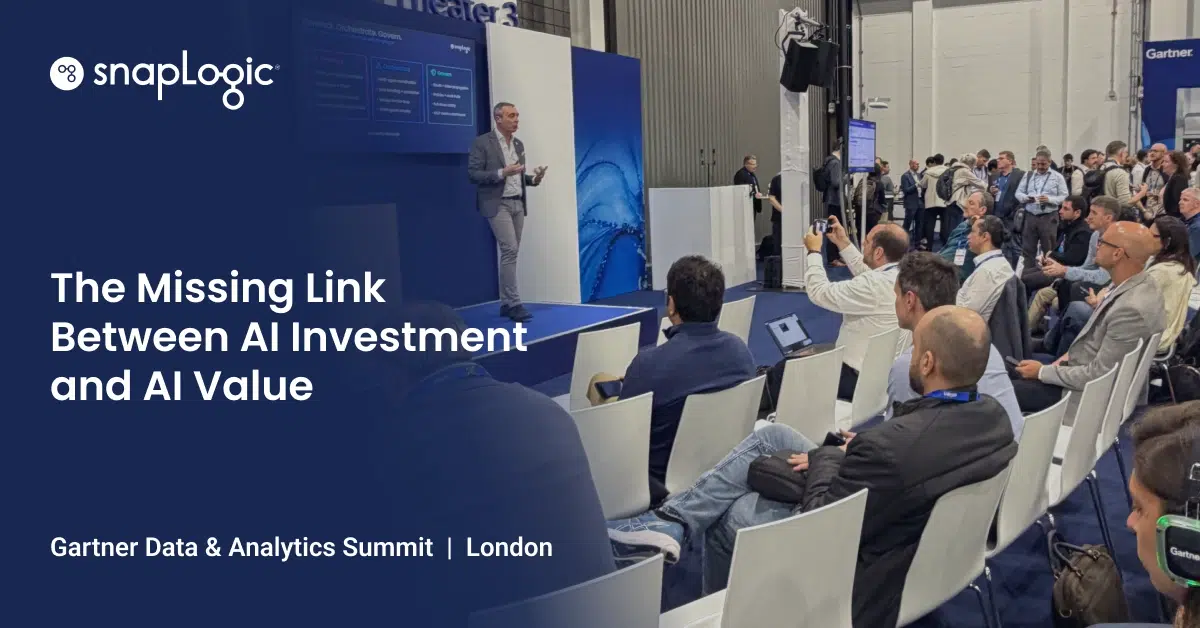




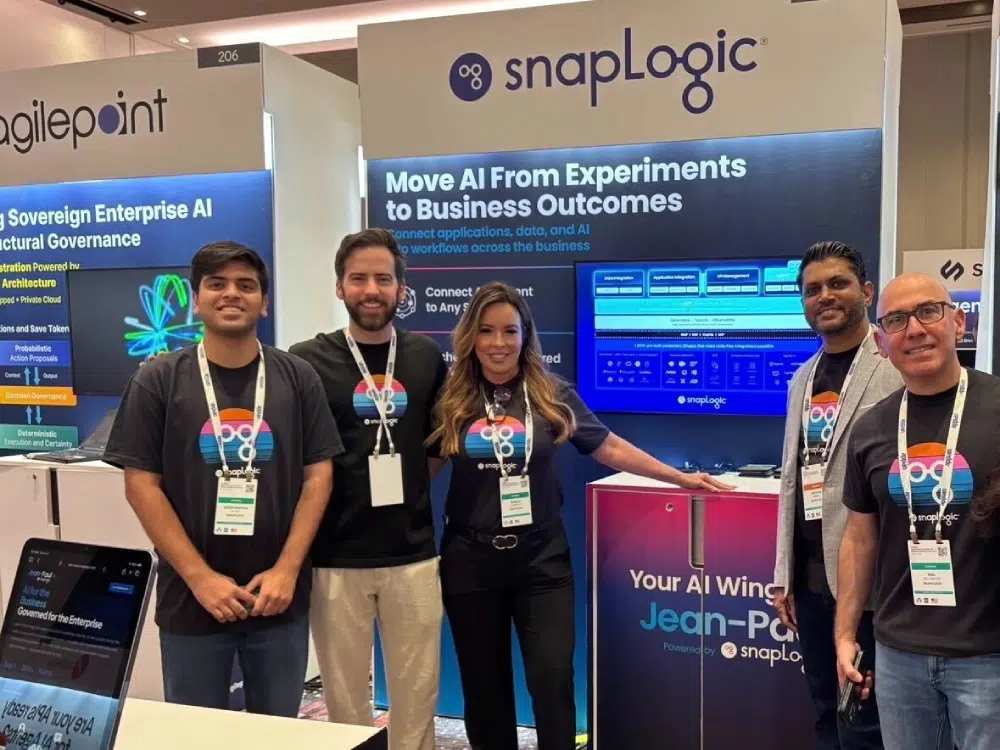
Last week, I attended the Gartner Application Innovation & Business Solutions Summit in Las Vegas with the SnapLogic team. The event brought together enterprise architects, application leaders, software engineering teams, CIO organizations, and technology executives from across industries, all focused on a common challenge: how to translate AI investments into measurable business outcomes and sustainable business value.
SnapLogic participated as both a sponsor and presenter. In our session, “From AI Experiments to Outcomes: The Execution Layer You’re Missing,” Bhavin Patel explored a theme that would appear repeatedly throughout the conference: AI itself is no longer the limiting factor. The harder challenge is execution. How do organizations connect AI to enterprise systems, workflows, and governance frameworks that enable real business outcomes?
The conversation around AI has matured
One of my biggest takeaways from the conference was how much the discussion around AI has evolved.
The excitement is still there. But the focus has shifted.
Many of the themes we explored during SnapLogic’s AgentFest in April, particularly around execution, governance, and enterprise AI adoption, were reinforced throughout the conference. Across analyst sessions, customer conversations, and technology showcases, the discussion consistently centered on a new challenge: how to move AI from experimentation to measurable business outcomes.
Organizations are no longer asking whether AI can create value. They’re asking how to operationalize it.
- How do you identify the right workflows?
- How do you build trust in AI-generated outputs?
- How do you govern autonomous actions?
- How do you connect AI to the systems, applications, and data that run the business?
And perhaps most importantly, how do you demonstrate return on the investments already being made?
The tone of the conversation was noticeably more pragmatic than a year ago. Not because organizations are less optimistic about AI, but because they now understand how difficult enterprise execution can be.
Execution is now the hard part
Across the conference, one theme appeared repeatedly: the challenge is no longer generating intelligence. The challenge is operationalizing it.
Organizations are learning that AI only creates value when it is connected to the right workflows, trusted by the right users, governed by the right controls, and integrated with the systems where work actually happens.
Discussions focused less on model capabilities and more on workflow design, governance, integration, and measurable outcomes. The conversation has moved from what AI can do to how organizations can deploy it successfully at enterprise scale.
For technology leaders, that is a much harder problem to solve.

Context is becoming the bottleneck
One word surfaced repeatedly throughout the conference: context.
AI agents can reason, summarize, and generate. But without access to enterprise context, they cannot take meaningful action.
That context lives across applications, APIs, cloud platforms, data warehouses, documents, and business workflows. In most enterprises, it is distributed across years of technology investments and organizational silos.
This is why integration is becoming increasingly strategic.
It is no longer just infrastructure. It is the foundation that determines whether AI can understand the business, act across systems, and deliver measurable outcomes.
Model Context Protocol (MCP) was also a major topic throughout the event. Gartner analysts discussed its growing role in helping agents interact with enterprise tools and systems. At the same time, many organizations are discovering that enabling agent access is only part of the challenge. Connectivity, execution, governance, security, and observability remain critical requirements for enterprise deployment.
The organizations that succeed will be the ones that connect AI to the systems where business knowledge already exists.
Governance is moving to the center
Another major theme was governance.
As AI moves from generating content to executing work, governance becomes foundational.
Questions around security, policy enforcement, auditability, access control, observability, and cost management surfaced throughout the conference. Technology leaders are increasingly focused on ensuring that AI can operate safely, transparently, and predictably within enterprise environments.
One topic that appeared repeatedly throughout the conference was the economics of AI. As organizations move beyond pilots and begin deploying agents at scale, the conversation is increasingly shifting from what AI can do to what it costs to operate, govern, and scale. Token consumption, model selection, and operational efficiency are becoming important considerations as enterprises evaluate the long-term economics of AI. Leaders are increasingly evaluating not only what an AI solution can do, but how efficiently it can deliver outcomes over time.
Several Gartner sessions emphasized that governance should be viewed as an enabler of scale rather than simply a compliance exercise. Organizations that establish trust, control, and cost visibility early will be better positioned to move AI into production.
This aligns closely with what we are hearing from customers.
Production AI requires more than a model and a prompt. It requires the operational infrastructure necessary to manage AI responsibly across complex business environments.
What production AI looks like
One thing I appreciated about the conference was the growing emphasis on real-world implementations rather than theoretical possibilities.
The discussion was less about individual models and more about what it takes to operationalize AI within enterprise environments. Organizations are increasingly focused on how agents access enterprise context, execute work across systems, and operate within established governance frameworks.
These challenges are not theoretical. They are the same challenges organizations encounter as they move from AI pilots to production deployments.
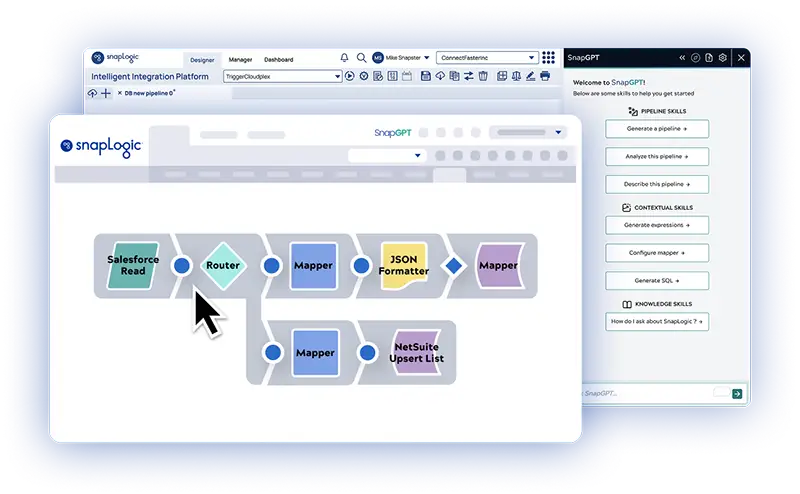
We have seen them firsthand through Jean-Paul, SnapLogic’s internally developed enterprise AI agent. Unlike traditional AI assistants focused on search or personal productivity, Jean-Paul operates as a governed agentic system that connects enterprise applications, data, and workflows to execute real business tasks. By combining AI reasoning with enterprise connectivity, reusable workflows, and governance controls, it helps teams automate work and accelerate decision-making while maintaining visibility, security, and auditability.
Experiences like this reinforce a broader lesson that surfaced repeatedly throughout the conference: the value of AI comes not from the model itself, but from its ability to operate within real business processes, with the appropriate context, execution, and governance.

A more thoughtful phase of adoption
Another signal that stood out was the level of discipline organizations are bringing to AI investments.
Many enterprises are reevaluating years of accumulated technology complexity as they prepare for the next phase of AI adoption. Rather than adding more disconnected tools, leaders are looking for ways to simplify architecture, reduce operational overhead, and create a stronger foundation for AI-driven workflows.
This came through in conversations around application modernization, integration, APIs, data architecture, agentic workflows, and platform consolidation.
The focus is increasingly on building an environment that can support AI at scale rather than simply enabling another pilot project.
In many ways, this feels like a healthy evolution for the industry.
The market is moving beyond AI as a technology experiment and toward AI as a business capability.
From AI ambition to business value
The biggest takeaway I left with is that the market is entering a more mature phase of AI adoption.
The first phase was defined by experimentation.
The next phase will be defined by execution, governance, economics, and the ability to demonstrate measurable business outcomes.
That is a healthy evolution.
The caution I heard throughout the conference was not skepticism. It was discipline. Technology leaders want to make smart decisions, choose architectures that can scale, and ensure their AI investments deliver meaningful results.
Throughout the conference, I kept hearing variations of the same three requirements for successful enterprise AI:
- Context: Access to the systems, applications, APIs, and data where business knowledge lives.
- Execution: The ability to securely execute work across agents, workflows, applications, and people.
- Governance: The trust, security, visibility, and control required to operate AI in production.
These three requirements closely mirror the conversations we are having with customers as they work to connect enterprise context, operationalize AI through real business processes, and establish the governance required for production deployment.
For enterprises, the question is no longer whether AI can generate an answer.
The question is whether AI can securely execute work across the systems, data, and workflows that run the business.
That is where AI moves from experimentation to execution.
And that is where business value begins.
It will be fascinating to see how organizations navigate this next phase of AI adoption over the coming year. I’m looking forward to continuing the conversation with customers, partners, analysts, and industry peers as the market evolves.
Ready to learn more? Take a self-guided product tour or schedule a personalized demo with our team today.