



The billion-dollar question nobody’s asking
Enterprise leaders are pouring money into AI. Budgets are up 72% year over year, according to McKinsey. Models are getting better. Copilots are multiplying. And yet, in most organisations, the conversation still centres on the same question: how do we get value from our data?
It’s the right question. It’s just not the only one anymore.
For two decades, enterprise integration has been about unlocking data. As in, moving data from where it lives to where it’s needed. Point-to-point connections gave way to ESBs, which gave way to iPaaS platforms. Each wave made data more accessible. And that mattered enormously. You can’t run analytics on data trapped in silos. You can’t build AI models on data you can’t reach.
But here’s what I’ve been exploring in conversations with customers and at events like Siemens Realize Live: the bottleneck has shifted. The problem is no longer just getting data out of systems. It’s getting intelligence back in.
The shift: two eras of enterprise integration
Era 1: Unlocking data
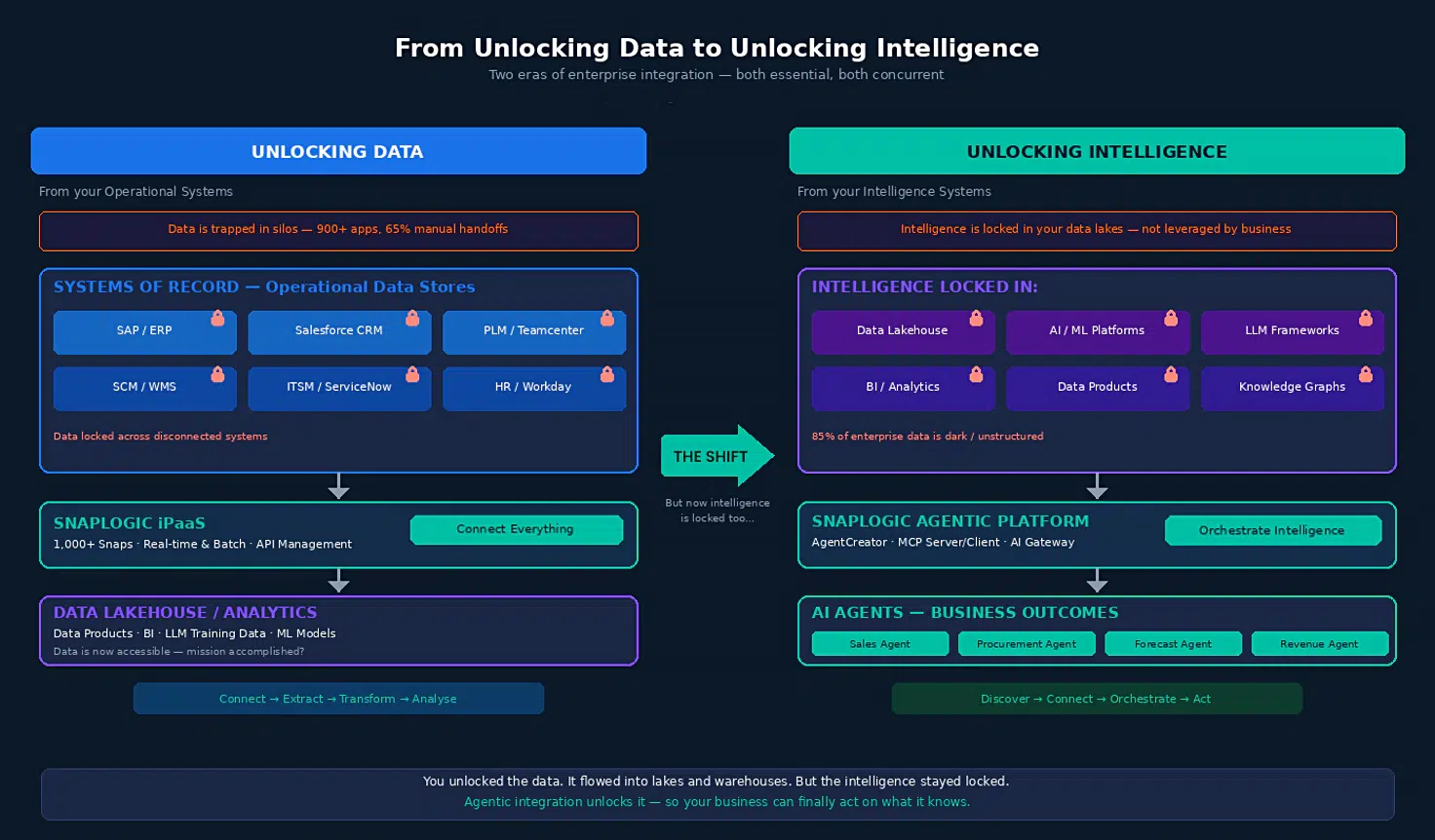
This is where most enterprises still operate. Integration connects systems of record (ERP, PLM, CRM) to systems of intelligence (data lakes, analytics platforms, LLM frameworks). The value chain is clear: connect → extract → transform → analyse. SnapLogic was born in this era, and our iPaaS foundation (1,000+ pre-built Snaps, real-time and batch pipelines, and API management) remains the backbone.
Era 2: Unlocking intelligence
This is the shift happening now. AI agents consume data, and they act on it. A Sales Agent doesn’t wait for a rep to pull a report. It scores leads from six data sources, generates proposals with real-time pricing from SAP, and autonomously triggers contract workflows. The integration layer isn’t just moving data anymore. It’s orchestrating outcomes.
The challenge is that these two eras aren’t sequential. They’re concurrent. You need both, running in parallel, governed consistently. And that’s where most organisations hit a wall.
The numbers that tell the story
of enterprises increasing AI budgets YoY
of enterprise data is dark or unstructured
apps per enterprise, 65% manual handoffs
of engineering data sits on desktops
Sources: McKinsey 2025, BCG 2025, Tony Hemmelgarn (CEO, Siemens Digital Industries Software) at Realize Live 2026.
That last number stopped me cold. Fifty-one percent. Not in legacy mainframes. Not in on-premises databases. On desktops. If half your engineering data never makes it into a governed system, your AI agents are making decisions with half the picture.
Here’s a pattern I keep coming back to. Every wave of technology that solved one complexity problem inadvertently created the next:
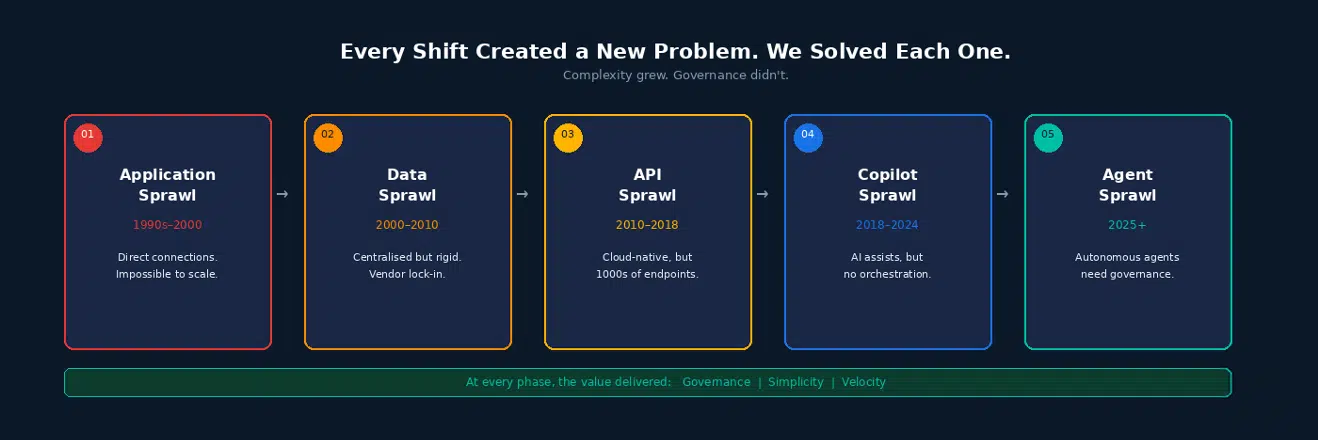
The common thread? At every phase, complexity grew faster than governance. The organisations that win aren’t the ones with the most agents. They’re the ones with orchestration.
MCP: the standard that changes everything
If there’s one technical development I’d ask every enterprise architect to pay attention to, it’s the Model Context Protocol. MCP is to AI agents what REST was to web services. A universal way for agents to discover and call enterprise tools at runtime.
Here’s what that means practically: today, connecting an AI agent to your CRM requires custom integration code. A Salesforce connector for Claude is different from one for GPT-4o is different from one for Gemini. Multiply that across every system in your stack, and you get the same n×m integration problem we solved twenty years ago with ESBs.
MCP collapses that. Any MCP client connects to any MCP server. Zero custom integration code. SnapLogic’s MCP Server (live since July 2025) and MCP Client (November 2025) already support this. Meaning any enterprise agent can call any of the 1,000+ Snaps in the SnapLogic catalogue through a standard protocol.
“Agents dynamically discover enterprise tools and capabilities at runtime. Any MCP client connects to any MCP server; zero custom integration code.”
From the Erlangen presentation on Modern Enterprise Integration
Where are you on the AI maturity curve?
In my conversations with enterprise teams, I’ve found it useful to map organisations against five levels of AI maturity:
| Level | Stage | Description |
|---|---|---|
| L1 | Aware (~30%) | Recognises AI potential, no active projects |
| L2 | Experimenting (~40%) | Running POCs and pilots in isolated pockets |
| L3 | Operational (~20%) | AI in production with measurable value |
| L4 | Systemic (~8%) | Enterprise platform with shared governance |
| L5 | Agentic (~1%) | Multi-agent operations, autonomous workflows |
Most customers are sitting between L2 and L3
Most enterprises I work with sit at L2 or L3. They’ve proven AI works. The question they’re wrestling with now isn’t whether to scale, but how. And without creating the same ungoverned sprawl that plagued every previous technology wave.
The ROI question, reframed
There’s a tension I hear in almost every boardroom conversation about AI: leadership wants ROI. But the investments so far have been in infrastructure, such as data platforms, model training, and copilot licences. The returns feel diffuse because the AI is helping people work slightly faster, not fundamentally changing how work gets done.
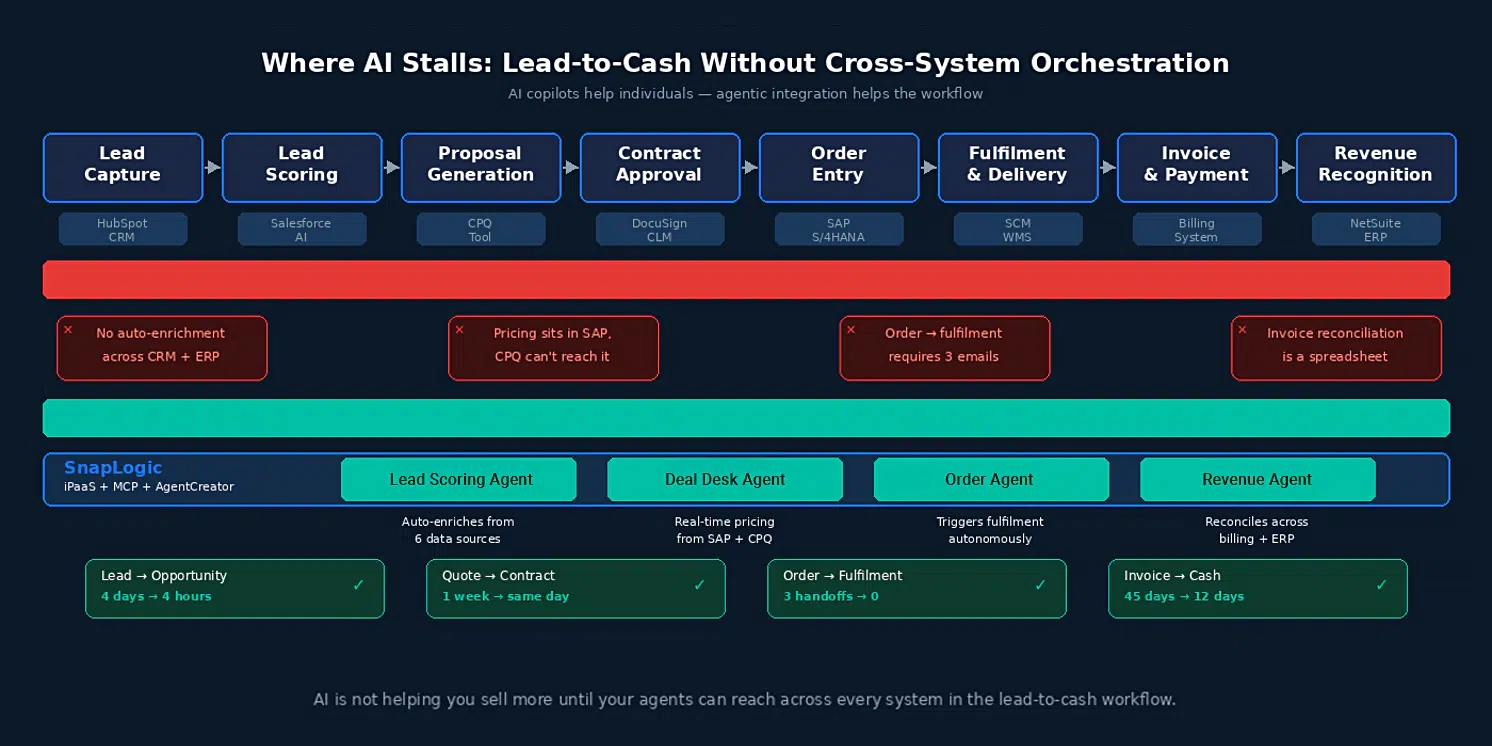
AI is not helping you sell more. Your sales copilot can draft an email faster, but it can’t pull real-time pricing from SAP to build a proposal. It can’t check inventory in SCM before committing delivery dates. It can’t trigger contract approval in DocuSign and simultaneously update the forecast in your CRM. The bottlenecks in your lead-to-cash workflow are the handoffs between systems that no single copilot can see.
The same pattern shows up in procure-to-pay. A procurement copilot can help draft an RFQ, but it can’t cross-reference supplier performance in your SRM, check budget availability in your ERP, validate compliance in your GRC tool, and trigger a three-way match across PO, receipt, and invoice, all in a single autonomous workflow. Those are the bottlenecks that cost real money: late payments eroding supplier terms, maverick spend bypassing contracts, manual reconciliation consuming finance teams.
Agentic integration reframes the ROI conversation. Instead of measuring how much faster someone writes an email, you measure how many deals close without a single manual handoff between CRM, CPQ, ERP, and billing. Instead of tracking copilot adoption, you track cycle time reduction from lead to cash.
Rather than incremental improvement, that’s a category change in how enterprise revenue operations work.
Where SnapLogic fits: the AI execution layer
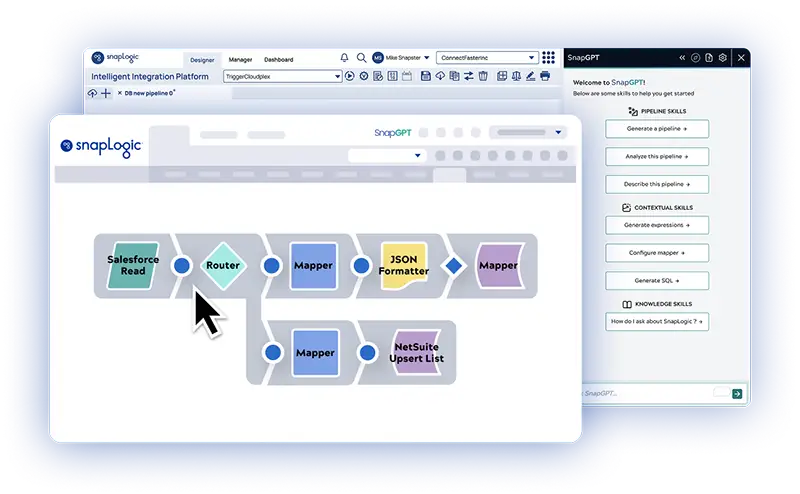
SnapLogic is an Enterprise Agentic Integration Platform. Three pillars power the shift from unlocking data to unlocking intelligence:
IPAAS FOUNDATION
Connect everything
1,000+ pre-built snaps, real-time and batch integration, API management, data engineering pipelines, enterprise governance
AGENTCREATOR
Build AI agents
LLM-powered agent builder, RAG pipeline integration, Extended Thinking + Plan Mode, multi-model orchestration, production-grade deployment
MCP + AI GATEWAY
Orchestrate at scale
MCP Server and Client support, Trusted Agent Identity, AI Gateway (auth, throttling), Pipeline-as-AI-Tool exposure, universal agent connectivity
SnapLogic helps you unlock data and intelligence
The key insight is that these aren’t three separate products. They’re one platform operating across both eras at the same time. The iPaaS foundation continues to unlock data. AgentCreator and MCP unlock intelligence. And the governance layer spans all.
What this means for you
If you’re an enterprise leader evaluating your AI strategy, here are three questions worth sitting with:
1. Are you still only unlocking data? Data accessibility is necessary but insufficient. If your AI investments stop at the data lake, you’re building the foundation without the house.
2. Can your agents reach across system boundaries? A Sales Agent that can’t check inventory before committing delivery dates is making promises with half the picture. Cross-system orchestration is the difference between a demo and production.
3. Do you have governance that scales with autonomy? Every agent you deploy without Trusted Identity, audit trails, and recovery mechanisms adds risk. The organisations moving fastest are the ones who built governance in from the start.
Ready to see it in action?
Take a self-guided product tour or book a demo with our team to discover how SnapLogic can help you move from unlocking data to unlocking intelligence across your enterprise.