


The Friday afternoon email
There’s a particular kind of dread that hits when a supplier sends an end-of-life notice on a Friday afternoon.
Not for the component you’ve been watching. The other one. The semiconductor that’s buried 3 levels deep in your BOM, across 4 product families, in production at 3 sites. The one nobody flagged because it was always available…until it wasn’t.
If you work in high-tech manufacturing, you’ve lived some version of this story. And you know what happens next.
The 4-6 week reality
Here’s the honest timeline for most organisations:
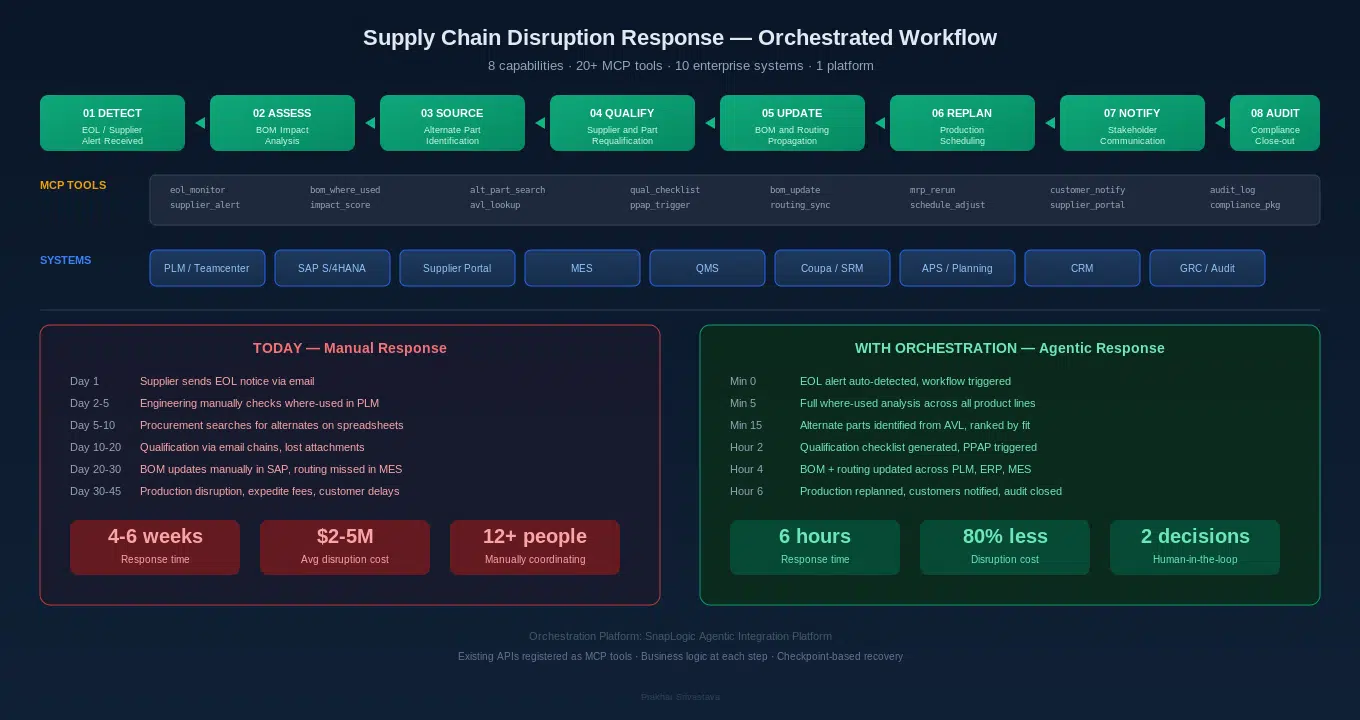
- Day 1: The EOL notice arrives via email. It sits in someone’s inbox over the weekend.
- Day 2-5: Engineering opens PLM, manually runs where-used queries across product lines. This takes days because the BOM structures are nested, and nobody trusts the automated reports.
- Day 5-10: Procurement opens a spreadsheet. Starts calling distributors. Checks the AVL, which lives in a different system than PLM. Cross-references manually.
- Day 10-20: Qualification begins via email chains. Test reports get lost as attachments. Quality requires PPAP documentation that procurement currently lacks.
- Day 20-30: Someone updates the BOM in SAP. But the MES routing still references the old component. Quality holds trigger at one site but not the others.
- Day 30-45: Production disruption. Expedited fees. Customer delays. The war room convenes.
- Cost per event: $2-5M in disruption, expedite charges, and delayed revenue.
- People involved: 12+, across engineering, procurement, quality, manufacturing, and supply chain.
- Duration: 4-6 weeks minimum.
The systems are all there. PLM, ERP, MES, QMS, SRM, APS. The data exists. The APIs are often already exposed. What’s missing is orchestration.
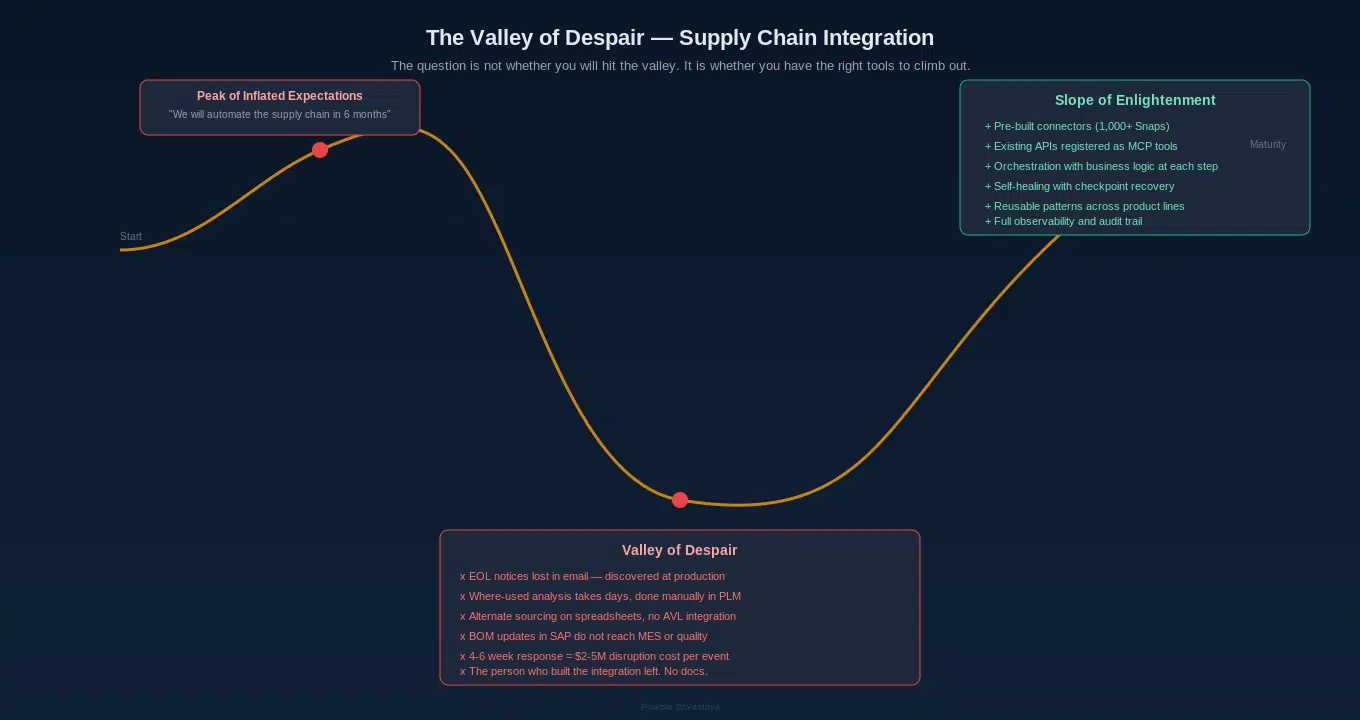
The “Valley of Despair” supply chain edition
I’ve written in the past about the Valley of Despair in PLM integration. Supply chain has its own version, and it might be worse.
The peak of inflated expectations: “We’ll automate supply chain response in 6 months.”
The valley: EOL notices lost in email. Where-used analysis that takes days. Alternate sourcing on spreadsheets with no AVL integration. BOM updates in SAP that never reach MES or quality. The person who built the critical integration has left the company, and the documentation is a 2019 wiki page that has not been updated since.
The question isn’t whether you’ll hit the valley. Most manufacturing organisations are already in it. The question is whether you have the right tools and approach to climb out.
What the orchestrated response looks like
We’ve been working with an approach that uses MCP (Model Context Protocol) in a dual role.
First, as a registration layer. Take your existing enterprise APIs (e.g., your PLM queries, your SAP RFC calls, your supplier portal webhooks, your MES interfaces), and register them as MCP tools. You’re not rebuilding anything. You’re making what you’ve already built discoverable and callable.
Second, add the orchestration fabric. Now the workflow engine can call these registered tools in sequence, with business logic at each step.
For supply chain disruption response, that’s roughly eight steps:
- Detect: EOL or supplier disruption alert auto-ingested from supplier portals, industry databases, or notification feeds. No more email sitting in an inbox over the weekend.
- Assess: Full where-used analysis across all product lines, all sites. Automated, not manual. Minutes, not days.
- Source: Alternate part identification from the AVL, cross-referenced with supplier qualification status, lead times, and cost, and ranked by fit.
- Qualify: Qualification checklist auto-generated. PPAP triggered with the supplier. This is where human judgment still matters; you can’t automate the decision to approve an alternate for a safety-critical application.
- Update: BOM and routing changes propagated across PLM, ERP, and MES simultaneously. Not sequentially. Not manually.
- Re-plan: MRP rerun with the new component. Production schedule adjusted. Capacity impact assessed.
- Notify: Customer communication triggered. Supplier portal updated. Internal stakeholders were informed of the full impact summary.
- Audit: Compliance package generated. Full traceability from the original EOL notice through every decision and system change. Closed.
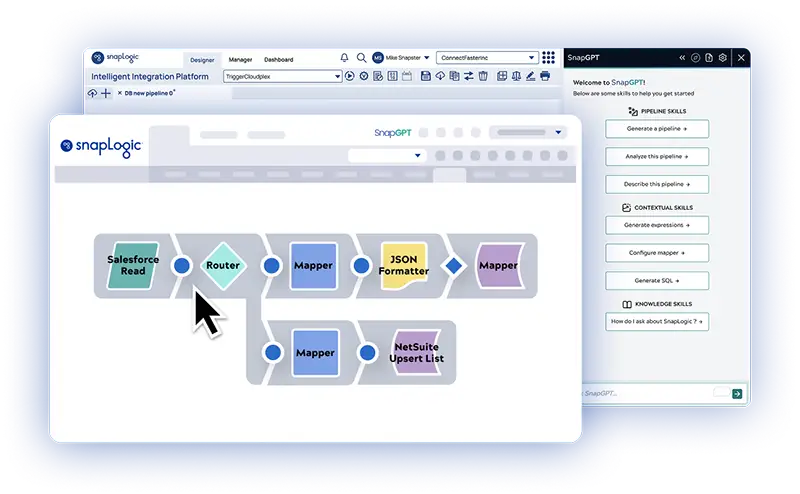
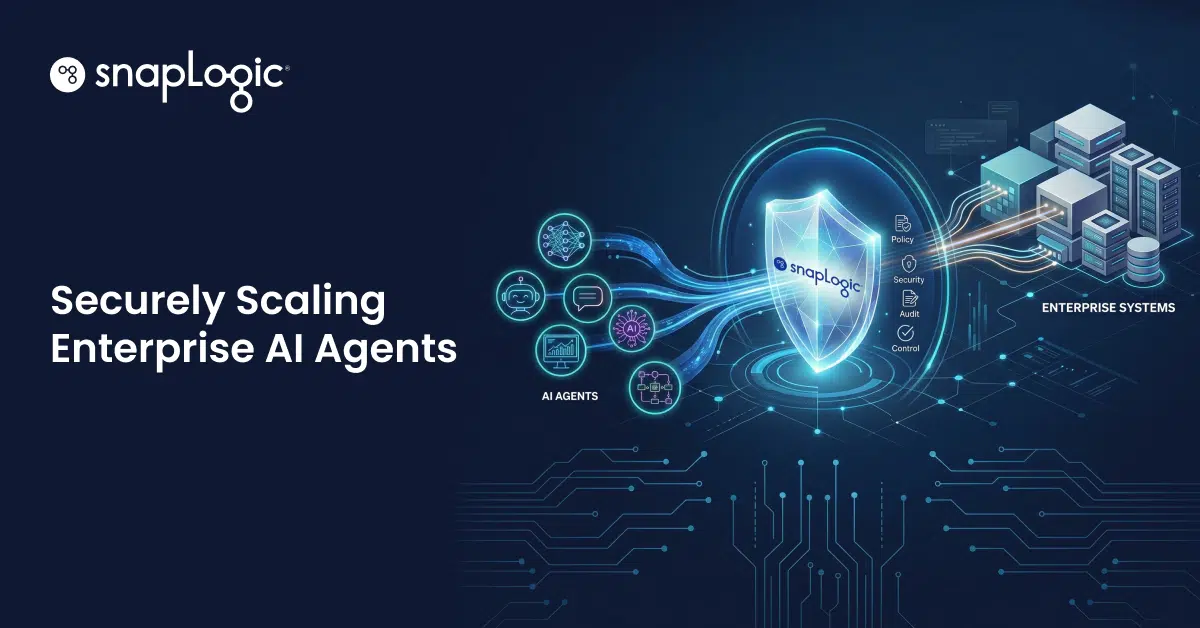
The platform handling this, SnapLogic’s Agentic Integration Platform, sits between your existing systems, calling your APIs as tools, sequencing the workflow, and applying business logic at each step.
The architecture behind it
If you’re an architect or technical leader, here’s how the stack looks:
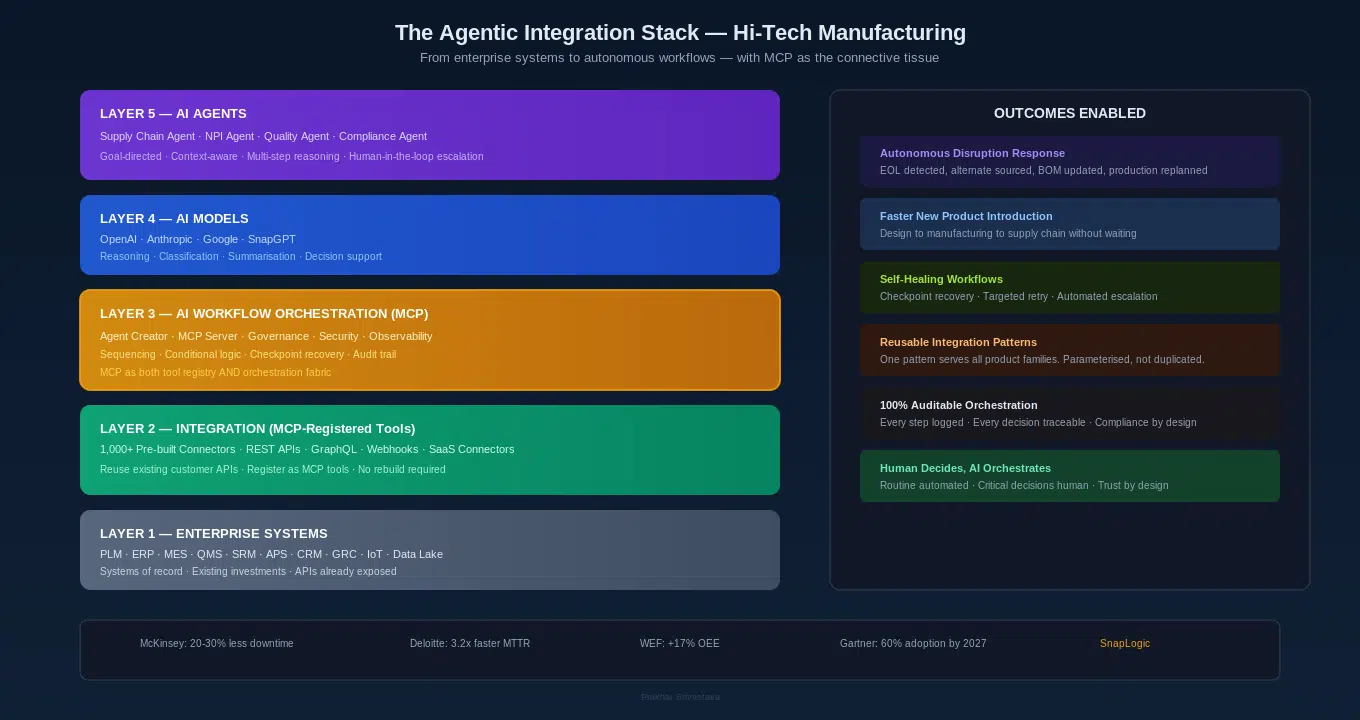
That includes 5 layers, starting from the base:
- At the base are your enterprise systems, which are the investments you’ve already made.
- Above that, integration: your existing APIs and connectors, registered as MCP tools.
- The orchestration layer sequences them with business logic, governance, and recovery.
- AI models provide reasoning and classification. And at the top, purpose-built agents (in this case, a Supply Chain Agent, an NPI Agent, and a Quality Agent) that understand the business context and can make decisions, or escalate to humans when they should.
The critical insight: MCP plays a dual role. It’s both the registration mechanism (making your tools discoverable) and the orchestration fabric (calling them in the right sequence with the right logic). This isn’t two separate platforms. It’s one.
What we’re still sorting out
I want to be transparent about what’s hard.
The qualification step (Step 4) is the bottleneck. You can automate the checklist generation, the PPAP trigger, and the document assembly. But the decision to approve an alternate part, especially for a safety-critical or regulatory-controlled application, is a human one. And it should be.
Failure recovery across 10 systems is still evolving. When Step 5 fails (say the SAP BOM update times out because of a batch job lock), the recovery agent needs to decide: retry, resume from checkpoint, or escalate. The classification model gets this right about 85% of the time. That’s good enough for most transient failures. It’s not good enough for structural ones.
And the data quality challenge is real. If your AVL hasn’t been maintained, or your where-used data in PLM is incomplete, orchestration amplifies the problem. You get a fast wrong answer instead of a slow wrong answer. The garbage-in, garbage-out principle doesn’t disappear just because you added AI.
These are solvable problems. But they’re not fully solved yet. And anyone who tells you otherwise is selling something.
Get the ebook: Integrating the Modern Manufacturer
Getting started
If you’re in high-tech manufacturing and supply chain disruption is a pain point (and it almost certainly is), here’s where to start:
- Audit your APIs. What’s already exposed in PLM, ERP, MES, and your supplier portal? You probably have more MCP-ready tools than you think.
- Pick one disruption scenario. Not the theoretical one. The one that actually happened last quarter. Map the 8 steps. Where were the delays? Where were the handoffs?
- Register and orchestrate the ideal path first. Get the sequencing right before you add failure recovery.
- Add human-in-the-loop at the right points. This includes qualification approval and alternate part selection for critical applications. Let the AI orchestrate the routine. Let humans decide the consequences.
We’re doing this work right now, and every week we learn something new. The patterns aren’t fully baked. But the direction — reuse what exists, register it, orchestrate it, let the platform handle the sequencing — feels right. Increasingly, the data backs it up.
Spend your Friday evenings with your family and friends, not responding to emails in a panic. Book a SnapLogic demo today.