




Integrating the Modern Manufacturer
How leading manufacturers are using Agentic Integration to unify OT, IT, and the supply chain

The data traps blocking AI and operational excellence
Fragmented systems and manual processes are blocking manufacturers from achieving operational excellence and deploying AI at scale. The business cost is measurable: in an ABB survey, 83% of industry decision-makers reported that unplanned downtime costs a minimum of $10,000 per hour, with 76% estimating the cost can reach $500,000 per hour. Excess inventory and manual reconciliation compound the impact, freezing millions more in operational budgets.
The integration gap is a value chain problem
At the root is an integration gap that keeps data siloed across the value chain. Operational technology, including PLCs, SCADA, and MES, rarely communicates with enterprise systems like ERP, CRM, and SCM. Supply chain decisions lag reality by hours or days, and quality, yield, and throughput data sits locked in machines and spreadsheets until the window for effective response has closed.
Fragmented data makes AI unreliable
Disconnected data degrades AI performance. Demand forecasting without simultaneous access to sales history, inventory levels, supplier lead times, and production capacity generates errors at scale. As AI deployments expand, ungoverned point-to-point integrations create sprawl that compounds cost and resists audit.
What this looks like on the ground
The operational impact may appear in a variety of ways:
- A component shortage surfaces in the ERP 48 hours after it became critical
- A quality issue triggers hours of manual data-pulling before root cause analysis can begin
- A field issue consumes a full day of manually tracing product genealogy across systems
- Leadership requests a real-time view of global inventory and production status, which will take days to procure
The common thread across each scenario is latency. Critical data exists across the organization, but reaches decision-makers too late for meaningful action.
Did you know? According to nearly 60% of the AI leaders and representatives surveyed by Deloitte, their organization’s primary challenges with adopting agentic AI are integrating with legacy systems and addressing risk and compliance concerns.

The solution: a unified data fabric
The integration gap that creates strategic liability for manufacturers is precisely what SnapLogic was built to solve, providing the unified data fabric and agentic AI needed to break down silos and enable real-time operations.
By directly addressing the core barriers (OT/IT disconnect, supply chain fragility, and slow time-to-insight), SnapLogic offers a path to move from a reactive organization to an intelligent, connected enterprise.
- Unified OT/IT integration layer
Governance becomes a bottleneck. New operating models and approval processes take time to design, delaying actual delivery. - Real-time supply chain visibility
Pre-built Snaps for EDI, logistics APIs, and supplier portals deliver live inventory, demand, and fulfillment data, automatically reconciled and ready for decision-making. - AI-powered data pipelines
SnapLogic’s agentic AI continuously monitors data flows, detects anomalies, and self-heals integration failures, freeing engineering teams for higher-value work.
SnapLogic platform capabilities
- AI-powered integration automation
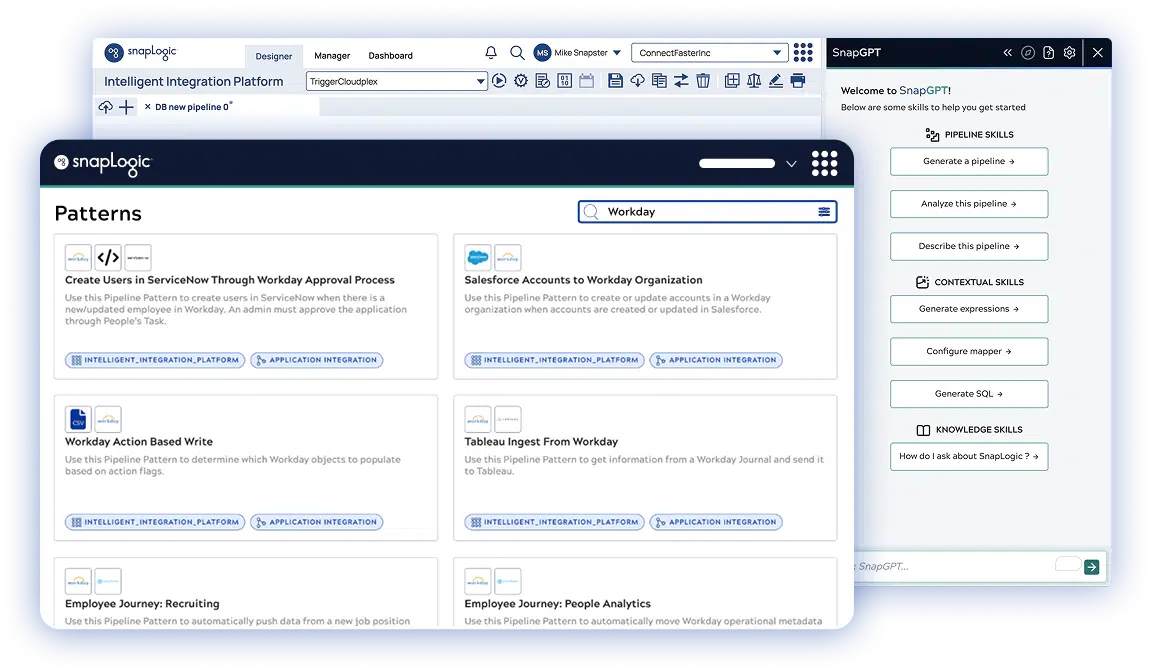
- Pre-built Snaps for 1,000+ enterprise systems
- Agentic workflows that self-orchestrate across apps and data
- Low-code/no-code designer for business and technical teams
- Real-time and batch processing at enterprise scale
Measurable business outcomes with integration
SnapLogic connects data across the manufacturing value chain to deliver measurable impact in fulfillment predictability, quality compliance, and product feedback loops. The use cases below represent the most common areas where customers see immediate results.
Global manufacturing and fulfillment predictability
Achieving predictable production build and cost. Connecting supply chain, production, and inventory data gives teams early visibility into component risks before they affect the line. Proactive mitigation reduces material rush fees and keeps build costs under control.
Improved cash flow
Free trapped working capital through right-sized inventory. Real-time visibility into actual demand, in-transit inventory, and supplier capacity allows manufacturers to right-size safety stock and reduce capital tied up in excess inventory.
Higher OTIF performance
Identify supply risks before they impact customer commitments. SnapLogic surfaces early warnings of supplier delays and component shortages days or weeks in advance. Teams can reroute, re-source, or communicate proactively before commitments are at risk.
Supply chain resilience
Automatically identify alternate suppliers and routing when disruptions occur. When SnapLogic detects a supply anomaly, it queries prequalified supplier data, checks capacity and lead times, and can automatically initiate RFQ processes. Procurement teams shift from manual searches to structured risk mitigation.
Reduced expediting costs
Eliminate expensive air freight and premium charges through better visibility. Full supply chain integration enables early detection of shortages, giving teams time to arrange cost-effective alternatives before emergency measures become the only option.
Optimized inventory turns
Match global inventory levels to actual demand patterns. SnapLogic feeds live demand signals from point of sale, distributors, and customer forecasts into planning engines. This supports agentic AI workflows that trigger corrective action before issues escalate.
Digital production feedback loop
Closing the cycle from customer insight to product improvement. Field data and customer feedback reach engineering teams faster when CRM, IoT, and PLM systems are connected. Change order cycles shorten and products improve with every release.
Quality and regulatory compliance
100% digital traceability across every production record. AI-driven integration creates audit-ready production records and complete product genealogy. Batch releases accelerate and quality management shifts from reactive sampling to continuous oversight.
Did you know? AI-driven forecasting in Manufacturing consistently delivers significant accuracy improvements over traditional methods. Error rates that typically range from 25-40% with manual approaches fall to 10-16% with machine learning models.
Industry leaders transforming operations
Manufacturers are already achieving significant business value by leveraging SnapLogic to unify their operations. These customer voices showcase the tangible benefits of streamlined processes and complete organizational data visibility.
Industrial manufacturing company
Background: Bidirectional SAP to Salesforce integration for leads/quotes, data warehouse ingestion into Redshift and Power BI, and file transfer across servers. Also exploring SnapGPT.
“We use SnapLogic mainly to integrate systems. We have a nice integration between Salesforce and SAP running over here. Lots of the process leads and quotes are happening through this integration…It’s a nice tool. It gives us a complete view of the environment through one platform. It makes it a lot easier to find the different assets within your organization. You don’t have to spend hours trying to find a specific pipeline.”
– IT Coordinator
Consumer manufacturing company
Background: SnapLogic supported a full SAP upgrade across finance, supply chain, and logistics.
“We just completed a big project of an SAP upgrade. We have all finance, supply chain, logistics, and everything integrated…This year we’ll be focusing on some more integration.”
– Senior Director of IT
PARTNER SPOTLIGHT
SnapLogic + Infosys
Manufacturing transformation is rarely a single-system problem. It involves legacy SAP environments, IoT data streams, supplier networks, and a growing demand for real-time operational visibility. As a multinational IT services and consulting company, Infosys brings industry depth and delivery scale to navigate that complexity. SnapLogic provides the integration platform that ties it all together, cutting implementation time and reducing the technical debt that slows most programs down.
The playbook: how to get started
Moving from identifying the integration problem to achieving real-time operational intelligence requires a clear path. This simple four-step playbook provides manufacturers with a rapid, actionable roadmap to prioritize their biggest data silos and deploy high-value, agentic integration solutions quickly.
Step 1
Map your integration landscape
Identify your top 5 data silos: typically ERP, MES, supply chain, quality, and analytics. Prioritize by business impact.
Step 2
Start with a high-value use case
Pick one process (e.g., supply chain visibility, quality reporting, or procurement automation), and build a working integration in under 30 days.
Step 3
Expand with agentic templates
Use SnapLogic’s manufacturing-specific Snap Packs and agentic templates to scale across SAP, Oracle, Salesforce, and IoT systems.
Step 4
Measure and iterate
Track integration uptime, data freshness, and business outcomes. Use SnapLogic’s built-in monitoring to continuously optimize.

SnapLogic fast start
Most customers see their first integration running within days, not months. SnapLogic’s pre-built Snaps and agentic templates dramatically reduce time-to-value for Manufacturing use cases.

Next steps for your integration journey
Ready to break down your manufacturing silos? See how SnapLogic helps manufacturers integrate everything, from the factory floor to the executive dashboard, faster than you thought possible.