



MCP has emerged as the standard for connecting AI agents to the world. With that status comes new expectations: easier and quicker creation of MCP servers, and libraries of example tool definitions that are ready to use.
Technological advances are always a conversation between developers and users. New capabilities may be exciting to their creators, who have an idea in mind of what their potential is, but the reality will be determined by users on the ground.
This is why early and frequent feedback is important to make sure that users are getting what they need, and that technology does not lose its way in abstract advances that do not deliver concrete value.
A sign of a maturing technology is the arrival of wrappers that make it easier to work with, and pre-built content for common requirements.
What is the Model Context Protocol (MCP)?
The latest example of this trend is the Model Context Protocol, or MCP. Even in the context of the very recent interest in GenAI — let’s not forget that ChatGPT is not quite four years old as I write this! — MCP is a relatively late arrival, having gone from an internal tool built by Anthropic to becoming a ubiquitous public standard in just over a year.
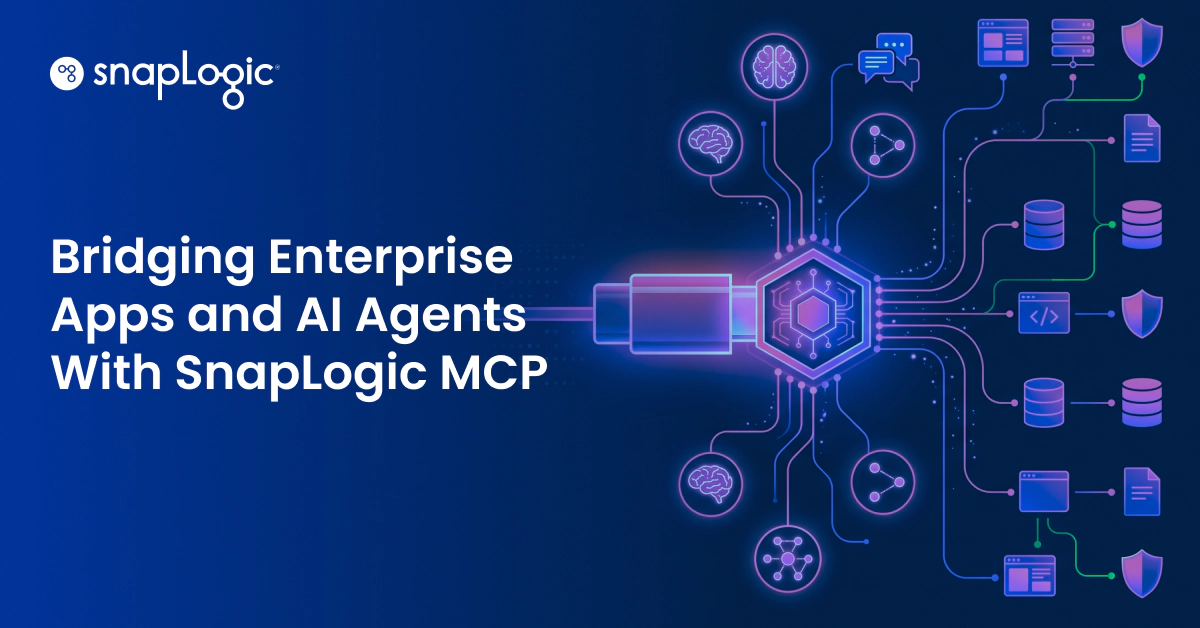
In that time, it has lived up to its billing of “USB-C for AI,” becoming the widely adopted universal connection between AI agents and the tools and data sources that they need to be valuable to their users.
But of course raw connectivity does not deliver value on its own; rather, it’s a necessary prerequisite, but one that needs to be wrapped in additional functionality to be truly useful.
Connecting AI agents to enterprise systems with MCP
For SnapLogic users, MCP support has been a valuable addition to the platform’s capabilities, making it easy to enable AI agents to take advantage of the extensive connectivity which the platform already offers.
Initial MCP support in SnapLogic focused on offering up MCP servers backed by pipelines, which in turn can use 1000+ Snaps to connect to existing systems, apps, and data. This easy connectivity was the key factor in accelerating AI projects and bringing them to production.
Without access to the systems, apps, and data that are used to run the business, too many AI projects fail to deliver on their promise and never get beyond the pilot phase. But with SnapLogic and MCP, our users can deliver agentic AI projects to their own users that bring concrete real-world benefits.
SnapCode: MCP-enabled integrations for AI coding environments
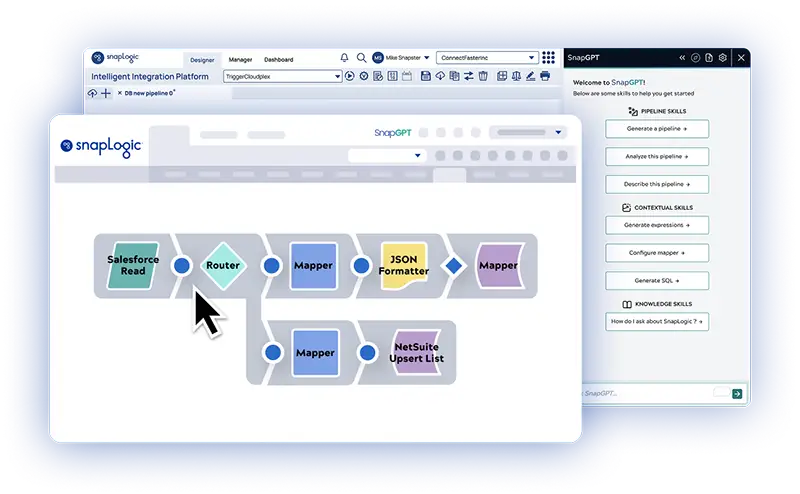
The whole SnapLogic platform is now itself MCP-enabled, supporting users who prefer to work in AI-enabled coding environments such as Claude Code. SnapCode is the next step in our mission to enable users, allowing them to create valuable automations for themselves, and complementing our no-code graphical development environment.
And of course SnapCode is also finding new fans among people who do have coding expertise, and who prefer a text-based pro-code interface to a graphical one.
For both groups, SnapLogic meets them where they are and offers powerful new capabilities when they need access to existing systems, apps, and data.
Create MCP servers with a wizard or natural-language prompts
This new development is also quickly revealing our users’ next requirements as they get to grips with using MCP.
We continue to reduce the gap between intention and automation, first by adding a wizard to guide users through the creation of new MCP servers, then by enabling MCP servers to be created directly using natural-language prompts, and most recently by adding a registry of existing MCP servers.
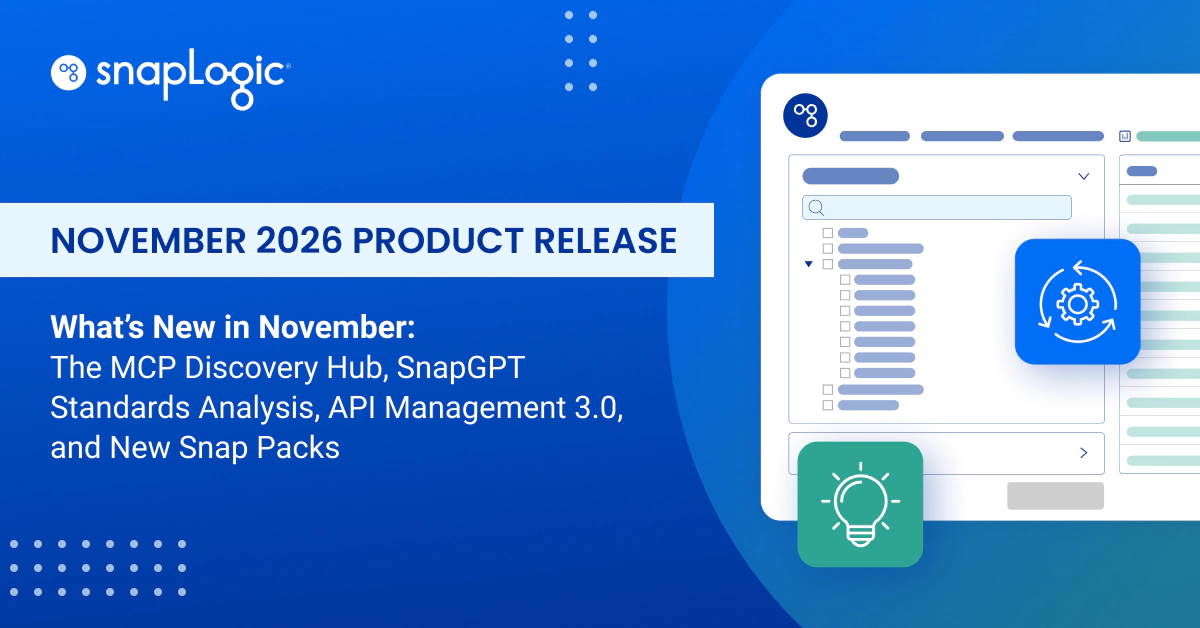
The new MCP Discovery Hub facilitates reuse, enforces best practices, and therefore increases trust and accelerates delivery of new capabilities for AI agents via MCP.
An agentic data fabric with built-in security and compliance
These developments make SnapLogic into a true agentic data fabric, an integrated foundation that users and AI agents can rely upon unquestioningly when it comes to offering connectivity to the apps, systems, and data which the business relies on.
That connectivity is built on top of the solid and proven SnapLogic foundation, which already delivers high-throughput and low-latency integration that powers businesses that are household names across a wide variety of sectors.
In particular, the security and compliance guarantees of the SnapLogic architecture carry through to the newest MCP connectivity, avoiding the need for lengthy approval cycles by compliance teams or governance committees.
Pre-built MCP server tools for common business technologies
As the AI market continues to mature, practitioners come to expect more examples and templates that are ready to use, without requiring them to spend time on reproducing low-value work that is not differentiated from one project to the next.
This is why we now also offer pre-built MCP server tools that are ready to use, enabling rapid integration between AI agents and a growing number of common business technologies.
Trusted Agent Identity, governance, and MCP usage monitoring
All of these tools deliver the usual benefits of the SnapLogic platform that users have come to rely on, from Trusted Agent Identity to built-in governance, to the ability to easily monitor usage of the newly enabled MCP capabilities.
What comes next for MCP on SnapLogic
We will continue to develop new platform functionality and new prebuilt content to take advantage of it, helping to shorten the time-to-value of new AI projects and enabling our users to deliver true and concrete business outcomes.
After all, the value of USB-C is not the standard itself, but the wide variety of cables and devices that are ready to use thanks to that common standard.
Ready to transform your enterprise AI integration with MCP? Take a self-guided SnapLogic MCP server tour, or talk with our team of experts and book a custom demo.