

What SnapLogic is and how it is designed
SnapLogic is a cloud-native, AI-powered enterprise integration platform designed to unify:
These capabilities operate within a single control plane and a consistent development experience.
The platform emphasizes:
- Low and no-code visual development
- Centralized governance
- Continuous cloud delivery
- Embedded generative AI
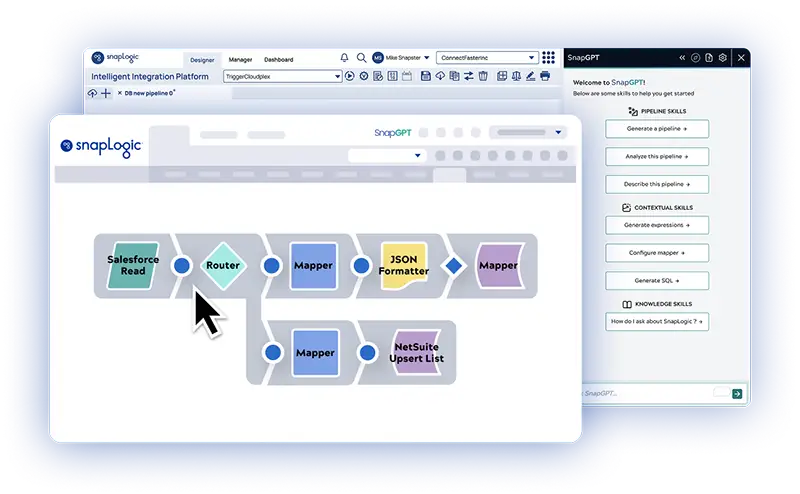
Native capabilities such as SnapGPT and AgentCreator support the creation of natural-language pipelines and low-code AI agent development. Governance, orchestration, and monitoring are integrated into the same system used to design integrations.
SnapLogic’s roadmap centers on integration, automation, and AI orchestration as its primary domain of specialization.
What Fivetran is and where it fits in the integration market
Fivetran is a data movement platform founded in 2012, built around automated ELT pipelines that extract data from source systems and load it into cloud data warehouses and lakes. The platform is purpose-built for this use case, with a strong library of managed connectors covering SaaS applications, databases, and cloud services.
Fivetran’s design philosophy centers on reliability and simplicity in data replication. Organizations use the platform to automate the movement of data into centralized analytics environments, particularly Snowflake, BigQuery, Databricks, and Redshift. The platform handles schema drift, connector maintenance, and incremental loading automatically, reducing the operational burden of keeping data pipelines current.
Fivetran’s market position is defined by depth in data movement. Its capabilities are focused on replication and transformation pipelines rather than application integration, API management, or workflow automation. As organizations expand their AI initiatives to include agentic workflows, operational system connectivity, and governed AI orchestration, the scope of what Fivetran covers becomes a relevant consideration in platform evaluation.
Architectural approach and platform structure
Architecture shapes what a platform can do and how operationally coherent it is at scale. The differences between SnapLogic and Fivetran are most visible here because the two platforms were built to solve different problems.
SnapLogic was designed from the ground up as a unified cloud-native platform. Integration, APIs, automation, monitoring, and AI orchestration share a single control plane, a consistent development experience, and a unified governance model. The same platform that moves data between enterprise systems also manages APIs, orchestrates workflows, and runs AI agents.
Fivetran’s architecture is optimized for a specific and well-defined job: automated, reliable data movement into analytics destinations. Connectors are managed and maintained by Fivetran, schema changes are handled automatically, and pipelines are designed to run with minimal configuration. That focus delivers real value for data engineering teams that need dependable replication at scale.
The architectural boundary becomes relevant when organizations need capabilities that extend beyond data movement. Application integration, API lifecycle management, workflow automation, and AI agent orchestration require a different kind of platform, one where data movement is part of a broader operational system rather than the entire scope.
| Capability | SnapLogic | Fivetran |
|---|---|---|
| Core emphasis | Unified integration, data, API, automation, and AI as a single purpose-built product. | Automated ELT data movement into cloud data warehouses and lakes. |
| Portfolio structure | Single platform, single control plane, consistent experience across all capabilities. | Focused data pipeline platform; application integration, API management, and workflow automation are outside the product scope. |
| Control plane | Unified across design, governance, and runtime. | Manages connector execution and pipeline reliability within the data movement domain. |
| Hybrid support | Cloud-native with hybrid and on-premises support. | Primarily cloud-delivered; on-premises sources supported through local deployment agents. |
| Market validation | Gartner Magic Quadrant Visionary, recognized for AI and integration innovation. | Recognized in the Gartner Magic Quadrant for Data Integration Tools, focused on ELT and data replication. |
AI readiness and agentic integration
For AI to deliver operational value across an enterprise, the integration layer that connects AI agents to live systems needs to span applications, APIs, data pipelines, and workflows within a governed framework.
SnapLogic embedded generative AI into the platform through SnapGPT, which enables pipeline creation through natural-language prompts, and AgentCreator, which supports low-code AI agent development. Both operate within the same governance and monitoring framework as all other integration work. AI agents in SnapLogic are part of the same system used to design, run, and govern integrations.
Fivetran’s AI capabilities are focused on the data movement layer. The platform provides automated pipeline creation and connector recommendations. These features extend Fivetran’s core value proposition of reliable, low-maintenance data replication into AI-assisted configurations. They are not designed for agentic workflows, AI agent orchestration, or the broader integration scenarios that enterprise AI strategies require.
For organizations evaluating AI readiness, the relevant question is whether AI capabilities span the full integration surface or are scoped to a specific data movement function.
Operational model and lifecycle management
SnapLogic offers a unified operational view across application integration, data pipelines, APIs, and AI agents within a single monitoring interface. The platform is delivered continuously through cloud updates, without customer-managed upgrade cycles.
Fivetran’s operational model is built around connector reliability and pipeline health. The platform provides monitoring for sync status, failure alerts, and data freshness across managed connectors. For data engineering teams focused on warehouse ingestion, this model is well-suited to the task. For organizations that also need visibility into application integration, API performance, workflow execution, and AI agent activity, Fivetran’s operational surface covers the data layer only.
Organizations managing a broad integration estate typically address this by running Fivetran alongside additional platforms for application integration and automation. SnapLogic consolidates those requirements into a single operational environment.
Modernization and consolidation strategy
The business case for a modern integration platform is consolidation: replacing a fragmented collection of data pipelines, integration tools, API gateways, and workflow automation with a single, coherent system.
SnapLogic was built to support that consolidation. Application integration, data integration, API management, workflow automation, and AI orchestration are all integrated within a single platform and development experience. Organizations consolidating onto SnapLogic gain breadth without sacrificing architectural coherence.
Fivetran is a strong consolidation point for the data movement layer, particularly for organizations standardizing on a cloud data warehouse or lakehouse architecture. Its value in a consolidation strategy is most pronounced when the goal is rationalizing data pipeline tooling.
Organizations pursuing broader consolidation across application integration, API management, and automation will typically need to pair Fivetran with additional platforms to address the full scope of their needs.
Customer outcomes and strategic alignment
SnapLogic customers consistently report three categories of outcome:
- Faster time-to-integration through low-code visual development
- Lower total cost of ownership through platform consolidation
- Expanded AI capability through embedded GenAI features that operate within the same governance framework as all other integration work
Fivetran’s customer base reflects strong adoption among data engineering teams and analytics-focused organizations. Customers cite connector reliability, schema drift handling, and low operational overhead as consistent strengths. For organizations whose primary integration requirement is moving data into centralized analytics environments, these qualities are well-matched to the need.
For organizations with integration requirements that extend beyond data movement into operational systems, APIs, workflow automation, and AI orchestration, the scope alignment between Fivetran and those requirements becomes a central evaluation factor.
Strategic alignment is about what a vendor is optimizing for. SnapLogic’s roadmap centers on integration, automation, and AI orchestration as a unified domain. Fivetran’s roadmap centers on making automated data movement more reliable and comprehensive, with data engineering productivity as the primary design principle.
What this means for CIOs and CTOs
Integration infrastructure is increasingly the foundation on which an AI strategy is built or constrained. The ability to orchestrate AI agents, govern data flows, connect enterprise systems, and automate workflows within a coherent architecture shapes how quickly AI investments translate into operational outcomes.
CIOs and CTOs evaluating SnapLogic and Fivetran should examine a few specific questions:
- Does the organization need a platform that spans application integration, data movement, API management, and AI orchestration, or a best-of-breed data pipeline tool paired with additional platforms for other integration needs?
- Is AI orchestration a requirement across the full integration surface, or specifically within the data layer?
- What is the operational cost of managing multiple specialized platforms versus a single unified integration environment?
Fivetran is a genuine specialist in automated data movement. The evaluation question is whether that specialization covers the organization’s full integration strategy or a defined part of it.
Conclusion: integration strategy shapes AI scalability
Integration strategy has always been foundational to enterprise IT. As organizations scale AI initiatives, the integration layer becomes the infrastructure through which AI models connect to systems, data, and workflows.
SnapLogic and Fivetran serve different points on the integration spectrum. Fivetran delivers depth and reliability in automated data movement into analytics destinations. SnapLogic delivers breadth across application integration, data integration, API management, workflow automation, and AI orchestration within a unified platform.
The evaluation is not about which platform has more connectors or more features in a given category. It is about which architecture matches the organization’s integration strategy: a unified platform purpose-built for the full integration surface, or a specialized data movement tool operating as part of a multi-platform integration estate.
For organizations where integration, automation, and AI orchestration are central to long-term strategy, that question matters more than any individual feature comparison.
See the SnapLogic platform in action
Reading about architecture and AI readiness is one thing. Seeing how a unified integration and agentic orchestration platform actually works is another.
Explore the interactive SnapLogic Platform Tour to experience:
- Unified integration across apps, data, and APIs
- Embedded generative AI with SnapGPT
- Low-code AI agent development
- Centralized governance and monitoring
- Cloud-native execution across hybrid environments
If integration is becoming the execution layer for your automation and AI strategy, it’s worth seeing what a purpose-built platform looks like in practice.
Take the SnapLogic Platform Tour and evaluate the difference for yourself.