
What SnapLogic is and how it is designed
SnapLogic is a cloud-native, AI-powered enterprise integration platform designed to unify:
These capabilities operate within a single control plane and a consistent development experience.
The platform emphasizes:
- Low-code visual development
- Centralized governance
- Continuous cloud delivery
- Embedded generative AI
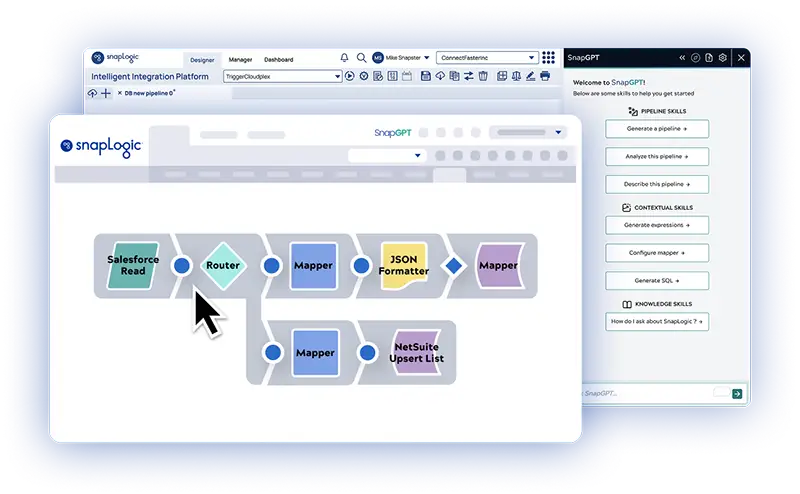
Native capabilities such as SnapGPT and AgentCreator support the creation of natural-language pipelines and low-code AI agent development. Governance, orchestration, and monitoring are integrated into the same system used to design integrations.
SnapLogic’s roadmap centers on integration, automation, and AI orchestration as its primary domain of specialization.
What Workato is and where it fits in the integration market
Workato is an integration and automation platform founded in 2013, built around a recipe-based development model and a broad library of SaaS connectors. The platform originated in the mid-market automation space and has since expanded its positioning toward enterprise buyers.
The Workato platform covers application integration, workflow automation, and API management, with AI-powered automation added more recently through its Copilot and Agentic Process Automation features. The platform’s design philosophy prioritizes accessibility for business users, which is a strength in straightforward SaaS-to-SaaS automation scenarios, and a limiting factor when enterprise-scale complexity, data volume, or governance requirements come into play.
Workato’s market position centers on ease of initial adoption and breadth of automation, particularly in organizations with SaaS-heavy environments and relatively contained integration requirements. Its AI capabilities have been introduced as a layer on top of the existing automation framework, extending recipe-based workflows into AI-assisted scenarios rather than reflecting a platform designed with AI orchestration as a foundational principle.
Architectural approach and platform structure
Architecture is not a feature. It determines how well a platform scales, governs, and enables AI, and the differences between SnapLogic and Workato become most visible here.
SnapLogic was designed from the ground up as a unified cloud-native platform. Integration, APIs, automation, monitoring, and AI orchestration share a single control plane, a consistent development experience, and a unified governance model. There is no seam between building a pipeline and governing it.
Workato’s architecture is built around the concept of “recipes,” which are modular automation units that trigger actions across connected systems. This model works well for event-driven automation and SaaS-to-SaaS workflows, but it introduces architectural boundaries when organizations need to manage complex data pipelines, enterprise API governance, and AI orchestration within a coherent operational framework.
Workato has expanded its surface area over time, but the recipe model remains the foundational unit, which shapes the platform’s governance and observability capabilities at scale.
| Capability | SnapLogic | Workato |
|---|---|---|
| Core emphasis | Unified integration, data, API, automation, and AI as a single purpose-built product. | Automation-first platform spanning integration, workflow, and AI, built around a recipe-based development model. |
| Portfolio structure | Single platform, single control plane, consistent experience across all capabilities. | Recipe-driven automation platform; API management and data capabilities are extensions of the core automation layer. |
| Control plane | Unified across design, governance, and runtime. | The platform manages recipe execution. API and data management carry distinct configuration experiences. |
| Hybrid support | Cloud-native with hybrid and on-premises support. | Primarily cloud-delivered; on-premises automation supported via Workato On-Prem. |
| Market validation | Gartner Magic Quadrant Visionary, recognized for AI and integration innovation. | Gartner Magic Quadrant Challenger, recognized for ease of use and breadth of automation. |
AI readiness and agentic integration
For AI to scale across an enterprise, it cannot sit on top of the integration layer. It has to be part of it.
SnapLogic embedded generative AI into the platform through SnapGPT, which enables pipeline creation through natural-language prompts, and AgentCreator, which supports low-code AI agent development. Both operate within the same governance and monitoring framework as all other integration work. AI agents in SnapLogic are not a separate product layer; they are part of the same system used to design, run, and govern integrations.
Workato has introduced AI capabilities through Workato Copilot and its Agentic Process Automation framework, enabling recipe generation through natural language and AI-assisted automation design. These features are built on top of the existing recipe execution model and extend Workato’s automation reach into AI-driven workflows. However, the underlying architecture remains automation-first; AI capabilities layer onto that framework rather than being embedded in the platform’s foundational design.
For organizations evaluating AI readiness, the question is not whether a vendor offers AI features. It is whether those features are architecturally integrated or operationally bolted on.
Operational model and lifecycle management
SnapLogic offers a unified operational view across application integration, data pipelines, APIs, and AI agents within a single monitoring interface. The platform is delivered continuously through cloud updates, without the need for customer-managed upgrade cycles.
Workato’s operational model is centered on recipe management, which includes monitoring recipe runs, job histories, and error handling within the Workato dashboard. For teams operating primarily within SaaS automation workflows, this model is approachable. For organizations managing complex data pipelines, enterprise API governance, and multi-environment deployments at scale, operational visibility across Workato’s expanded capability set may require coordination across separate views and tooling. Cloud delivery is continuous, but governance across integration, API, and data capabilities does not share a single operational surface.
Modernization and consolidation strategy
The business case for a modern integration platform is consolidation: replacing a fragmented collection of legacy ETL tools, API gateways, workflow automation, and custom scripts with a single, coherent system.
SnapLogic was built to support exactly that consolidation. Application integration, data integration, API management, workflow automation, and AI orchestration operate within one platform and one development experience. Organizations can consolidate onto a single vendor without trading architectural coherence for breadth.
Workato covers automation, integration, and API management, but its recipe-based model is most naturally suited to event-driven SaaS automation. Organizations pursuing broader consolidation (including complex data movement, enterprise API governance, and AI orchestration) may find that Workato’s architecture requires additional tooling or workarounds to address use cases that fall outside the automation paradigm it was built around.
Customer outcomes and strategic alignment
SnapLogic customers consistently report three categories of outcome:
- Faster time-to-integration through low-code visual development
- Lower total cost of ownership through platform consolidation
- Expanded AI capability through embedded GenAI features that do not require separate tooling or separate governance
Workato’s customer base reflects strong adoption in mid-market and departmental automation use cases. Customers frequently cite time-to-automation, ease of use, and strong SaaS connector coverage as strengths.
For organizations with automation-heavy, SaaS-centric environments, these qualities are meaningful. For organizations with complex enterprise integration requirements spanning legacy systems, high-volume data pipelines, and AI orchestration at scale, the recipe-based model’s architectural boundaries become more relevant to the evaluation.
Strategic alignment is not just about what a platform does today. It is about what a vendor is optimizing for. SnapLogic’s roadmap is centered on integration, automation, and AI orchestration as a unified domain. Workato’s roadmap spans automation, AI, and expanding enterprise coverage, with automation as the primary design principle and integration as an extension of that model.
What this means for CIOs and CTOs
Integration infrastructure is increasingly the foundation on which an AI strategy is built or constrained. The ability to orchestrate AI agents, govern data flows, connect enterprise systems, and automate workflows within a coherent architecture shapes how quickly AI investments translate into operational outcomes.
CIOs and CTOs evaluating SnapLogic and Workato should examine a few specific questions:
- Are AI orchestration and integration governance part of the same system, or does AI sit in a separate product layer that requires separate management?
- Does the platform deliver all required capabilities through a single design and operational experience, or through multiple interfaces assembled under one brand?
- Is the vendor’s primary innovation focus on integration and AI orchestration, or on automation breadth with integration and AI as extensions of a recipe-based model?
Vendors with broad automation coverage can be compelling in departmental or SaaS-centric evaluations. The architectural question is whether that breadth translates into operational simplicity or operational complexity when enterprise-scale requirements apply.
Conclusion: Integration strategy shapes AI scalability
Integration strategy has always been foundational to enterprise IT. As organizations scale AI initiatives, the integration layer becomes the infrastructure through which AI models connect to systems, data, and workflows.
SnapLogic and Workato are both active platforms with strong market presence and evolving AI roadmaps. The evaluation is not simply about which platform has more features. It is about which architecture best supports an organization’s AI and integration strategy at scale: a platform purpose-built for unified integration and embedded AI, or an automation-first platform where integration and AI capabilities extend from a recipe-based foundation.
For organizations where integration, automation, and AI orchestration are central to long-term strategy, the answer to that question matters more than the length of any feature list.
See the platform in action
Reading about architecture and AI readiness is one thing. Seeing how a unified integration and agentic orchestration platform actually works is another.
Explore the interactive SnapLogic Platform Tour to experience:
- Unified integration across apps, data, and APIs
- Embedded generative AI with SnapGPT
- Low-code AI agent development
- Centralized governance and monitoring
- Cloud-native execution across hybrid environments
If integration is becoming the execution layer for your automation and AI strategy, it’s worth seeing what a purpose-built platform looks like in practice.
Take the SnapLogic Platform Tour and evaluate the difference for yourself.