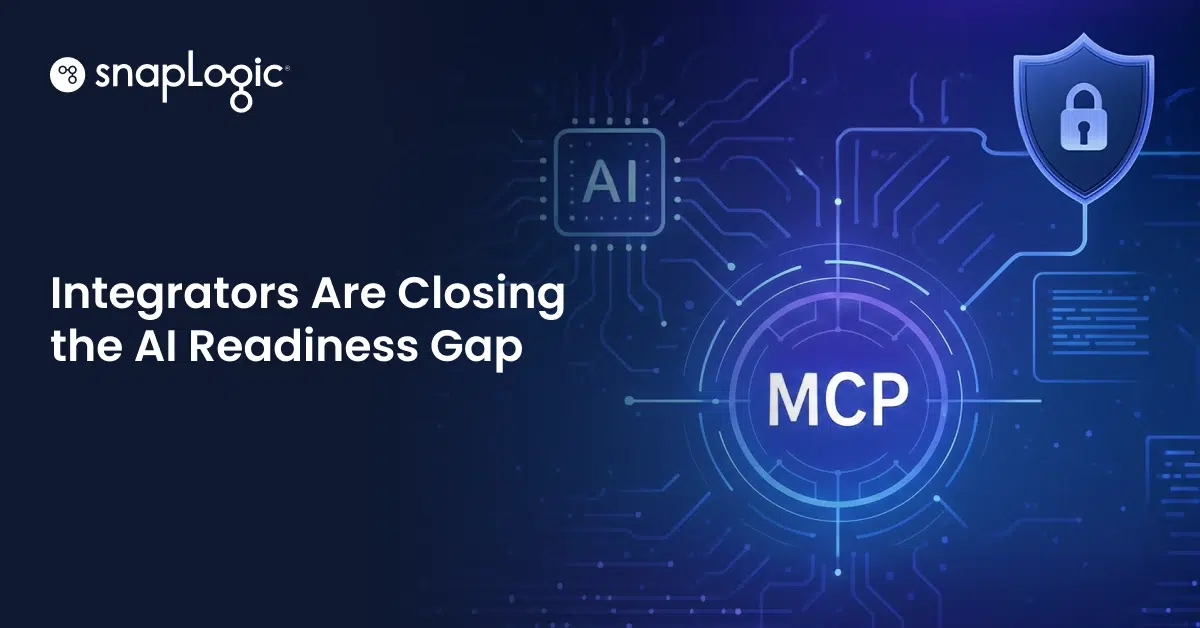



The Model Context Protocol (MCP) has moved quickly from a niche AI specification to a foundational standard for how enterprises connect AI agents to real systems.
Introduced by Anthropic in late 2024 and rapidly adopted by Microsoft, OpenAI, and Google, MCP solves a problem that has long plagued AI development: the M×N integration problem, where every AI model needs a custom connector for every tool it wants to use.
MCP replaces that with a single, standardized interface. The result is a growing ecosystem of platforms and frameworks that expose their capabilities as MCP servers, and a growing need to understand which tools are worth building on.
This post covers the leading options for MCP integration in 2026, with notes on what each does well and where each fits in a production architecture.
What are the key benefits of using an iPaaS with native MCP support?
Enterprise integration platforms that support MCP natively remove a significant layer of overhead from AI development. Rather than building and maintaining custom connectors between AI agents and each enterprise system, teams can expose existing integration pipelines directly as MCP servers. The agent consumes a standard interface; the platform handles authentication, transformation, and routing underneath.
The operational advantages compound over time. An iPaaS with native MCP support brings its existing governance, observability, and access control framework to every agent connection, so IT teams can monitor what agents are calling, enforce usage policies, and audit activity across the stack. Security and compliance requirements that would otherwise need to be solved at the agent layer are handled at the platform layer instead.
For organizations with established integration estates, native MCP support means those existing pipelines become immediately available to AI agents without rebuilding. The integration work already done continues to deliver value in the agentic context.
Which integration platforms currently have native support for Model Context Protocol (MCP)?
As of mid-2026, a growing number of enterprise integration platforms have shipped or announced native MCP support. SnapLogic, Workato, and MuleSoft have all released production MCP capabilities. Among developer-oriented frameworks, LangChain provides MCP adapter libraries, and n8n added an instance-level MCP server in April 2026.
Breadth of coverage varies significantly. Some platforms support MCP server creation only, others support both server and client modes, and fewer still have built governance and observability into their MCP implementation. The distinction matters for production deployments: connecting an AI agent to an MCP server is straightforward; operating that connection reliably at enterprise scale requires the platform to do more than just expose an endpoint.
The ecosystem is consolidating around a smaller set of platforms that treat MCP as a first-class capability rather than a point of integration. That gap between foundational support and production-ready support is where most evaluation decisions are made.
What should IT leaders look for in an integration platform’s MCP capabilities?
Not all MCP implementations are built for enterprise use. Early-stage support often means little more than an exposed endpoint, which is sufficient for a prototype but falls short of what production agent deployments require.
As organizations move from evaluating MCP to running it in live environments, the platform layer becomes the critical variable. The questions worth asking are not whether a platform supports MCP, but how deeply that support is built in, and whether the operational controls exist to run it at scale.
Four areas warrant close evaluation.
- Governance and access controls. Production AI agents make real calls to real systems. The platform should provide role-based access controls, authentication management, and the ability to restrict what any given agent or user can invoke. Audit logs should be available at the connection level, not just the application level.
- Bidirectional MCP support. Platforms that function as both MCP servers and MCP clients give teams more architectural options. Server mode lets you expose existing integrations to external agents; client mode lets your own agents consume third-party MCP servers. Both capabilities matter as agent ecosystems grow more interconnected.
- Integration depth, not just breadth. App coverage numbers can be misleading if the underlying integrations only support basic trigger-and-action operations. IT leaders should evaluate whether the platform can handle the data transformation, error handling, and retry logic that production integrations require, and whether those capabilities extend into the MCP layer.
- Operational tooling. Observability, alerting, and debugging tools for MCP connections are still maturing across the industry. Platforms that surface request traces, latency metrics, and failure diagnostics at the MCP layer reduce the operational burden on engineering teams managing agent deployments in production.
Top 5 tools for integrating MCP
1. SnapLogic
SnapLogic is the most complete enterprise MCP platform available today. The company has been building toward agentic integration since 2017 and announced MCP support in 2025, expanding it significantly with the June 2026 release.
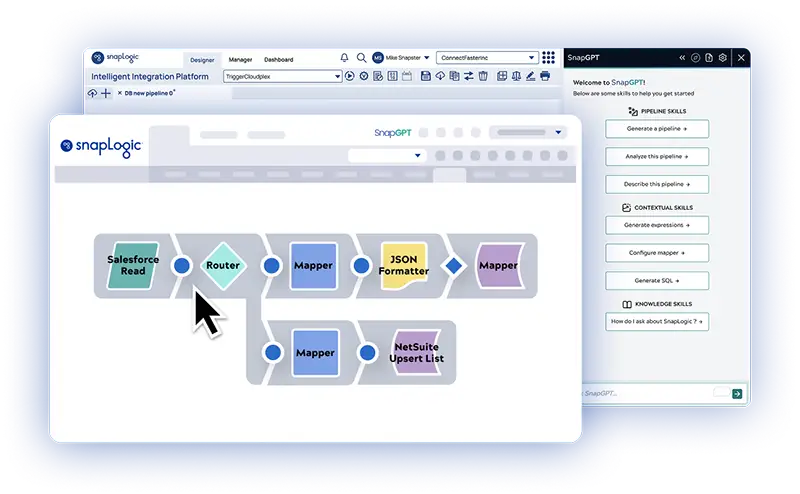
What sets SnapLogic apart is the combination of MCP server creation, pipeline orchestration, and enterprise governance in a single low-code platform. Teams can expose any of their existing integrations, data flows, or workflows as an MCP server in minutes using the MCP Server Pipeline Builder. Those servers are then immediately available to any MCP-compatible AI agent (e.g., Claude, GPT-4, custom agents), without rebuilding anything.
Critically, SnapLogic layers governance, observability, and access controls across every MCP connection, which matters for enterprises running agents in production. The platform has been deployed in this capacity across global organizations in financial services, manufacturing, and retail.
For enterprises that want MCP to work at scale, with auditability and without rebuilding their integration fabric from scratch, SnapLogic is the category leader.
2. LangChain
LangChain is a widely used open-source framework for building AI agents with MCP support via its langchain-mcp-adapters library. The adapter converts MCP tools into LangChain and LangGraph-compatible tools, allowing developers to connect to multiple MCP servers without writing custom integration code for each one.
LangChain gives engineering teams code-first flexibility but requires meaningful Python expertise to use effectively. It is not designed for business users, and building production-ready agent logic on top of it typically demands ongoing engineering investment. MCP support is functional, though the ecosystem is still maturing.
3. Workato
Workato positions its Enterprise MCP offering as a fully managed solution for turning enterprise applications into governed MCP servers, targeting teams that need security and access controls around AI agent connectivity. The platform’s Genies are pre-built agents for functions like Sales, HR, and IT that can act as both MCP clients and servers.
Workato’s strength is in business-user-friendly workflow automation, particularly in HR, finance, and IT operations. Teams with complex data integration needs or high-volume pipeline workloads will likely find it underpowered for those specific use cases.
4. n8n
n8n supports MCP on both sides: it can consume MCP servers as tools for its AI agents, and expose its own workflows as MCP servers for external agents to call. A native instance-level MCP server launched in April 2026, allowing compatible AI clients to build and publish workflows directly inside an n8n instance.
n8n is a practical option for smaller, developer-led teams that want open-source flexibility and self-hosted deployment. Governance and enterprise security controls are limited compared to purpose-built enterprise platforms, and scaling beyond technical teams tends to require additional investment.
5. Zapier
Zapier MCP provides AI agents with access to multiple apps and actions through a remote MCP server, without requiring custom API integrations for each connection. The breadth of app coverage is Zapier’s primary advantage, but the depth of each integration is limited to trigger-and-action operations.
It does not support complex data transformation or enterprise governance requirements. For teams already using Zapier who need lightweight agent-to-app connectivity, it is a convenient starting point, though organizations with more demanding integration needs will quickly find its ceiling.
How to choose an MCP integration tool
The right MCP integration tool depends on where in the stack you are operating. For enterprise data integration, agent orchestration, and governance at scale, SnapLogic delivers the most complete platform. For custom agent logic and research-stage builds, LangChain and CrewAI provide flexibility. For business-user automation extending into AI, Workato and Zapier serve established teams looking to modernize existing workflows.
What all of these tools share is a commitment to MCP as the standard connection layer. The ecosystem is moving in one direction, and the real question for organizations is how much infrastructure they want to own versus how much they want a platform to manage for them.
Want to see how it works? Try a self-guided product tour of our MCP integration capabilities, or book a personalized demo today.