



What is headless integration?
Headless integration refers to connecting and exchanging data between systems programmatically, through APIs, events, or automated processes, with no graphical user interface involved in the transaction. The word “headless” describes that particular exchange; the systems involved can each still have a UI for other purposes.
In a headless integration, the systems talk directly to each other. No person logs in, navigates screens, or manually moves or re-enters data as part of that exchange.
How does headless integration work?
In a headless setup, systems communicate directly through defined interfaces, typically APIs. A backend service, scheduled job, or automated agent can trigger data movement, transformations, or actions between systems entirely on its own, with no UI rendering or human interaction required for that specific exchange.
This usually relies on well-documented APIs, webhooks, or event streams on both sides of the integration. The integrating system (or agent) authenticates, calls the appropriate endpoint or subscribes to an event, and processes the response, all without a browser or desktop application in the loop.
What are examples of headless integration?
Common examples include a scheduled job that pulls new records from a CRM and pushes them into a data warehouse overnight, a webhook that fires when a support ticket is created and automatically creates a corresponding task in a project management tool, and an AI agent that queries multiple backend systems via API to assemble an answer without any of those systems’ UIs ever loading.
Headless commerce is a well-known variant: the storefront (UI) is decoupled from the backend commerce engine, and the two communicate purely through APIs.
Why does headless integration matter?
Headless integration is what makes automation possible at scale. It removes the human-in-the-loop dependency from routine or high-volume operations, letting systems (and increasingly AI agents) interact with each other continuously and reliably.
It’s foundational to modern automated pipelines, agent-to-system workflows, and any process that needs to run unattended. As more work shifts to AI agents that need to read from and write to enterprise systems directly, the quality and completeness of a system’s headless integration surface (its APIs) increasingly determine whether an agent can act on it at all.
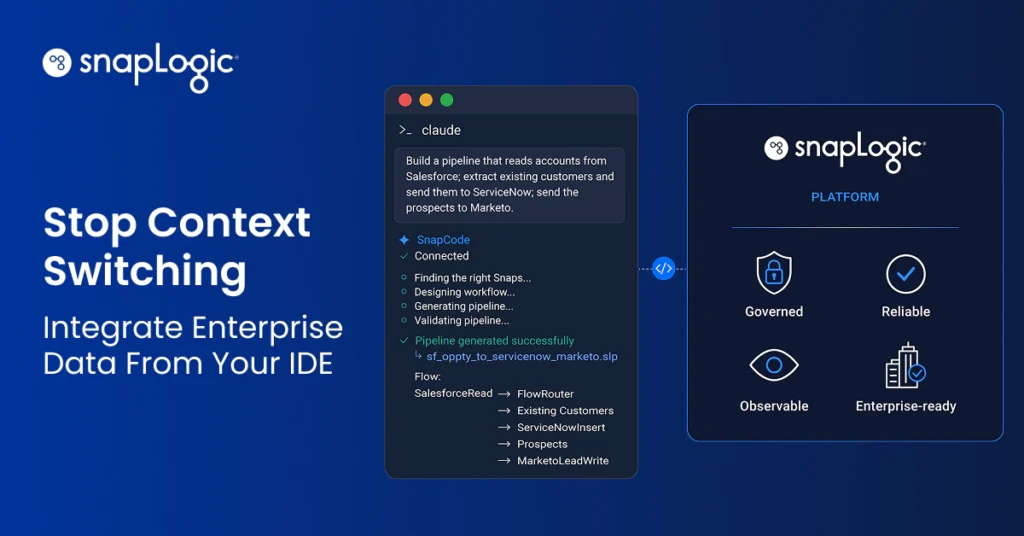
Explore SnapLogic MCP Server, SnapLogic’s headless integration layer for the agentic enterprise.