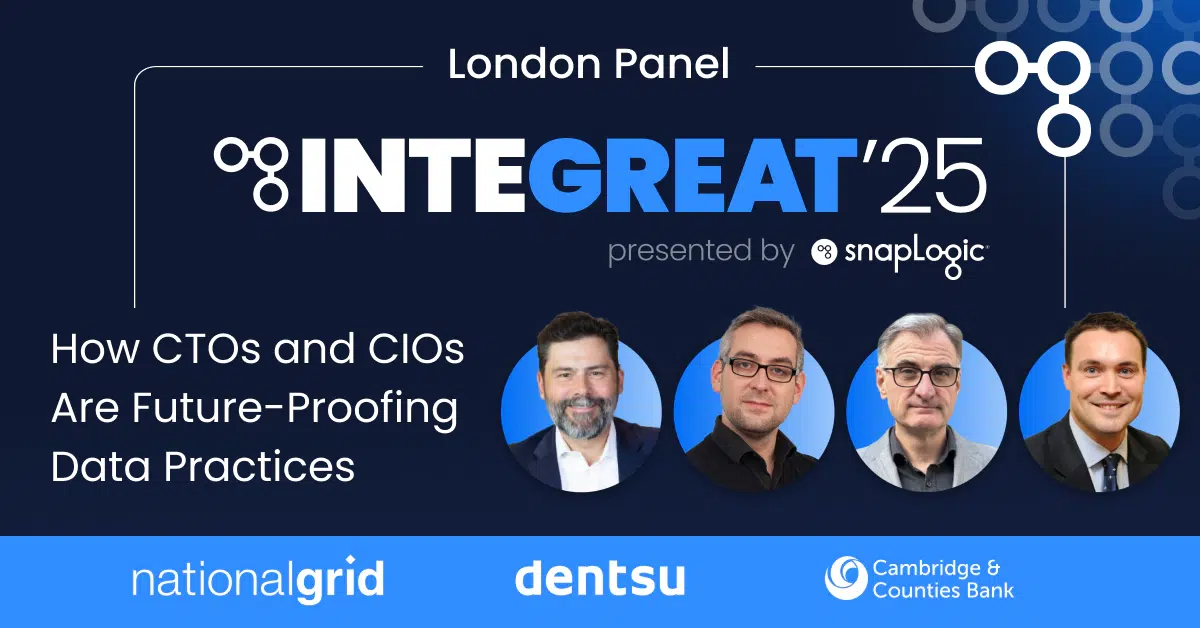



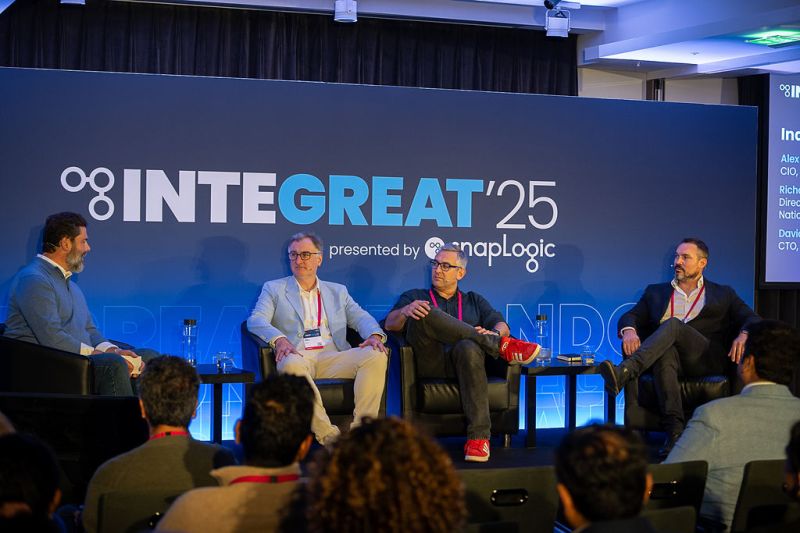
During Integreat 2025 in London, SnapLogic Chief Technology Officer Jeremiah Stone hosted a panel discussion with Alexandre Bedier, Chief Information Officer of Dentsu, Richard Wiles, Director of Product & Platforms at National Grid, and David Holton, Chief Transformation Officer of Cambridge & Counties Bank.
The conversation was wide-ranging, but with broad agreement on the questions of the day and prescriptions for addressing them, perhaps surprisingly, given the three very different industries the three panelists hail from. This unanimity, backed up by the trend of the audience questions and the many further conversations after the panel had concluded, led us to attempt to distill some of the most applicable advice from these industry thought leaders.
Listen to business users and empower them to do the right thing
David opened this topic by sharing, “quite often you’ve got a lot of really good ideas coming in, and part of our role is to sift those into what can be delivered. What can you actually get into production? What can you make a reality?”
Richard said one concern was the risk of jumping too early to proposed solutions, noting that he has “the blessing and the curse” of working for “an organization full of engineers, as people arrive with a proposed solution.” Actually, what works better is a combination of business expertise and technical expertise to get to a better outcome.
Alex agreed, saying that in his experience, the best ideas come from the people who are closest to the business problem to be solved, or to the opportunity to be seized. He focuses on empowering users and other leaders, “with a lot of education, a lot of empowerment, and making sure that people are co-leading those transformations with you.”
Changing the culture and the structure
All of the panelists agreed on the importance of breaking down silos throughout the organization. The way to achieve the most impactful results is to bring cross-functional teams together, generating ideas, and making things happen.
David pointed out the importance of “creating a culture where colleagues feel empowered to come in with ideas.” However, it’s not enough just to listen. It is equally important to deliver something tangible in response. “But if you do that, you’ve then got to help deliver on those because the first time they have an idea and it doesn’t go anywhere, then that stops and actually that becomes a negative piece,” he said.
Richard took issue with the idea that there must be a conflict between the view of the users and the leadership: “Sometimes people doing bottom-up innovation identify the same things that you’re going after at a strategic level,” he said.
Instead of trying to impose a vision from above, the panelists agreed on the importance of relaxing some of the tight controls in favour of getting the right people involved with critical initiatives.
Now add AI
Alex was the first to introduce the topic of AI to the discussion, and specifically, the mismatch between users’ expectations and the reality of what is necessary. For AI to be useful within the enterprise, leaders still need to put their data house in order: the data needs to be more structured, cleaner, and more documented, not less.
These requirements and their sudden visibility can put a lot of pressure on IT teams. But this structure is a prerequisite that far too many organizations forget about before jumping into the next AI revolution.
One of the particular pain points highlighted by the panel was normalising data across a variety of different sources. In David’s world, some of that data might come directly from customers, some from data brokers, some of it might be generated internally by employees of the bank, and some of it will be from validated third-party sources like Companies House, Experian, et cetera. “Trying to mesh all of those together to get one version, a correct version of the truth to then go through the process can be quite a challenge,” he added, with some understatement.
Centralise or federate?
Alex pointed out that the difference between centralisation and federation is mainly timing. Federation is much faster, enabling enormous reductions in effort across the organisation and far more throughput and better results — at the cost of some ultimate standardisation.
This topic is intimately related to AI, in that AI is making what were already known to be best practices into absolute hard requirements. David pointed out that “you could probably get away with saying data was something that a team over here ran and managed in the past; you’re not going to be able to do that in the future.”
But there is no postponing this work, he added. “As you look to bring in things like agentic AI, you’ll have more users of data in the future than you had in the past, and therefore the work needs to happen now, before we go too far down the AI route.”
“The really interesting and exciting thing about this technology is it’s emerging; nobody’s got the answers yet. Some people are reading two paragraphs ahead of everybody else, but nobody has all the answers.”
David Holton, CTO of Cambridge & Counties Bank
Common ground and future agility
The main takeaway from the panel was about how much commonality there was between the very different industries represented by the three panellists. Getting users on board and providing structured access to data were the two key requirements that everyone agreed upon, both in general and specifically for success with AI.
An important subsidiary point is that this is not a one-time exercise. A federated organisation with true distributed ownership of data will be agile enough to address whatever challenges the future may bring.
It is perhaps worth pointing out explicitly that two of the three panelists work in very highly regulated industries, so this is not a situation where you can go wild with any data you can get your hands on and figure it out as you go. That does not necessarily need to be a brake on innovation, though, as long as you involve your compliance and audit team early on. That way, they can propose solutions and explore possibilities collaboratively, instead of finding themselves in the position of having to shoot down something promising.
Want to see the full panel session from Integreat 2025 in London? You can view them all on-demand.