

Enterprise integration has become a strategic foundation for automation, analytics, and AI-driven operations. As organizations invest in agentic AI, real-time data flows, and composable architectures, the integration platform increasingly determines how quickly those initiatives can scale.
SnapLogic and MuleSoft are both established enterprise integration platforms. Each supports large-scale connectivity across applications, data sources, and APIs. Their approaches reflect different histories, portfolio structures, and architectural priorities.
Independent market comparisons reflect strong enterprise adoption for both platforms across usability, governance, and integration depth. For buyers, the decision comes down to architectural alignment and long-term AI strategy rather than feature parity alone.
This comparison focuses on platform design, AI readiness, operational models, and modernization strategy to help CIOs and CTOs evaluate long-term alignment.
What SnapLogic is and how it is designed
SnapLogic is a cloud-native, AI-powered enterprise integration platform designed to unify:
These capabilities operate within a single control plane and a consistent development experience.
The platform emphasizes:
- Low-code visual development
- Centralized governance
- Continuous cloud delivery
- Embedded generative AI
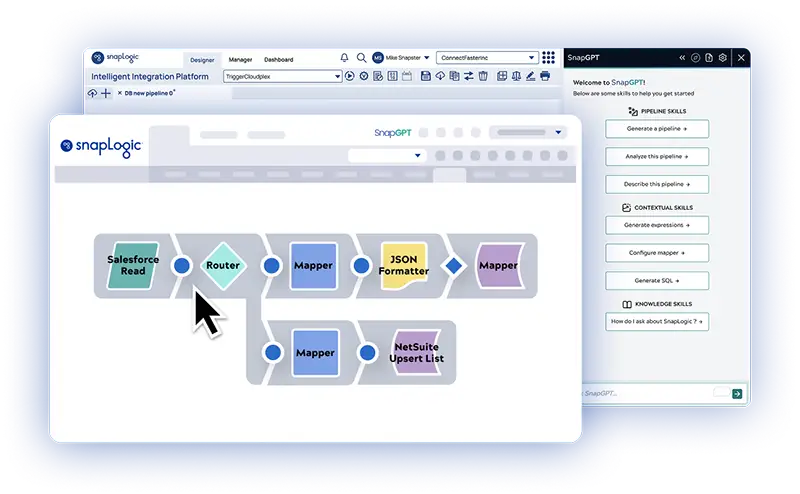
Native capabilities such as SnapGPT and AgentCreator support the creation of natural-language pipelines and low-code AI agent development. Governance, orchestration, and monitoring are integrated into the same system used to design integrations.
SnapLogic’s roadmap centers on integration, automation, and AI orchestration as its primary domain of specialization.
What MuleSoft is and where it fits in the integration market
MuleSoft provides application integration and API management through its Anypoint Platform. Since its acquisition in 2018, it has operated as part of Salesforce’s broader enterprise software portfolio.
Within Salesforce’s ecosystem, MuleSoft complements products such as:
- Tableau
- Slack
- Heroku
- Salesforce Commerce Cloud
MuleSoft’s API-led connectivity model is widely used for structuring enterprise integrations into reusable services and managed APIs.
As one product within a multi-solution SaaS portfolio, MuleSoft operates alongside broader Salesforce platform initiatives, including Data Cloud and AI services. Recent announcements, such as MuleSoft Agent Fabric, highlight Salesforce’s focus on automated agent discovery and orchestration within its ecosystem.
From a commercial perspective, organizations may also encounter MuleSoft within Salesforce’s broader “Data Foundation” sales motion, where integration, data, and cloud infrastructure offerings are positioned together. This reflects MuleSoft’s role within a broader platform strategy rather than as a standalone integration-focused vendor.
Architectural approach and platform structure
Architecture influences scalability, governance, and AI enablement.
SnapLogic delivers integration, APIs, automation, monitoring, and AI orchestration within a unified cloud-native platform. Development, governance, and runtime management share a consistent interface and control plane.
MuleSoft’s Anypoint Platform includes API design, runtime management, and governance components organized around its API-led methodology. Deployments may include managed cloud options or runtime fabrics that support hybrid environments.
Both platforms support hybrid and cloud deployments. Their structural organization and operational layering reflect different design philosophies and product evolution paths.
| Capability | SnapLogic | MuleSoft |
|---|---|---|
| Core emphasis | Unified integration + AI orchestration | API-led connectivity + integration |
| Portfolio structure | Integration-focused vendor | Part of the broader Salesforce portfolio |
| Control plane | Single unified interface | Multi-component platform environment |
| Hybrid support | Cloud-native with hybrid execution | Cloud and managed runtime options |
| Market validation | Strong enterprise ratings on G2 | Strong enterprise ratings on G2 |
AI readiness and agentic integration
AI-driven workflows require orchestration across data, applications, and APIs with centralized governance.
SnapLogic embeds generative AI directly into the integration experience. SnapGPT supports conversational pipeline design, while AgentCreator enables low-code AI agent development that can reason and act across systems. AI governance and operational visibility are unified within the same platform layer as integration design.
MuleSoft’s AI strategy aligns with Salesforce’s broader AI ecosystem, including Einstein services and agent discovery capabilities such as Agent Fabric. For organizations building AI primarily within Salesforce environments, this alignment can provide tight ecosystem integration.
For enterprises pursuing agentic integration strategies that span multiple clouds and enterprise systems, leadership teams often evaluate:
- How AI is embedded within integration workflows
- Whether orchestration spans beyond a single SaaS ecosystem
- Governance consistency across agents and integrations
- Vendor focus and roadmap prioritization
As AI initiatives mature, integration increasingly becomes the execution backbone for intelligent automation.
Operational model and lifecycle management
Long-term sustainability includes upgrade cycles, deployment management, and operational overhead.
SnapLogic operates on a continuous cloud delivery model. Updates, security enhancements, and new functionality are delivered automatically without scheduled upgrade projects.
MuleSoft provides managed cloud services and hybrid runtime options that may involve version management and infrastructure oversight, depending on the deployment model.
IT leaders evaluating operational models often assess:
- Upgrade planning requirements
- Infrastructure management responsibilities
- DevOps resource allocation
- Predictability of lifecycle events
Operational simplicity becomes more material as integration footprints expand to support automation and AI agents across the enterprise.
Modernization and consolidation strategy
Modernization initiatives often aim to reduce complexity, improve governance, and prepare for AI adoption.
SnapLogic modernization efforts typically focus on:
- Consolidating disparate integration tools
- Simplifying integration asset footprints
- Embedding AI into workflow design
- Aligning architecture to cloud-native principles
MuleSoft modernization strategies often center on implementing API-led frameworks and service reuse models to standardize enterprise connectivity, particularly within Salesforce-aligned environments.
Both approaches support modernization. The emphasis placed on consolidation, AI embedding, and architectural reset varies by organizational priorities and ecosystem alignment.
Customer outcomes and strategic alignment
Organizations evaluating either platform commonly prioritize:
- Speed of integration delivery
- Reduction of tool sprawl
- Governance consistency
- Support for AI-driven automation
- Long-term cost structure
SnapLogic customers frequently report improved development velocity, simplified architecture, and stronger AI orchestration readiness following consolidation.
MuleSoft customers highlight API governance discipline and alignment with Salesforce-centered digital transformation strategies.
Independent third-party reviews demonstrate that both platforms are considered capable and mature. The strategic differentiator increasingly centers on architectural coherence and AI roadmap alignment.
What this means for CIOs and CTOs
Integration platforms now function as the execution layer for automation and AI agents.
Strategic considerations include:
- Whether integration is a primary specialization of the vendor
- How AI capabilities are embedded within the integration experience
- The degree of architectural consolidation desired
- Alignment with broader SaaS ecosystem strategy
- Operational model preferences
As AI initiatives move from experimentation to operationalization, integration architecture directly influences scalability, governance, and long-term adaptability.
Conclusion: Integration strategy shapes AI scalability
SnapLogic and MuleSoft both support enterprise-scale integration, API management, and hybrid deployment.
SnapLogic centers its platform strategy on unified integration and embedded generative AI, with integration as its primary corporate focus.
MuleSoft operates as a key integration and API product within Salesforce’s broader SaaS portfolio, aligned with Salesforce’s ecosystem strategy and evolving AI initiatives such as Agent Fabric.
For organizations pursuing agentic integration and AI-first architecture, evaluating platform specialization, architectural coherence, ecosystem alignment, and vendor roadmap focus can help determine which solution best supports long-term strategy.
As integration becomes the backbone of automation and intelligent systems, architectural clarity and strategic alignment increasingly shape what organizations can build next.
See the platform in action
Reading about architecture and AI readiness is one thing. Seeing how a unified integration and agentic orchestration platform actually works is another.
Explore the interactive SnapLogic Platform Tour to experience:
- Unified integration across apps, data, and APIs
- Embedded generative AI with SnapGPT
- Low-code AI agent development
- Centralized governance and monitoring
- Cloud-native execution across hybrid environments
If integration is becoming the execution layer for your automation and AI strategy, it’s worth seeing what a purpose-built platform looks like in practice.
Take the SnapLogic Platform Tour and evaluate the difference for yourself.