




Financial services organizations are under growing pressure to modernize data infrastructure while maintaining strict governance, security, and regulatory compliance. At the same time, executive expectations around AI adoption, operational efficiency, and digital experience continue to rise.
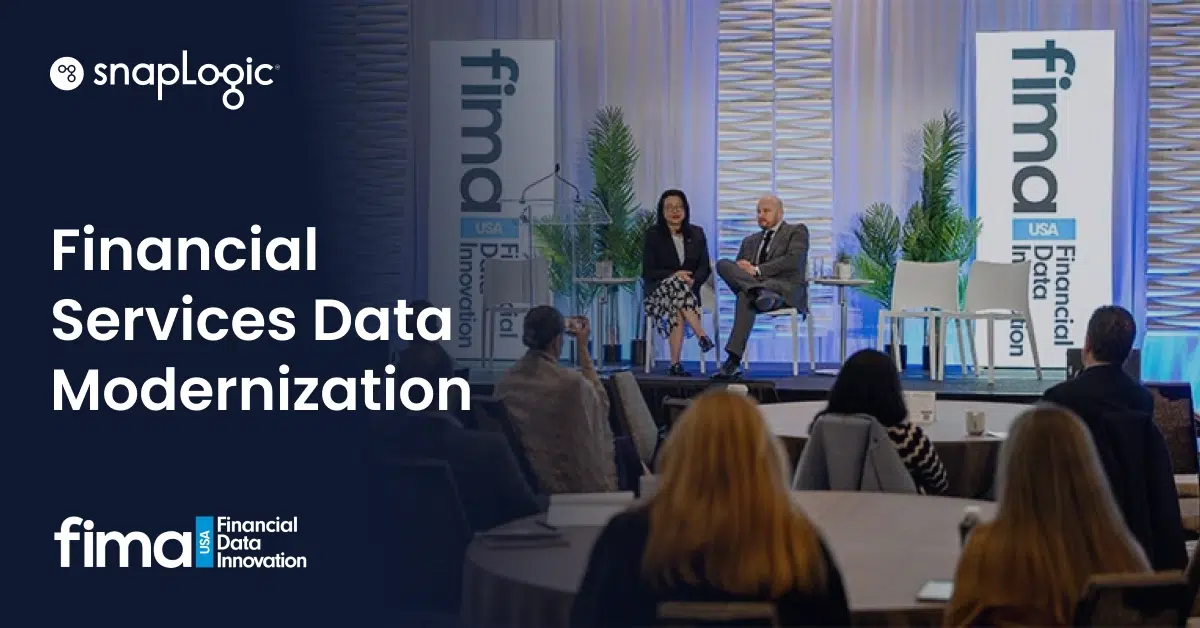
These realities are shaping the conversations at the FIMA Financial Information Management Conference. It’s an event focused less on experimentation and more on execution.
For many banks, insurers, and capital markets firms, the question is no longer whether to modernize data and AI capabilities, but whether their existing integration and data foundations can support those initiatives at enterprise scale.
The data complexity challenge in financial services
Financial services institutions manage some of the largest and most complex data environments in any industry. But data volume alone does not translate into business value.
Across the industry, common challenges continue to surface:
- Fragmented data across legacy systems, cloud platforms, and third-party tools
- Increasing integration complexity as new technologies are layered on top of existing infrastructure
- Governance, lineage, and audit requirements that slow delivery
- Limited confidence in data quality for analytics and AI use cases
As complexity increases, so does operational and regulatory risk, particularly in environments where data accuracy, traceability, and control are non-negotiable.
Why AI readiness depends on data modernization
AI has moved quickly from experimentation to expectation. Executive teams and boards are now asking how AI initiatives will be operationalized safely, governed effectively, and scaled responsibly.
Yet many AI initiatives stall for reasons unrelated to models or algorithms. Common blockers include:
- Disconnected or brittle data pipelines
- Inconsistent governance frameworks
- Manual integration processes that cannot scale
- Limited visibility into data lineage and usage
As a result, AI readiness in financial services has become inseparable from modernizing the execution layer that connects data, systems, and AI. Before organizations can deploy AI with confidence, they must ensure data is unified, accessible, governed, and trusted.
What financial institutions are doing differently
Across the financial services market, progress is being driven by simplification. Not by adding more tools, but by reducing friction in how data moves, is governed, and is operationalized.
We see this reflected in real-world examples:
Regulatory compliance at scale: Financial institutions are modernizing their integration and governance to meet evolving regulatory requirements, while enhancing transparency and reducing reporting friction. When data lineage is built into the integration layer from the start, compliance becomes a byproduct of good architecture rather than a last-minute scramble.
AI enablement in banking: A large global bank selected SnapLogic as a strategic integration partner for its company-wide data integration initiative — a program designed to monetize data assets and improve customer experience through faster, more governed data insights. The goal: accelerate time-to-market for new services while reducing the cost and fragility of manual integration.
Modern infrastructure adoption: Banks and credit unions are transitioning to cloud-native, serverless architectures to simplify operations and enhance scalability. The institutions making the most progress are those that have standardized their integration layer first, enabling everything else to move faster.
In each case, success is driven by unified data access, consistent governance, and scalable integration. Not isolated technology investments.
The business case is clear
The returns on this kind of modernization are measurable. A Forrester Total Economic Impact study found that SnapLogic customers achieve an average 181% ROI, with payback in under six months and more than $3.3 million in realized benefits, spanning development efficiency, cost savings, and faster market delivery.
For financial services organizations where every integration delay carries compliance, reputational, or revenue risk, that math matters.
From strategy to execution
A recurring theme among financial services leaders is the shift from exploration to execution.
Today’s focus is on:
- Running analytics and AI initiatives in production (not in pilots)
- Reducing long-term integration and maintenance costs
- Ensuring governance frameworks withstand audit and regulatory scrutiny
- Supporting business growth without increasing operational risk
These priorities are at the center of discussions at FIMA and across the broader industry.
Continuing the conversation at FIMA
SnapLogic will be at FIMA to connect with financial services leaders navigating data modernization, integration, and AI readiness in regulated environments.
We look forward to peer-level conversations around:
- Enterprise data modernization and integration strategy
- AI readiness within regulated financial services organizations
- Reducing vendor sprawl and architectural complexity
- Secure, scalable execution at enterprise scale
Schedule a private 15-minute conversation with the SnapLogic team during FIMA to discuss modernizing legacy integration platforms and moving AI initiatives into production.