



If you’ve been anywhere near enterprise AI conversations this year, you’ve heard the same question over and over: Should we be building autonomous agents… or doubling down on human-in-the-loop AI?
That exact tension is why Jordan Millhausen (one of our Solutions Engineers) and I hosted our recent webinar on Augmented Intelligence vs. Autonomous Agents. We didn’t want another hype tour. We wanted to give teams a practical playbook for deploying AI automation in the real world — where humans, risk controls, and messy data are part of the job.
The industry reality check: the agent era is here, but so is “agent washing.”
Let’s start with the honest industry backdrop. Agentic AI is absolutely a top enterprise trend right now. But Gartner is also warning that a big chunk of “agentic” projects will be canceled by 2027 because of cost, unclear value, or weak risk controls. And they’ve called out “agent washing” as vendors slap the label on things that are basically just chatbots with extra steps.
So the question isn’t “Are agents real?” They are. The question is “Where do they belong, and how do we integrate them safely into operations that already work?”
That’s the question that Jordan and I set out to tackle.
What we mean by agents vs. augmented intelligence
Early in the session, I leaned on a definition I like from Gartner: AI agents are autonomous or semi-autonomous software entities that perceive, decide, and act toward goals. In other words, they’re not just following a fixed script. They can choose tools, adjust to conditions, and keep going after the goal even when reality — or the input data — doesn’t cooperate.
By contrast, augmented intelligence is what many organizations are already doing today: use AI for discrete steps inside predictable workflows. Think summarizing a document, extracting fields, or drafting a recommendation…then pausing for a person to review or approve.
Neither model is “better.” They’re different instruments. The trick is knowing which one to use, when.
Why most AI projects stall before production
We also talked about the elephant in the room: proofs of concept are everywhere, production deployments are not. I cited data showing that the majority of AI initiatives never cross that gap, and the blockers are consistent: data access, privacy, security, governance, and compliance.
In our own survey, 94% of respondents said they face barriers to effective AI usage, even though many are already using AI daily. The reason? It’s easy to demo AI on clean offline data. It’s hard to connect AI to real enterprise systems without opening security traps.
This is also why standards like Model Context Protocol (MCP) are showing up everywhere: MCP creates a consistent client-server way for models to call tools and data sources without custom one-off integrations. Think “USB-C for AI.”
Which leads to the heart of the webinar: how to decide augmented vs. agentic in practice.
Top 3 takeaways from the webinar
1) Use a simple decision rule: auditability vs. speed
Here’s the rule of thumb I shared:
“Deterministic auditability where it matters, probabilistic speed where it counts.”
If the outcome must be perfectly traceable (i.e., regulatory steps, high-risk approvals, anything where you need a bulletproof “who/what/why” record) you want augmented intelligence with clear human checkpoints.
If the task is more about throughput and resilience, where the cost of waiting on humans is higher than the cost of occasional exceptions, that’s a strong case for agentic execution, provided it runs inside policy guardrails.
Framed another way: don’t ask “Can an agent do this?” Ask “Should an agent do this, given the business risk?”
2) “Human in the loop” is a dial, not a switch
One of the most common misconceptions I see: people treat oversight like a binary. Either an agent is fully autonomous, or humans approve everything. Both extremes fail.
In the session, we talked about setting confidence thresholds and exception paths so the agent only escalates when it’s uncertain or when policy says it must. That way, humans stay focused on edge cases, not babysitting automation.
The real key performance indicator (KPI) isn’t “how many steps are automated.” It’s a blend of:
- auto-resolution rate
- exception rate
- cycle time improvement
- human review load
If you turn oversight into a feedback loop, the system gets better. If you turn oversight into a gate on every step, you just recreated manual work with new tooling.
3) Governance + interoperability are the path to safe scale
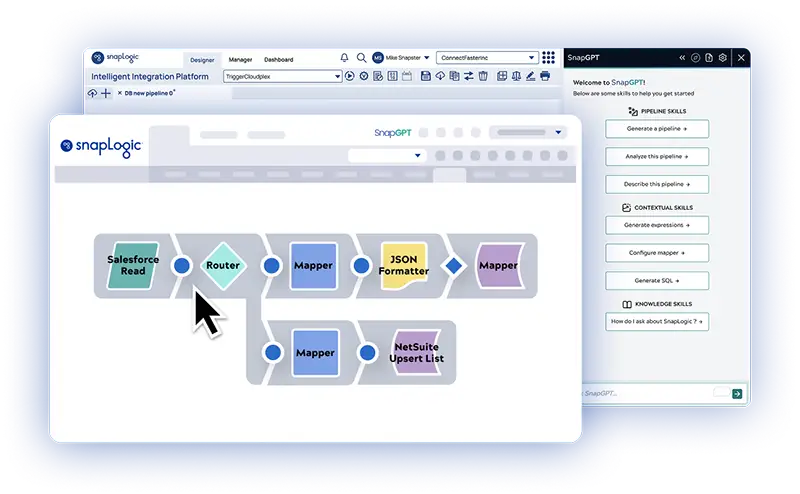
Jordan’s demo showed this vividly. We started with an augmented flow: Intelligent Document Processing (IDP) extracted a PDF into structured JSON, then paused for review. Next, we switched into an agentic flow that updated Salesforce, handled real-world failure conditions (like field length limits), and kept going without collapsing the workflow.
What made that safe wasn’t the model. It was the governed tools layer:
- Tools built once and reused across agents
- Wrapped with APIM policies and RBAC permissions
- Fully observable with trace/telemetry
And this is where MCP matters in enterprise settings. SnapLogic pipelines can act as MCP servers (exposing governed tools to any external agent) and MCP clients (calling tools hosted in outside MCP servers). That gives you interoperability without sacrificing control.
In short: safe scale comes from standardized access to tools and enterprise governance, not from hoping an LLM behaves how you think it will — and does so consistently, even in the face of messy data.
Where to go from here
If you remember one thing from the session, make it this:
Agents and augmented intelligence are complementary. The winning enterprise model is augmented where trust matters, agentic where speed matters, all governed through reusable tools and policies.
The hype cycle will keep spinning. Some agentic projects will fail. But the teams that succeed will be the ones who treat autonomy like a capability to earn, not a checkbox to buy.
If you want to rewatch the demo or share it with your team, grab the recording. And if you’re working through the “augmented vs. agentic” decision for a real workflow, I’m always happy to compare notes.