




Agentic AI is rapidly emerging across pharmaceutical, biotechnology, and medical technology sectors. Commercial teams are eager for next-best-action recommendations, medical affairs seek faster literature synthesis, and compliance teams prioritize greater visibility into HCP interactions.
While the ambition is real, the industry-wide rush for implementation often leads organizations to prioritize the AI’s “intelligence” over the critical infrastructure required to support it. This urgency risks not just failed pilots, but significant compliance and data integrity challenges that can derail progress early on.
Getting agentic AI right in a regulated industry requires treating these foundational requirements as the core of the project rather than secondary checkboxes. Here are five pillars that matter most.
1. Make the data foundation the first phase of the project
Sales activity, CRM history, call notes, medical data, and market data typically live in separate systems that don’t communicate. An AI model layered on top of that fragmentation produces confidently wrong outputs, and it does so quickly. This creates a “garbage in, garbage out” risk. In a regulated industry, a bad recommendation can result in compliance exposure.
Treating data foundation work as its own phase means mapping every source system feeding the agent, from CRM and call logs to medical and market data, and establishing clear ownership for data quality before a single agent goes live. It means agreeing on shared definitions for core entities such as accounts, HCPs, and products so that different teams feed the model consistent versions of the same fact. It means budgeting real-time and real engineering hours for this phase.
- Organizations seeing measurable value from agentic AI consistently give this phase the same rigor and resourcing as the AI layer itself.
2. Build compliance and consent checks into the decision layer
Consent and outreach frequency rules vary by country and by product line, and most pharma commercial teams already have gaps between what’s allowed and what’s actually happening in the field. Agentic AI operating at scale surfaces those gaps quickly. An agent generating hundreds of recommendations a day exposes exactly where existing rules aren’t being followed, often for the first time in a way anyone can see clearly.
The practical response is to encode consent status, contact frequency caps, and regional regulatory rules as hard constraints inside the agent’s decisioning logic itself. That means building a lookup for consent and channel preference into every recommendation step, setting automatic holds when a contact approaches a frequency cap, and giving compliance teams a live dashboard.
- Done well, this turns compliance into a proactive gate that a noncompliant action cannot pass through.
3. Route every generated message through a person
In a regulated industry, human review is the reason the technology gets to keep operating. There is a critical design distinction to maintain here: AI drafts content to drive efficiency, and human sign-off is a mandatory step before any action, such as sending an email or scheduling outreach, is actually taken.
In practice, this means building an explicit approval checkpoint into every agent workflow that touches a healthcare professional. This means routing AI-generated content through the same content management, medical, legal, and regulatory review processes already used for materials authored by human beings. It also means giving reviewers the context behind a recommendation, so they can catch a bad suggestion before it goes out.
- Programs built to last treat this checkpoint as core design from day one.
4. Plan for a multi-phase rollout, and loop in your stakeholders
A realistic path runs through a foundation phase of one to three months focused on data and infrastructure, a pilot phase of roughly six months tested against real data in a locked-down environment, and an enterprise rollout starting around month nine.
Each phase needs its own success criteria, agreed with stakeholders before it starts, so a pilot is measured against clearly defined outcomes. It means communicating early and often that a strong proof of concept is a signal to proceed carefully, and that the system still needs validation before every rep in every market gets access to it.
- Naming the foundation and pilot work as necessary engineering and putting real dates against each phase saves every AI program lead from a difficult conversation later.
5. Weigh governance maturity as heavily as model capability
Compliance and governance capability is becoming core infrastructure for agentic AI. Recent acquisition activity in the pharma tech space reflects a market consolidating around this capability.
When evaluating vendors, this means asking pointed questions before signing anything: how does the platform handle consent and regional rule differences out of the box, what audit trail does it generate for every agent action, and how quickly can governance rules be updated as regulations change. It means asking for references from other regulated customers who can speak to how the vendor’s governance tooling performed under a real audit.
- Pharma tech leaders evaluating build versus buy decisions over the next year should put a vendor’s governance track record on the same footing as its technical intelligence claims. Both matter equally in this industry.
Building a sustainable foundation for AI in pharma and bioscience
The successful adoption of agentic AI in pharmaceuticals and life sciences is defined less by the sophistication of the model than by the robustness of its supporting framework. By prioritizing data integrity, embedding compliance into the decision layer, maintaining human oversight, managing stakeholder expectations, and selecting governance-focused partners, pharma leaders can bridge the gap between experimental pilots and production-ready systems.
Organizations that treat these fundamentals as their primary mission today will define the industry’s standard of innovation, successfully running agentic AI in production, while others remain in the demo phase.
Want to see these principles in action? Dive deeper into highlights from our recent webinar, “The AI-Ready Pharma Commercial Engine,” for expert insights on navigating real-world AI implementation challenges.
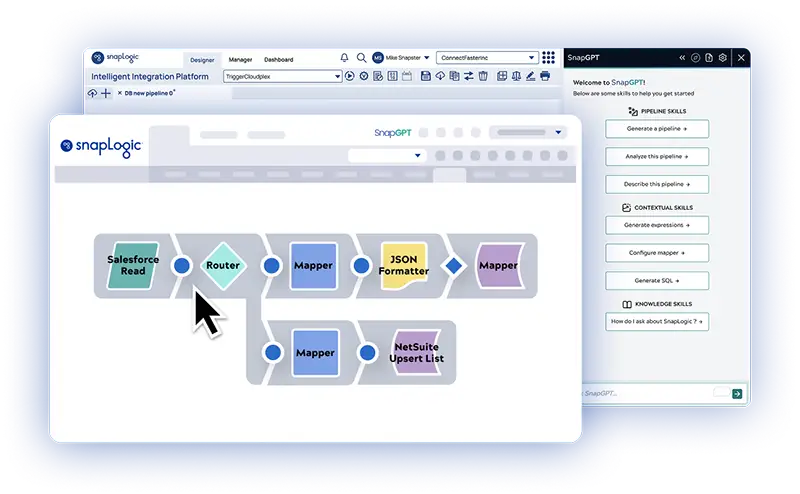
You can also take a self-guided tour of the SnapLogic platform or book a personalized demo with our team of experts.