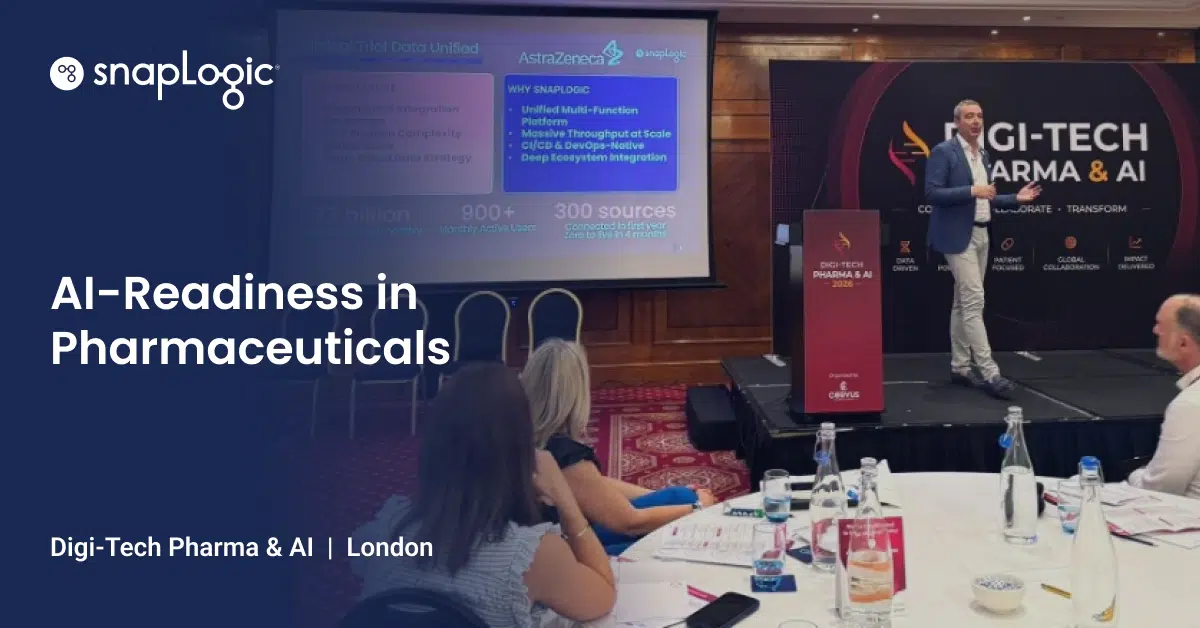





The SnapLogic team has been on the road again, this time in London, to catch up on the current state of AI in the pharmaceutical industry and explore its future direction.
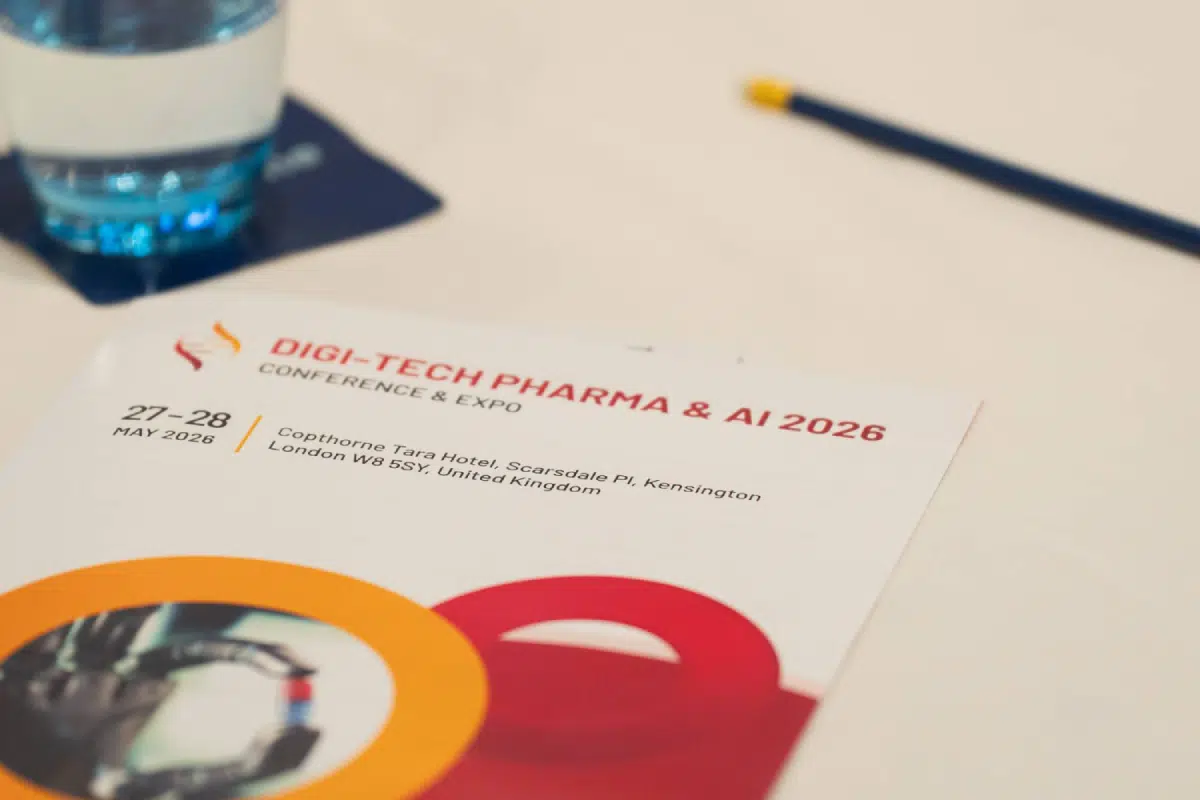
As the name implies, Digi-Tech Pharma & AI is an event focused on the pharmaceutical industry, and the opportunity and challenge of bringing AI into productive use there.
The day started with a declaration of intent, with the somewhat provocative statement from the stage that “chatbots are not AI.” I would tend to agree that many AI use cases, especially in the enterprise, are not suited to conversational interface models, primarily due to the latency introduced for any use case that requires processing a non-trivial amount of data.
The other big challenge (which was announced early on and was an unbroken thread throughout the two days of the event) was around explainability and observability. Black-box models are not sufficient, and perhaps especially not in pharma; the expectation is that any output must be documented, explainable, and auditable, including long after the fact.
What pharma needs from AI
This conversation about the specific need for governance is important because it is all too easy, when discussing projects that rely on IT as much as data integration or AI, to fall into talking mostly to IT people and mostly about IT concerns. At DigiTech Pharma & AI, the conversations were pharma conversations, between people who use IT and AI as tools in the service of some other goal, and with some very specific requirements around how those tools can and should be deployed.
Across all the industries in which SnapLogic operates, we have seen that projects originating from technology tend to fail to achieve their full potential due to a lack of a clear and concrete goal to work towards and measure against. When a new technological capability, such as the current generation of AI, emerges, it needs to be harnessed to concrete goals to succeed. This makes it important for us as technologists to listen to conversations like these, which are upstream of IT, to make sure that we are aligned with those needs.
This alignment is especially important because the deployment and scaling of AI brings new challenges over and above those it shares with previous technological waves, precisely because of how immediately capable it can be. It is all too easy for AI to fall into the gap between that elevated technical capability and the ability of the enterprise to adopt it and adapt to it.Overall organisational and architectural maturity in many organisations still lags behind technical capabilities, even where individual areas of high capability exist.
It is all too easy for AI to fall into the gap between that elevated technical capability and the ability of the enterprise to adopt it and adapt to it.
Early progress with AI in pharma
None of this is to say that the pharma industry is not leveraging AI! Over the course of the two days, we heard about many success stories, with projects in many different domains. There were:
- “Digital twin” projects, creating the possibility for in silico research
- Data sharing initiatives between industry and academia, including ways to combine local learning with shared models
- Research that was far too arcane for non-specialists like me to follow (but sounded very impressive, especially after some quick Wikipedia research to figure out at least an outline of what was being discussed)
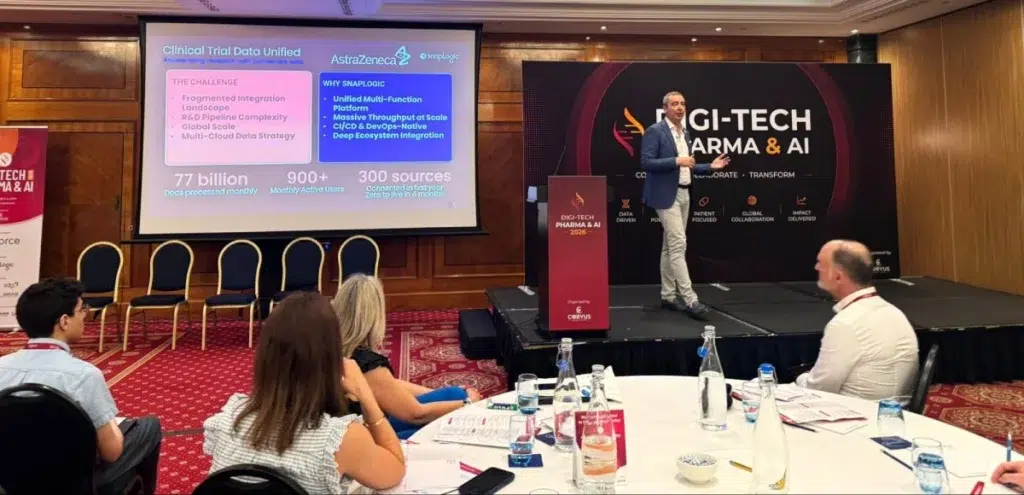
Where I was able to catch up with the conversation again was in the discussion of what had been learned from those projects, and what was required to go further. This is home ground for SnapLogic, and in fact, my own presentation was about the success of our projects with pharma customers such as AstraZeneca or Boehringer Ingelheim.
Owning data and outcomes
Exploring further the opening theme about businesses needing to take ownership of AI projects, there were many conversations about data ownership and how it integrates data into business goals and objectives. This shift does require data literacy on the part of the business, rather than ceding ownership to IT departments.
Another big area of focus was on treating AI as an enabler of new capabilities, not a static asset to be added to an inventory. This was very much in line with what we heard at the Gartner Data & Analytics event a couple of weeks ago, with the shift from ”human in the loop” to the far more empowering “human in the lead.”
This shift is important because it is the lens through which the most promising use cases can be identified. It is becoming clear that personal productivity, no matter how much it is increased with AI, is different from operational excellence.
In a pharma context, making one researcher more productive will not shift the needle on the sort of ambitions that were discussed at the conference: new treatments, developed in new ways, and delivered more universally and effectively.
Governing and auditing
Because of the sensitivity of the data being managed, whether in terms of valuable IP or of protected patient data, governance is a top-level concern. IT governance cannot be an afterthought; it must be integrated proactively in research and patient care, both pre-development and post-deployment.
Adding AI effectively into that mix requires that the entire workflow be re-examined and updated, rather than just layering new technology on top of “how things have always been done.” This deep integration is the difference between evidence strong enough to steer research in new directions, or just enough to confirm what already happened. Achieving such acceleration requires a digital backbone to connect intention to action to evidence and accelerate evidence-based decision-making.
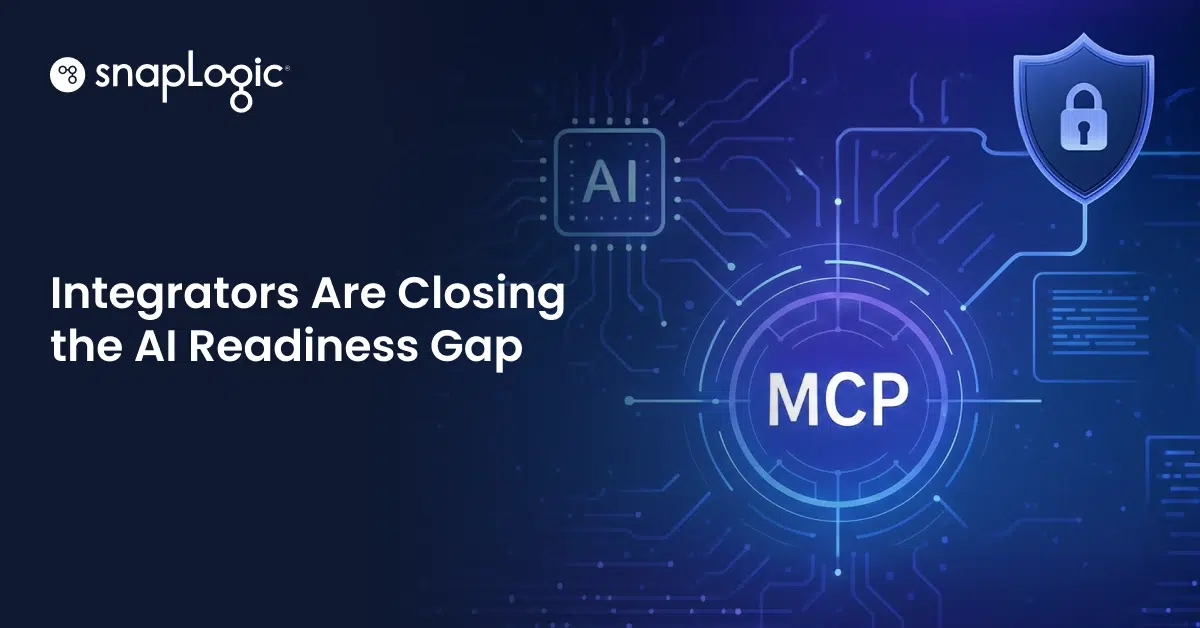
A subsidiary point is that MCP has arrived in pharma too, with several vendors presenting new ways for agents to access their offerings. This proliferation of access makes proper governance of those agentic interactions all the more crucial.
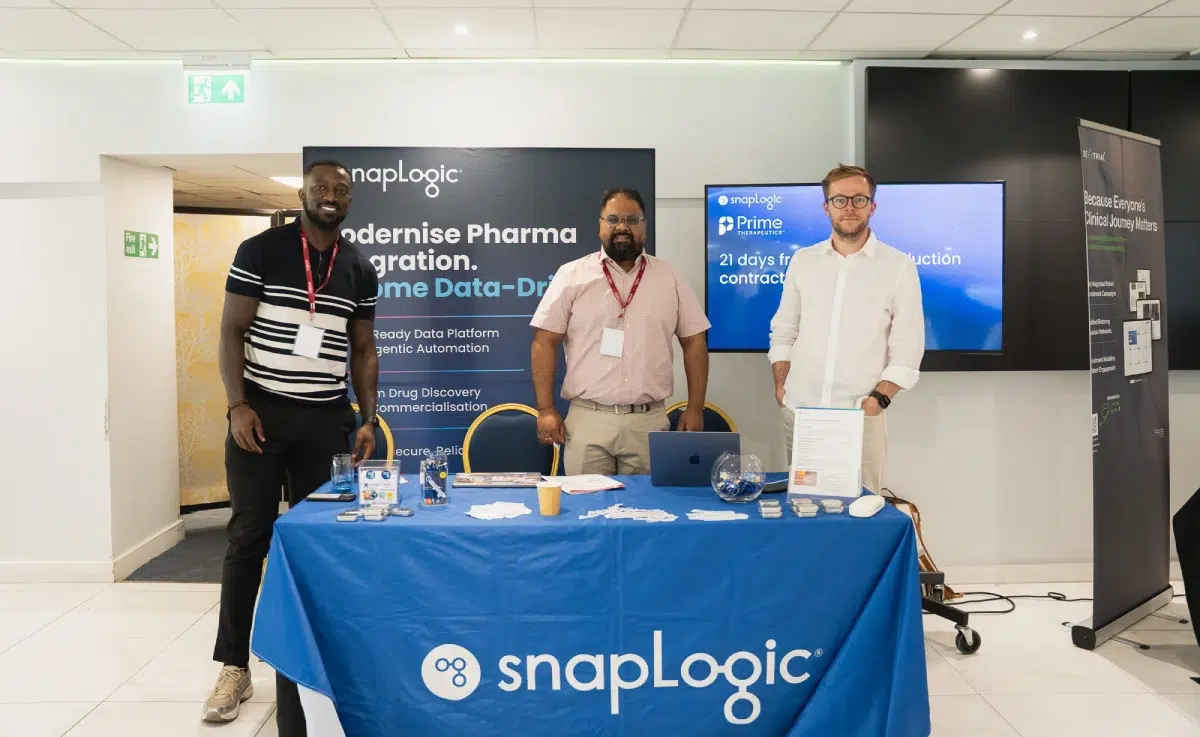
I had several conversations about SnapLogic’s new Trusted Agent Identity capabilities, which propagate users’ access credentials to agents and all the way through the chain to the tools and resources that those agents are accessing. This is important both in the moment and also over time to make it possible to audit and review what actions have been taken in the past.
For a more detailed exploration of Trusted Agent Identity, please join me and my colleague Matt Sager for an upcoming webinar about MCP governance. Register for the North America broadcast or the EMEA broadcast.
Breaking down silos
The well-known problem of disconnected IT systems is perhaps particularly prevalent in large pharmaceutical companies that have grown through mergers and acquisitions, with all of the duplication and disconnection that implies. Indeed, one presenter mentioned in passing that they were trying to join up 800 different systems, which is par for the course in this space.
The main problems of data silos that were raised over and over again throughout the conference are mostly the same as in other industries, but with some twists that are specific to pharma:
- Duplication of effort through parallel projects that are not aware of each other’s efforts
- Lack of access to existing data, whether basic research or clinical trials
- Difficulty in making data FAIR (Findable, Accessible, Interoperable, and Reusable)
The good news is that joining up silos not only addresses these concerns but also minimises the risk of investment in new digital solutions. This benefit manifests in a couple of different ways.
One is technical: the creation of the solid integrated data foundation that is key to the success of new initiatives in healthcare research and delivery that are enabled by AI.
The other is more philosophical and goes back to the point about ownership. In a disconnected environment, the focus is on ownership of a particular system or data set. A joined-up architecture enables co-design of shared tools instead of an exclusionary focus on ownership of data assets.
That collaborative approach is what delivers the acceleration in delivery that benefits everyone: the pharma companies, the healthcare providers, and of course, the patients, which sooner or later means all of us.
Wrapping up
One of the pithiest recapitulations came from Frederik Buijs at Roche, who stated:
”Data governance is required for acceleration, data literacy for scale, and data sharing for effective results.”
Between the capabilities of the SnapLogic platform itself and the advisory and consulting expertise of our Enterprise Architects and specialist partners, we are well placed to deliver on all three fronts for our customers, whether in pharmaceuticals or any of the many other industries that we serve.