



As AI development scales, new management and operational capabilities become as important as the tools to build with. The November release brings new features and extensions to existing ones to make it easy to scale the benefits of AI across an entire enterprise.
The November product release continues the work from the previous release in consolidating and extending SnapLogic’s AI features, while also continuing work on the solid platform foundations that underpin these latest developments.
As AI continues to mature and to move from isolated experiments and pilots to production roll-out at scale, one of the concerns that is frequently voiced is the risk of duplication and loss of control. The new Discovery Hub, first available in the November release, helps to address that concern. New tools have also been added to the SnapLogic MCP Server and to SnapGPT. Meanwhile, work on the platform’s foundations continues, with new features in Monitor as well as new Snaps.
See the full SnapLogic November 2026 Product Release
New: MCP Discovery Hub
The Discovery Hub is what is sometimes known as an MCP Registry: a searchable, Environment-wide catalog of published MCP Servers and their tools. By providing this visibility into resources that have already been created, the Discovery Hub helps to encourage reuse and avoid duplication. Developers can find an existing server, copy a working client config for Claude Code, Cursor, or VS Code, and connect right away.
The Discovery Hub pairs with governance and observability to form the MCP Gateway for an Environment (Org). APIM policies control access, and Monitor provides usage visibility. Authentication stays between the client and the server, negotiated per the server’s own policy.
This capability, and the need for it, represent a sign of maturity in the SnapLogic platform and in how users are building with it. A shared registry is only useful, by definition, once enough people are building and using MCP servers. But once an organization hits that critical mass, there is the risk that different people and teams may end up duplicating effort, missing out on best practices, or failing to implement organizational standards. The Discovery Hub helps avoid all of these problems by making it easy to share reusable components, avoiding wasted effort and helping everyone achieve their goals faster.
New SnapLogic MCP Server tools
November brings new tools for project renaming, task discovery, and pipeline standards validation; cleaner file tool names; async pipeline execution and validation; credential-safe task details.
These features constitute ongoing evolution of the SnapLogic MCP Server’s capabilities, underlining SnapLogic’s commitment to the development of the functionality that supports “headless” usage of the platform from within agentic development environments such as Claude Code.
SnapGPT pipeline standard checks
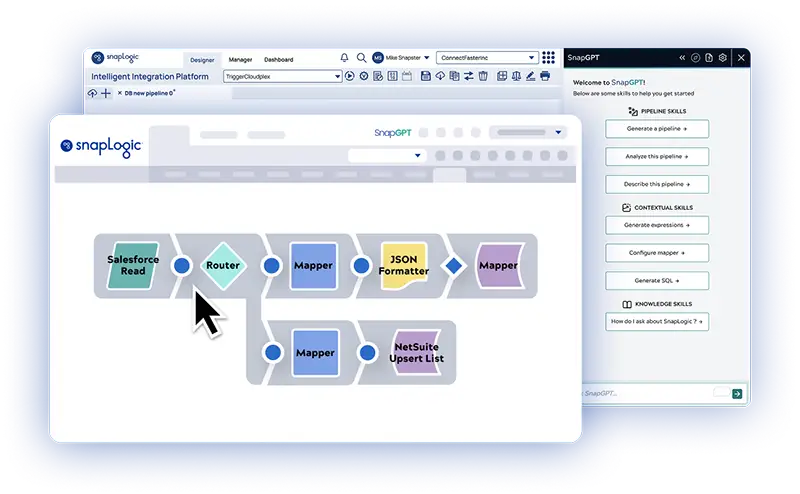
SnapGPT has supported interactive checks of pipelines against development standards for some time. This new capability enables users to check pipelines against their environment’s specific standards, analyze them with SnapGPT, and apply the recommended fixes.
When analyzing a pipeline with SnapGPT in Designer, users can apply the standards configured for that environment in Admin Manager. Users can also filter the findings by scope, level, and standard type, and apply all or some of the recommended fixes.
This new capability extends the pre-existing pipeline quality check functionality and makes it easy to enforce development standards across the organization by building the checks right into the development process itself.
Account usage in Monitor
The November release adds the Account Usage report in Monitor, enabling users to track Accounts used across pipelines and assess any impact from upgrades or other changes.
This added visibility is important for operations and security, making it possible to understand where configured credentials are used across all pipelines, making it easy to plan changes, identify any issues, and implement needed corrections.
New Snap Packs
Finally, the November release also brings new Snap Packs, which extend the reach of the AI features mentioned above:
- GitHub (Self-Managed and Cloud)
- GitLab (Self-Managed and Cloud)
- HL7
- Neo4j
These new Snap Packs expand integration capabilities, making it seamless to connect critical enterprise data sources and systems into your AI workflows.
Dive in deeper
Those are the highlights, but of course there is much more! Read the full release notes for all the details, and contact your Customer Success Manager with any questions.