




As SnapLogic customers adopt the latest AI features enthusiastically, we are continuing to build them out, focusing on ease of use and administration. The goal is to help people be productive quickly, while also ensuring that governance controls are in place to ensure that innovation is happening safely and securely.
The October 2026 release focuses on advancing agentic integration while also improving core platform functionality that underpins the agentic integration fabric. The highlights of this release are: giving SnapLogic platform administrators more control over how SnapGPT builds pipelines, speeding up API development in APIM 3.0, extending Enterprise MCP with secure single sign-on and more lifecycle tools, and adding visibility into Snap usage across your organization.
Together, these updates help enterprise teams build consistently, connect AI clients safely, and keep a clear view of what is running. Here’s what’s new.
Set the rules for SnapGPT
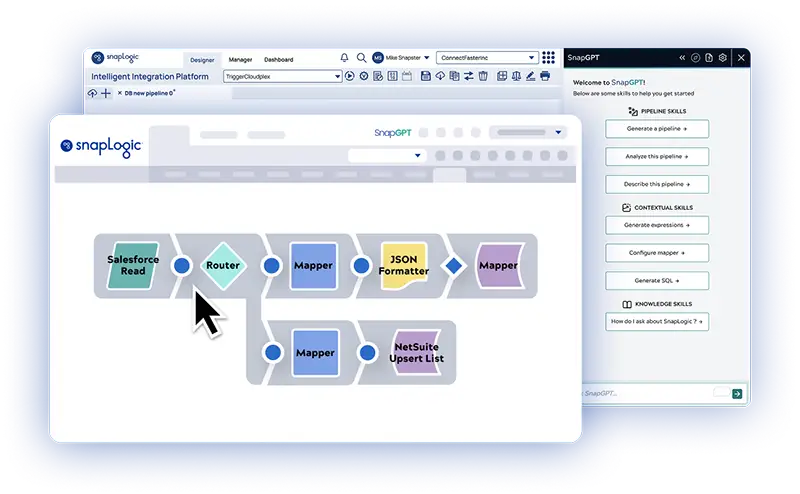
Organisations have best practices and standards they want to apply consistently as users build integrations with SnapLogic, whether to enforce standards or meet compliance requirements. To this end, environment admins can now publish Markdown-based standards in the new SnapGPT Standards tab in Admin Manager.
These standards control how SnapGPT generates or refines pipelines. SnapGPT automatically enforces Always standards for all users on every “generate” or “refine” request. Users can view the published standards and enable Optional standards for each session from the + menu in the SnapGPT panel in Designer.
API-first development in APIM 3.0
Ease of use isn’t just about the graphical user interface users see; it’s also about how many steps it takes to complete a task. Now, when you create an API Service from an OpenAPI or Swagger specification, APIM 3.0 can generate starter pipelines and tasks for endpoints.
On the Preview & Endpoint Configuration screen, you choose which endpoints to include, the task type (Triggered or Ultra/Always-On), and the target Snaplex for each endpoint. Generation runs in the background, and each pipeline includes routing, placeholder mappers, and error handling that you can customize in Designer.
The APIM category in Monitor Activity logs also captures events when you create a Service, create a Version, or publish a Service Version.
The SnapLogic Enterprise MCP Server
With the rapid adoption of MCP, users are moving beyond experimentation and starting to integrate production systems. To do that, secure authentication and expanded lifecycle tools are required to enable AI agents to perform more integration operations securely. MCP clients can now authenticate through a browser window, without embedding credentials in the client config.
This enables connection through the Anthropic Claude Connectors Directory. OAuth sessions renew automatically when the access token expires. The MCP client exchanges the refresh token silently, so long-running agent sessions continue without a new browser login.
Agents also gain new tools. Two of them, create_project_space and create_project, set up project containers in SnapLogic without switching to Manager. A third, delete_pipeline, removes a named pipeline from a project and completes pipeline lifecycle management.
The duplicate_check parameter is removed from execute_pipeline and validate_pipeline. If you submit content for an existing pipeline name, you now get a conflict error. The validate_pipeline tool also accepts pipeline_params to supply environment values during validation, and a timeout to control the polling wait.
The MCP Server feature now follows MCP specification version 2026-07-28. If the selected Snaplex does not support this version, an error message explains that the MCP Server falls back to the 2025-11-25 specification. Upgrade Snaplex nodes to 4.45.2 or later to use the latest version.
Monitor and platform enhancements
The Snap Usage report now lives in Monitor. Use it to analyze Snap usage and assess the impact of upgrades or changes by identifying which pipelines across the organization use specific Snaps and Snap Packs.
Activity logs in Monitor now include the count of users added to or removed from a group, and log Platform MCP server events such as assets, pipelines, Snaplexes, and servers. Each Monitor page also has a short description under its title that explains what you can do on the page, with a Learn more link to the related documentation.
A new public API fetches a single pipeline by its snode_id. It responds much faster than using the project export API for the same purpose.
Git Integration now supports GitHub Enterprise Cloud (GHEC) with data residency, where repositories are hosted on a custom domain such as https://company.ghe.com. Contact your CSM to enable this capability. This support also covers GHEC subscriptions without data residency.
Snap Pack updates
This release includes updates to several Snap Packs. An Environment admin can select the Snap Pack version in Admin Manager.
Salesforce
The retry mechanism across all Salesforce Snaps that use REST API, Bulk API v1, and Bulk API v2 now handles rate-limiting errors. The Snaps support HTTP REQUEST_LIMIT_EXCEEDED error responses and respect the Retry-After header when provided. If the response has no Retry-After header, the Snaps wait a default 5 minutes before retrying.
Slack
The Slack Snap Pack automatically retries requests that fail with HTTP 429 (Too Many Requests) errors and honors the Retry-After header. It also retries requests that fail because of 5xx server errors or timeouts. Redundant token validation calls were removed to reduce the number of API requests to Slack.
JWT
The JWT Snap Pack adds support for ECDSA (Elliptic Curve Digital Signature Algorithm) signing and validation. The JWT Generate Snap now supports custom headers, which lets you add the header key-value pairs required for target API authentication.
Oracle
The Oracle Insert, Update, Delete, and Merge Snaps add the Session parameter type, with support for STRING, INTEGER, and BOOLEAN data types.
Anaplan
The Anaplan Write and Anaplan Upload Snaps add support for pipe (|) and custom delimiters.
Teradata
The Teradata Snaps for Multi Execute, TPT Insert, TPT Update, TPT Upsert, and TPT Delete gain an optional Query Band field, which passes session-level query band expressions to the Teradata database for query identification and logging.
Fixes worth noting
- Scheduled Tasks run more reliably after you upgrade to 4.45. The intermittent execution failures caused by a Joda-Time NullPointerException no longer happen. To get this fix, upgrade your Snaplex nodes to 4.45.2.0.
- APIM proxies now pass the request body through on DELETE requests. To use this fix, upgrade your Snaplex to 4.45.2.0 or higher.
- When a Request Transformer rule’s header value expression returns a list (such as request.roles), the header is now always set. To get this fix, select Policies Snap Pack version 445patches36006 or later from the Admin Manager Snap Packs page.
- Infrastructure metrics in Monitor now render correctly across all supported time periods and date ranges.
More to come
Together, these enhancements help enterprises build, govern, and operate integrations as they scale their use of AI and agents. This release continues our focus on governed AI, faster development, and operational clarity. To see the full list of features, enhancements, and patches, check out the full October 2026 Release Notes from SnapLogic.
SnapLogic is on tour! Join us for IntegrateAI 2026 in your nearest city:
- San Francisco, CA | October 28 | Register for San Francisco
- London, UK | November 17 | Register for London