


Enterprise AI is moving from experimentation to execution, and that changes what organizations need from their integration platform. Building AI agents is only part of the challenge. Teams also need to connect them securely to enterprise systems, understand how they are performing, control what they can access, and operate them reliably in production.
The August 2026 SnapLogic release advances that foundation across MCP, SnapGPT, SnapCode, observability, security, and enterprise connectivity, helping organizations move agentic AI beyond pilots and into production.
MCP grows from a feature into infrastructure
MCP servers on SnapLogic are a major focus in this release. A dedicated MCP Metrics page in Monitor now tracks traffic, error rates, tool calls, and P99 latency across every deployed server, the same category of operational visibility teams expect from any production API layer. Pipelines can now be exposed directly as tools from Pipeline Properties, no wrapper Snap required, removing a layer of ceremony between having a pipeline and having something an agent can call as a tool.
The SnapLogic Platform MCP Server adds eight discovery and export tools, giving AI agents a broader view of the SnapLogic environment, from finding organizations, projects, assets, and accounts to exporting pipelines and entire projects.
A new MCP token exchange rule lets inbound tokens be swapped for tool-specific downstream credentials, following RFC 8693. For enterprise teams, this means individual tools can receive narrowly scoped downstream credentials instead of relying on broad shared access, reducing risk while preserving identity and auditability across agent-driven workflows.
Together, these capabilities give enterprises the execution, security, governance, and observability foundation required to operate agentic integration at scale. Teams get more than confirmation that MCP servers are running. They get visibility into how those servers are performing, who is calling them, and what downstream systems and tools they can access.
SnapGPT expands across the integration lifecycle
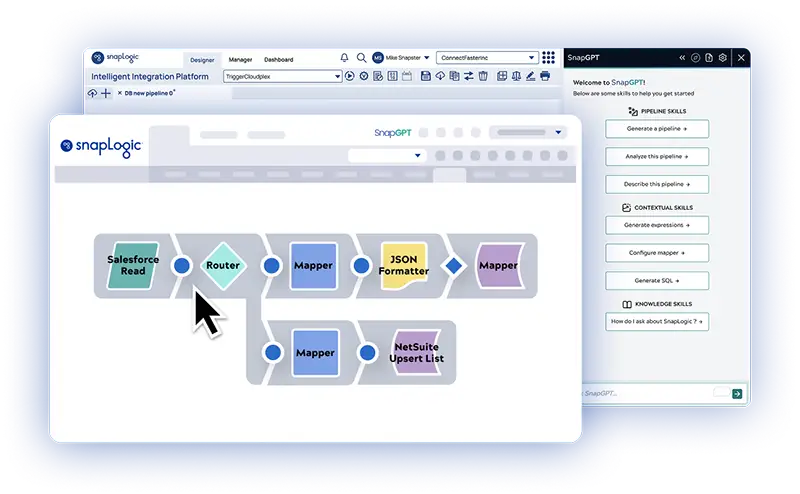
July marked the biggest evolution of SnapGPT since its 2023 launch, adding new agentic planning, generation, validation, and contextual capabilities. (See the July SnapGPT release details.) It provides deeper reasoning with Think Mode, guided requirement clarification with Plan Mode, multi-pipeline generation, complex workflow refactoring, and the ability to generate SnapLogic MCP Servers from natural language. The August release builds on that foundation by extending agentic assistance further into operations.
SnapGPT for Monitor brings AI-assisted Snaplex health checks, root-cause analysis for failed pipelines, and capacity planning directly into the operational view. This closes a gap that has existed since SnapGPT launched: operators troubleshooting failures at 2am have had no AI help until now, even as builders got AI assistance at design time.
Think and Plan modes also go further this release: they now run without needing a project context first, and can generate non-pipeline assets like test data and expression libraries. Builders can explore an idea, generate supporting test data, or draft an expression library before committing to a specific project structure. Together, these enhancements extend SnapGPT beyond design-time assistance into AI assistance across the integration lifecycle, from planning and building to troubleshooting and operations.
A new SnapGPT usage page in Monitor gives admins visibility into adoption, engagement, power users, and usage by skill, helping teams understand how SnapGPT is being adopted across their organization.
SnapCode gets easier to adopt
SnapCode brings SnapLogic integration capabilities directly into AI-native development environments like Claude Code, so developers can build applications and agentic workflows that need secure enterprise connectivity without leaving their coding environment.
In August, SnapCode becomes even easier to adopt through the SnapLogic-hosted Claude Code Plugin Marketplace, with one-command installation and HTTP-based connectivity to the SnapLogic MCP Server. The previous Docker-based distribution is deprecated, and existing users should migrate to the new plugin experience.
New Snap Packs and platform updates
Agentic AI is only as useful as the enterprise systems and data it can securely reach. The August release expands that foundation with new connectivity for Veeva Vault CRM, Zendesk, Dropbox, IBM MQ, and Open Table Iceberg environments. There is also a new ServiceNow Statistics Snap for pulling aggregate metrics without fetching individual records, useful for anyone building reporting pipelines needing a count or an average and had to pull full record sets to get it.
On the infrastructure side, Snaplex now supports JRE 21, and Asset Catalog is enabled by default across all environments, giving teams built-in visibility into their asset inventory with no manual setup required.
A Designer that finally organizes itself
The left-navigation pane in the platform Designer has been redesigned to unify discovery across Snaps, Pipelines, and Patterns, with a standardized hierarchy and real search. This consolidation removes a surprising amount of daily friction for anyone hunting across separate panels to find the right Snap or trace how a Pattern was built.
Validation gets smarter too, with new “Retry recommended” and “Start new validation” options in the toolbar, giving builders a clear signal for what to do next when something fails.
Classic Manager is officially retired in this release; Project Manager now owns asset management, and Admin Manager owns administrative functions. Splitting these responsibilities cleanly is crucial. Teams managing large numbers of projects and users have been asking for a clearer separation between what they’re building and who can access it. This release finally draws that line.
Building toward agentic integration you can trust
The Designer changes make pipelines easier to build. SnapGPT’s move into Monitor makes them easier to run. The MCP advancements make the agents built on top of them observable and governed.
As more of your integration work gets delegated to AI, whether that’s SnapGPT generating a pipeline or an agent acting through an MCP Server, the operational questions get harder: what did it change, why, and who’s accountable for the result?
This release is about making those questions answerable at the platform level rather than something each team has to solve on their own. Expect that investment to keep deepening as more of the integration lifecycle runs through AI.
See all the technical details in the August Release Notes.