




The June 2026 release helps teams build, manage, and operationalize AI-powered integrations faster. New capabilities include a guided MCP Server Builder, expanded AgentCreator support for OpenAI and Gemini, enhanced platform visibility, and a range of productivity improvements across Designer, Git, and platform operations.
Here’s a closer look at the innovations helping organizations accelerate MCP adoption, streamline agent development, and improve operational visibility across the SnapLogic platform.
Build MCP servers in minutes with MCP Server Pipeline Builder
The Model Context Protocol (MCP) has become the standard way for AI agents to connect to tools and data. SnapLogic now makes it faster and more accessible than ever to expose your integrations as MCP-compatible services.
The new MCP Server Pipeline Builder walks you through creating a fully functional MCP Server pipeline in just a few steps. Starting from a base template, you can browse and add the tools available in your Environment without touching the canvas. The result is a production-ready MCP Server pipeline built through a guided interface, ready for agents to call.
This builds on SnapLogic’s broader MCP story: the platform enables you to publish any pipeline as an MCP tool, giving enterprise AI agents structured, governed access to your data and systems at scale.
Unlike standalone MCP tooling, SnapLogic allows organizations to transform existing production integrations into MCP tools while preserving enterprise connectivity, security, observability, and operational controls.
The June release significantly shortens that path.
Smarter agent development with AgentCreator
AgentCreator gains two new Snaps in this release.
The OpenAI Responses Agent combines the Responses API tool calling with an agent execution loop, including built-in support for web search and file search. The Google Gemini Vertex Agent brings the same agentic loop capability to Vertex AI’s Gemini models. Both Snaps are designed to connect directly into SnapLogic pipelines, letting you build and orchestrate multi-step AI workflows without leaving the platform.
The Agent Visualizer now captures the System Prompt in logs, and expanding chevrons in the log diagram makes it easier to trace exactly how an agent reasoned through a task. Error messaging in the Agent Snap is also improved when a tool pipeline returns multiple records, with guidance on how to consolidate output before it reaches the LLM.
A more intuitive designer experience
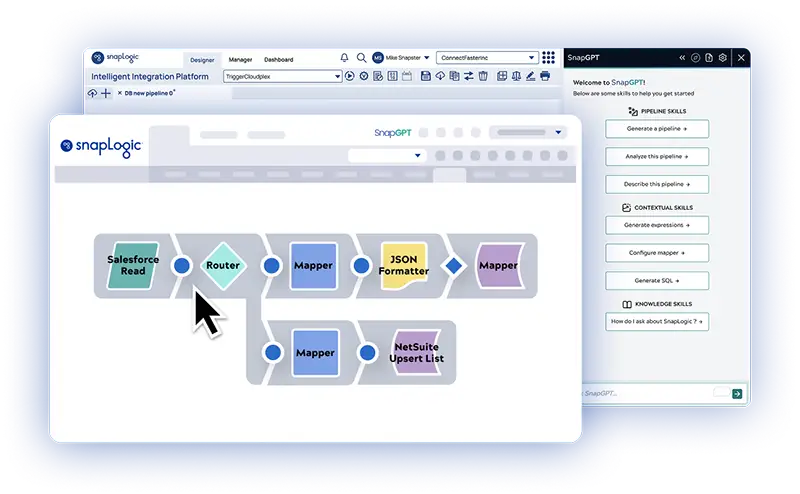
The pipeline canvas has a new persistent footer that shows the pipeline type, the Snaplex your pipeline is configured to run on, and keyboard shortcut hints without requiring any navigation away from the canvas.
Snap recommendations are now accessible directly from the right-click context menu on any Snap, with separate options for upstream and downstream suggestions. The pipeline editor tabs have been updated to a standardized style, and the canvas toolbar’s legacy Suggested Pipelines and Suggested Snaps buttons have been retired in favor of this context-menu approach.
API Management 3.0: faster navigation, sharper validation
The API Management Service Catalog and Policy Catalog now support keyword, project, owner, and tag-based search. Filters combine with AND logic and hide empty results automatically, which makes a meaningful difference when working in large environments.
Validation errors and warnings are now interactive. Clicking one opens the edit form for the relevant component, with the problem field highlighted. Finding and fixing configuration issues no longer requires navigating away from the error message.
Full visibility into your infrastructure
The Monitor’s Infrastructure page has been redesigned with a three-segment view selector: Graphs, Snaplexes, and Nodes. Switching between views carries your filter settings over automatically.
Inactive nodes are now visually distinct, displayed in greyscale when their last heartbeat is older than 15 minutes. The node details panel now breaks down disk usage into home and tmp separately.
New time presets (Last 4 weeks, Last 1 month, Last 45 days) replace the calendar picker for metric charts, optimized for the LTTB downsampling algorithm, so longer time ranges render cleanly. Pipeline execution search now accepts runtime IDs directly, and raw CSV downloads are available from the Notification Center’s alert and activity logs.
Expression Language: two functions now in the dropdown
Two commonly used Expression Language functions are now available from the dropdown instead of requiring manual input.
- Pipe.org returns your organization label as a string, making it easy to build artifact paths that stay valid when pipelines move between environments
- Task.name returns the name of the task that triggered the current execution, eliminating the need to duplicate the task name as a pipeline parameter.
Expanded Git integration
For GitHub and GitHub Enterprise Server, Git Checkout now lets you select a specific repository directory or the top-level directory rather than always starting from the root. A new public API lets you pull each Git-linked project in a project space with the latest files from its associated repository.
A new connectivity check button verifies whether an on-premises Git server is reachable and properly configured before you attempt a Git operation.
New and enhanced Snap capabilities
A new PPTX Parser Snap joins the Transform Snap Pack, enabling content extraction from PowerPoint files directly within a pipeline.
Additional enhancements across Snap Packs include:
- SSL Account in API Suite now supports expressions in Keystore/Truststore password and Key alias fields for dynamic runtime configuration
- The Zipfile Read and Decompress Snaps support the TAR.GZ format
- The Kafka Kerberos Account supports dynamic values in the Truststore Password field
- PostgreSQL and PostgreSQL Dynamic Accounts now support SSH-2 RSA, ed25519, and ECDSA key types
- Security dependencies have been updated across API Suite, Amazon Athena, ELT, Hadoop, Binary, Cassandra, Kafka, JWT, LDAP, Snowflake, Transform, SOAP, NetSuite SOAP, Birst, Workday, Xactly, and Zuora
Important reminders and deprecations
- MCP Server Preview retired: The MCP Server Preview has been retired. Please migrate any existing MCP Servers to the MCP Server Router Snap in the new MCP Server Snap Pack.
- Snaplex Ultra Scheduling: Starting with the August 2026 release, this will be enabled by default for all environments. To enable it early or confirm your status, contact [email protected].
- Classic Manager retirement: Classic Manager will be retired in the August 2026 release. Please transition to Project Manager and Admin Manager before then.
Follow along with us
The June release reflects the pace SnapLogic is setting across platform intelligence, agentic infrastructure, and developer experience. For full release notes and upgrade guidance, visit the SnapLogic documentation.