

For the past two years, enterprise AI conversations have followed a familiar pattern: impressive demos, cautious pilots, and a growing suspicion that the real value is always just around the corner. At AgentFest 2026, SnapLogic made the case that the corner has been turned.
The virtual event brought together enterprise architects, technology leaders, and real customers building production AI systems today. Not planning them, not piloting them, but running them. The central argument, repeated across every session, is that AI models alone are not enough. Without integration, governance, and orchestration, even the most powerful models stall at the edge of the enterprise.
“An AI model without integration is like a high-performance engine without a drive train. Incredible power, but it’s not moving your business forward.”
Dayle Hall, CMO, SnapLogic
From copilots to the agentic enterprise
SnapLogic CTO Jeremiah Stone opened with a reality check most in the room already suspected: industry research shows that roughly 95% of AI initiatives fail to deliver measurable, sustained P&L value. The reason is not the technology. Most AI investments have been focused on individual productivity, giving every employee a copilot. That helps individuals. It does not transform businesses.
The shift Jeremiah described is from AI as a personal assistant to AI as operational infrastructure: agents embedded in enterprise workflows, coordinating across systems, executing real work at scale.
But not every process is ready for agentic AI. According to Jeremiah, the highest-value candidates share three characteristics:
- High volume: The same steps are repeated hundreds of times a day across disconnected systems
- Data lookup intensive: Pulling from five, ten, or fifteen different systems simultaneously
- Decision support requiring contextual reasoning: Approvals, escalations, and risk assessments that previously required a human to synthesize structured and unstructured data
The future of AI in the enterprise lies in these powerful, autonomous agents, moving beyond personal assistance to become the core infrastructure driving real, measurable business transformation.
How CCB is using agentic AI to triple its lending capacity
A compelling session was hosted by David Holton, Chief Transformation Officer at Cambridge & Counties Bank, a UK specialist lender focused on SME businesses in real estate and asset finance.
David’s challenge was straightforward and painful. Brokers want same-day responses, but the bank’s manual underwriting process (covering data extraction, multiple system checks, document completion, and back-and-forth with submitters) was taking up to a week. By the time the bank responded, competitors had already closed the deal.
His goal is to grow the asset finance business from £100M to £300M a year without adding headcount, targeting a 3x capability uplift through agentic AI built on SnapLogic.
Key architecture decisions David highlighted:
- SnapLogic as the single control pane: Every agent request flows through a centralised orchestration layer, with policy enforcement and escalation logic applied consistently across the entire process
- Modular design: Each sub-agent (intake, credit, AML) is a discrete SnapLogic pipeline that can be updated, tested, or replaced without rebuilding the broader system
- Human in the loop: Deliberately kept prominent in the architecture. Agents handle the non-value-add steps; humans retain the high-value decisions and are escalated to automatically when an agent flags low confidence
- Full auditability: Everything an agent does is recorded, which is non-negotiable for UK Financial Services compliance
“Start with a problem, not a technology. Look for points of high operational friction where the benefit of reducing it is really clear.”
David Holton, CTO, Cambridge & Counties Bank
The architecture: MCP, AI gateway, and trusted agent identity
Dominic Wellington (Director of Product Marketing, Data and AI) and Roger Sramkoski (Senior Solutions Engineer) walked through the technical foundation that makes enterprise agentic AI work in practice.
Three new capabilities were announced at AgentFest:
- The AI gateway sits between MCP clients and MCP servers, handling authentication, authorization, and policy enforcement. It answers the questions that matter before any agent touches enterprise data: Who are you? What data do you have access to? Should you have access to that?
- Trusted agent identity ensures that agents act on behalf of human users, not as privileged system accounts. SnapLogic propagates the user’s authentication token from the agent all the way to core business systems, so the agent has the same access as the person it is working for.
- Enterprise-grade MCP server gives teams the ability to build a governed MCP server in SnapLogic in minutes, with a new configuration wizard, policy management that mirrors the existing APIM experience, and a dedicated asset tab in Project Manager. The live demo showed Claude querying Salesforce opportunities through SnapLogic pipelines, identifying at-risk accounts, and generating analysis and recommended next steps entirely from natural language.
SnapLogic also now has access to nearly 19,000 public MCP servers through third-party marketplaces, all instantly accessible from SnapLogic pipelines.
SnapGPT: beyond day one
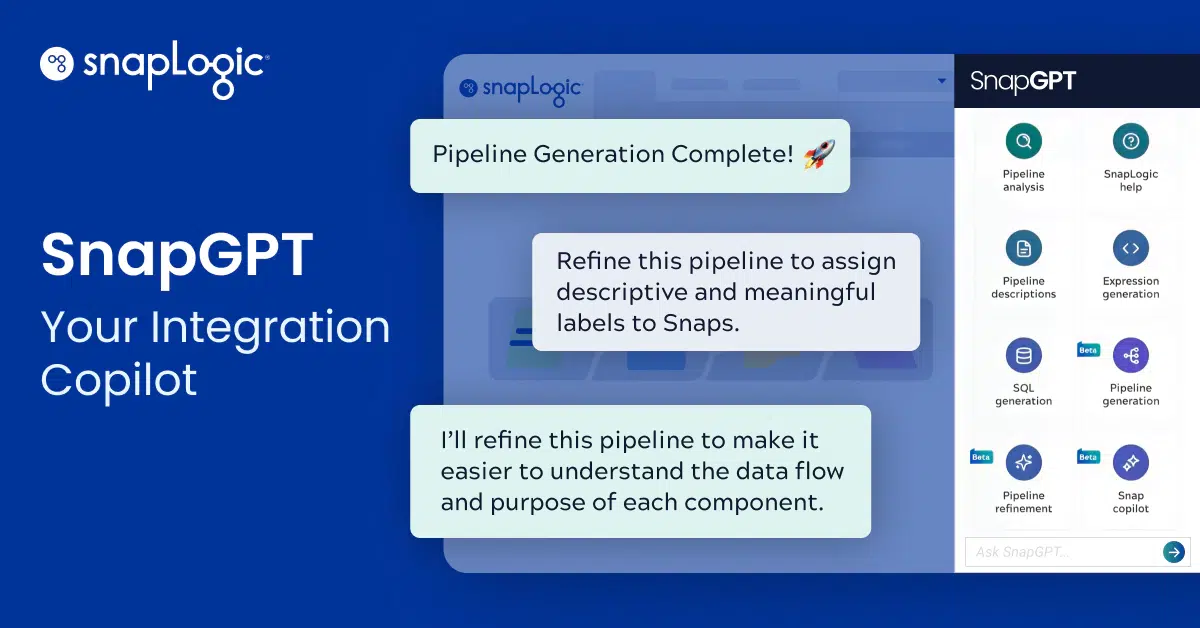
The SnapGPT session demonstrated capabilities well beyond the onboarding use case most people associate with the tool.
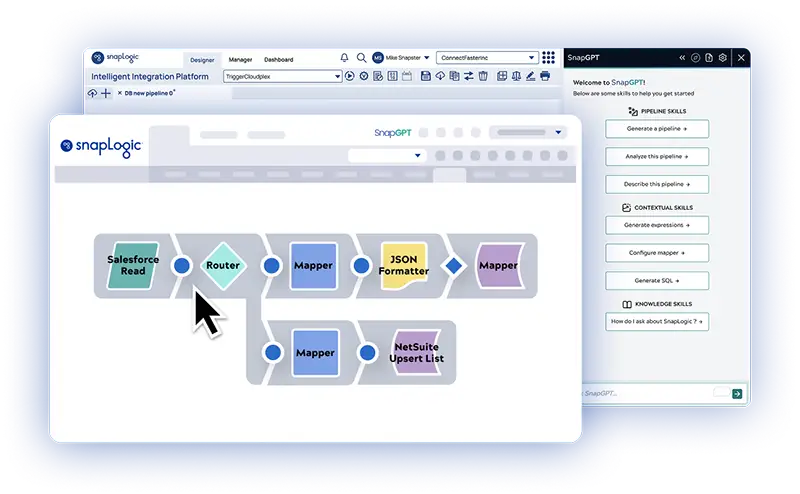
- Extended Thinking brings advanced reasoning to pipeline generation. Demonstrated by building a multi-branch Salesforce pipeline with full business logic, routing valid opportunities, near-valid records, and hygiene failures to separate Redshift tables.
- Data Insights is an opt-in feature that analyzes preview data in the pipeline and surfaces intelligence, including null fields, value ranges, compliance flags, and suggested business rules. The demo showed it automatically identifying that close dates in a dataset ranged from 2020 to 2026 and recommending a filter, without being asked. This is SnapGPT operating as a power-user tool, not a guided tour.
One telling data point: the most-used SnapGPT prompt in 2025 was “Describe the pipeline.” That is not a day-one user question. It is what an experienced developer asks when they inherit someone else’s work. The tool has grown up.
The panel: what’s really changing in enterprise AI
Moderated by SnapLogic President Molly Matthews, the closing panel brought together Hal Hallsson (Principal Enterprise Architect, Bison Transport), Sri Raghavan (Enterprise Strategy, AWS Tech Partnerships), and Mukta Agarwal (Client Partner, Government and Financial Services, Cognizant).
On AI copilots: Over 75% of developers report improved productivity. But copilots excel at repetitive, well-documented tasks. Legacy systems, complex, undocumented environments, and genuine strategic thinking remain firmly in human territory. Sri noted that AWS is building Kiro, an agentic AI-powered IDE, specifically to help bridge the gap for production deployments.
On governance: Traditional governance tracks users. Agentic governance must treat autonomous agents as digital labor, assigning them unique identities, clear boundaries, and continuous runtime monitoring. Hal shared that Bison Transport’s shift to event-driven integration forced a complete rethink of how governance worked, and that SnapLogic brought best practices they could adapt rather than build from scratch. Projects that previously took two years now take months.
“Governance is what traffic rules are for driving. It is not the car. It is the system that ensures you are driving safely in the right manner.”
Mukta Agarwal, Client Partner for Government Regulatory & BFSI, Cognizant
On talent: All three panelists agreed that AI is not replacing people; it is reshaping what people need to be good at. Mukta noted that Cognizant is prioritizing domain expertise and architectural thinking over raw technical skills. Sri introduced a new term: they are now hiring “strategy-tects,” people who combine the thinking of an architect and a strategist. The business problems have not changed. The ability to orchestrate the right tools to solve them is what matters now.
On the three-year view: Sri predicts that world-class integration teams will be defined by their ability to orchestrate human-agent collaboration at scale, with approximately 80% of the work sitting in process redesign and 20% in technology implementation.
An internal agent success story
The big release this year was Jean-Paul, SnapLogic’s own internal AI business agent. Jean-Paul runs in corporate Slack, connects to 15 internal systems, and has access to 45 tools. The internal results: a 30% increase in sales productivity, mapping to a 37x return on investment.
Jean-Paul queries Salesforce, Zendesk, SnapLogic’s platform analytics, ZoomInfo, and more simultaneously, producing account reports and analysis that would previously have required a specialist and several hours. It is SnapLogic’s own proof of concept, and it has been in production for months.
Winning the next phase of AI adoption
“The missing layer in enterprise AI is not intelligence. It is execution. And execution requires orchestration.”
Jeremiah Stone, CTO, SnapLogic
The companies that win the next phase of AI adoption will not necessarily be the ones with the best models. They will be the ones that connect those models to real systems, run them in real workflows, and govern them with real controls. SnapLogic is the agentic integration platform built to make that possible.
Ready to learn more? Take a self-guided platform tour or book a personalized demo today.