



Amid the industry focus on scaling artificial intelligence, many financial institutions are losing sight of a core purpose of technology: to strengthen customer relationships.
In a recent podcast, SnapLogic CMO Dayle Hall sat down with David Holton, Chief Transformation Officer at Cambridge & Counties Bank, to talk about what transformation really looks like inside a modern financial institution.
For a bank like Cambridge & Counties, that means using AI and automation thoughtfully, freeing employees from low-value manual work so they can spend more time where it matters most: with customers. Here are a few of the biggest takeaways from the conversation.
Keep the customer, not the technology, as the north star
One of Holton’s clearest points was that technology is an enabler, not the end goal. It’s easy to get caught up in the tools, but what matters is whether or not they’re actually improving business processes and driving better customer experiences.
That philosophy shapes how the bank is approaching AI. The focus is on using it to handle the “necessary waste” in banking operations (e.g., manual data handling, compliance steps, and repetitive internal work, etc.) so teams can focus on higher-value interactions.
As Holton put it, “No customer has ever thanked us for transposing their data.”
Customers value advice, responsiveness, and trusted relationships, not the administrative work behind the scenes. AI’s role is to automate that invisible work so teams can focus on meaningful customer interactions.
Use AI to create more space for human connection
At Cambridge & Counties, being human-first is not a reaction to AI. It is already part of the bank’s DNA.
Holton made it clear that the goal is not to replace people. It is to be more intentional about where people add the most value. Customer conversations, judgment, and relationship-building should stay human. The repetitive work happening behind the scenes is where AI can make the biggest difference.
A customer exploring a new loan, for example, may want to talk through a complex situation before filling out an application. That conversation is valuable. It builds trust and helps the bank better understand the customer’s needs.
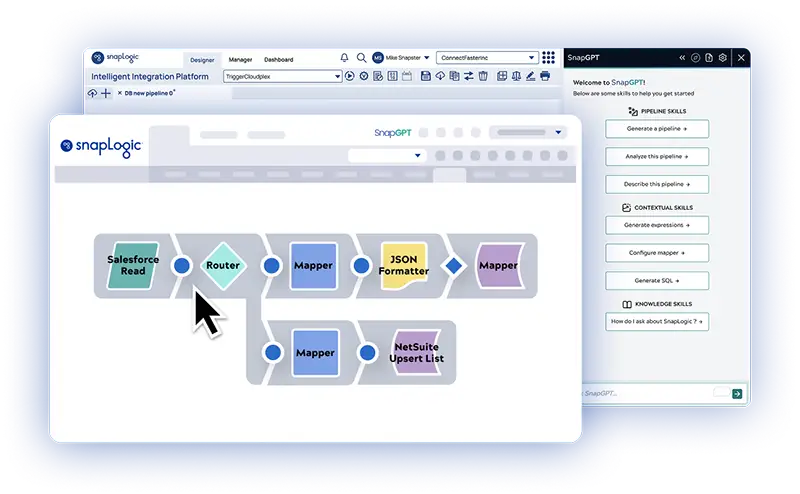
By contrast, moving data from one system to another or performing repetitive checks in the background is exactly the kind of work AI should handle. And where SnapLogic’s integration and automation capabilities are already at work for Cambridge & Counties.
Rethink the vendor relationship
Another strong theme in the conversation was Holton’s view of how technology vendors must evolve. In a rapidly evolving AI environment, traditional implementation models often fail to meet expectations.
Instead of fixed scopes and rigid deliverables, he sees more value in partnerships built on shared outcomes, shared risk, and the ability to adapt as needed. His advice to vendors was equally clear: show up with honesty, humility, and confidence.
Dayle’s response at the end of the podcast captured it well: “We may be a half page ahead of you, but we’re in it together.” That kind of shared-journey mentality, Holton argued, will define which technology partners thrive over the next few years.
Don’t automate bad processes
Holton made a simple but important point: process rationalization has to come before automation. If part of a process is inefficient or unnecessary, digitizing it just makes the problem move faster. He says it’s time to go back to workshops, map the process, talk to the people who know it best, and identify what truly adds value for the end customer.
It may sound old-school, but it is exactly the kind of discipline that makes transformation stick. It’s also a prerequisite for getting real value from integration platforms like SnapLogic. You want to automate the right things, not just the current things.
Govern AI like a digital colleague
In a regulated industry like banking, governance is central to how AI is put into practice.
Holton described AI agents as almost like digital colleagues: systems that need oversight, retraining, quality checks, and clear guardrails. One approach the bank is taking, working alongside SnapLogic, is breaking work into smaller, more defined agents rather than relying on one broad system to do everything. That makes the technology easier to understand, manage, and audit.
And as Holton noted, one of the advantages of the solution they’re building with SnapLogic is that “the auditing is real-time,” giving the bank more visibility into agent behavior than it would have had with workers doing the same tasks manually.
It is a thoughtful reminder that successful AI adoption is not just about what the technology can do. It is about how responsibly you put it to work.
A more human vision for AI
What stood out most in this conversation is that Cambridge & Counties Bank is not chasing AI for AI’s sake. The focus is on using it to improve the experience for both customers and employees.
For Holton, the future is not about replacing people. It is about giving them more time to do the work that customers actually value. And in a moment when so many AI conversations are focused on speed and scale alone, that human-first approach feels both practical and worth paying attention to. Listen to the podcast for the full conversation.
Want to hear more from David Holton and Dayle Hall? They are both speaking at AgentFest Virtual Summit 2026 on April 16. Register to get the production blueprint for Agentic AI.