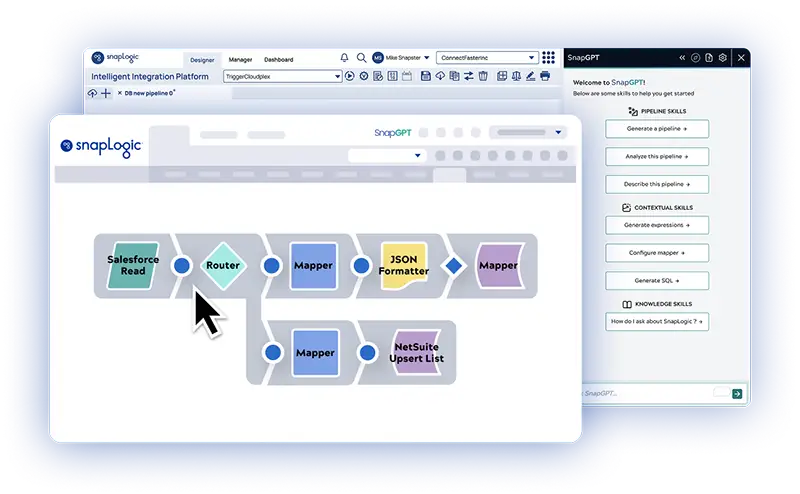





Our latest release runs the gamut of features, from 30x faster pipeline startup to enterprise-grade AI governance and a suite of new platform capabilities.
The SnapLogic May 2026 release marks a major step forward for the Agentic Integration Platform, with meaningful improvements across performance, AI capabilities, governance, and connectivity. Here are the highlights.
Performance: up to 30x faster pipeline startup
The Cache Service is now generally available (GA), reducing pipeline startup time by up to 30x. It works by caching asset references locally, cutting dependency on the control plane, and accelerating execution. An additional benefit is to increase resiliency and availability, especially where latency is a key concern.
The GA release adds auto-refresh for pipelines and accounts, so your cache stays current without manual intervention. This is an opt-in feature. Customers who want to enable it should reach out to their CSM.
AI and agents: MCP server, trusted agent identity, and smarter pipelines
This release brings significant new capabilities for AI-native integration, extending SnapLogic’s Agentic Integration Platform with MCP enhancements, stronger identity and security controls, and a set of quality-of-life improvements that make building and managing AI agent pipelines faster and more intuitive.
MCP server enhancements
SnapLogic’s MCP Server enables you to transform any pipeline into a callable tool for AI models through the Model Context Protocol (MCP), a standardized protocol for AI agent integrations.
With the MCP Server, you can:
- Expose pipeline functionality to any AI agent, regardless of where it was built
- Configure authentication, authorization, traffic shaping, and header transformation through the Policy Manager
- Choose between Triggered or Ultra execution modes
- Monitor all MCP Server requests and pipeline executions via a dedicated MCP Metrics page in Monitor
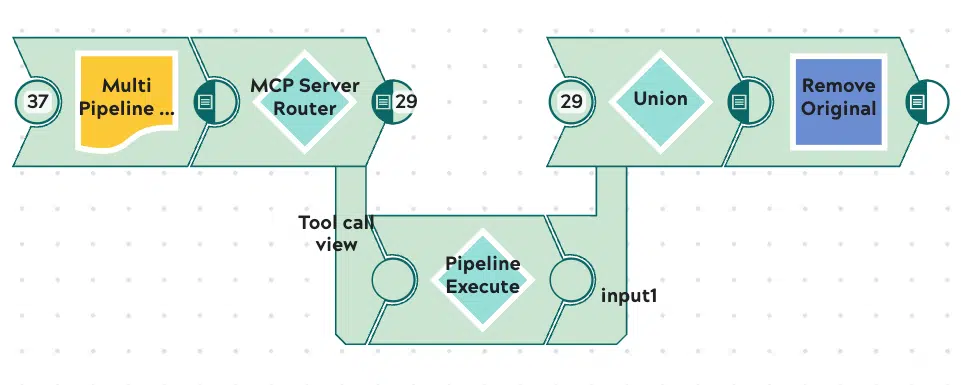
If you have been using the preview of the MCP Server to experiment with this feature, please do upgrade promptly, as there are some significant differences between this GA version and the preview.
OAuth2 and trusted agent identity
The MCP Server includes built-in OAuth2 support (Client Credentials and JWT Validator), integrated with SnapLogic’s Trusted Agent Identity capability. When an AI agent acts on behalf of a user, it carries that user’s specific identity and permissions.
Token propagation ensures the end-user’s identity flows through every layer, from the agent to the integration to the backend system, making every action fully secured and auditable.
Automated agent tagging
Pipelines are now automatically tagged as Agent or MCP Server pipelines based on their contents. Any pipeline using Agent Snaps is tagged as an Agent pipeline; any pipeline with an MCP Server Router Snap is tagged as an MCP Server. This makes it significantly easier to manage and discover your growing library of AI-ready tools.
Dynamic account passing
Agent Snaps can now use OpenAPI endpoints and APIM services as tools by dynamically passing account information as pipeline parameters, eliminating hardcoded credentials and enabling more flexible, reusable agent architectures.
SnapGPT insights: AI-powered analysis at design time
The May release brings SnapGPT closer to the data and the people who work with it, with new capabilities that make AI assistance smarter at design time and more transparent across the organization.
Preview data insights
You can now ask SnapGPT to analyze the preview data from any Snap directly within the Designer interface. Here’s how:
- Right-click a Snap
- Select Get Preview Data Insights
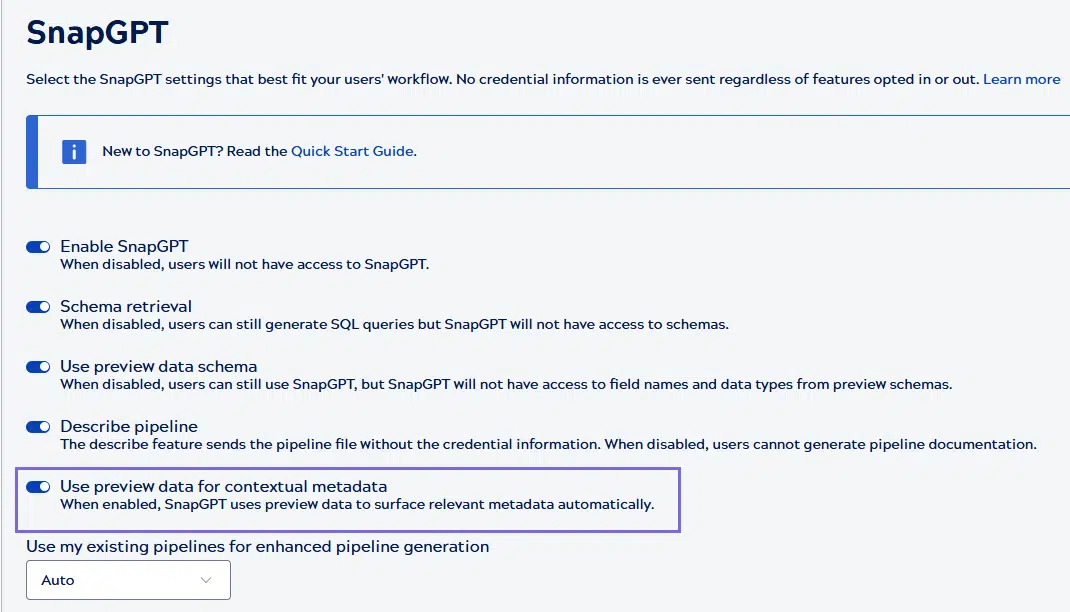
And SnapGPT surfaces key fields, business rules, and PII considerations based on your actual runtime data. These insights are then used as context when generating or refining pipelines, producing more accurate, data-aware outputs.
This feature requires the Use Preview Data for contextual metadata toggle to be enabled in SnapGPT settings. Admin opt-in is required, as preview data can contain sensitive information.
Full SnapGPT audit logging
All SnapGPT interactions are now fully logged. Environment admins can retrieve up to 45 days of SnapGPT usage events via the Public API, covering pipeline generation, pipeline analysis, expression configuration, Snap refinement, and Q&A. Activity logs in Monitor have also been updated to surface these events in real-time.
AI gateway: centralized governance for agent traffic
AI Gateway provides a centralized layer for authentication, authorization, and traffic throttling across all AI interactions on the SnapLogic platform.
Combined with the dedicated MCP observability dashboard, it provides enterprise teams with real-time visibility into how agents interact with your systems, along with the necessary controls to operate AI at scale safely.
Learn more in the press release: “SnapLogic Announces AI Gateway and Trusted Agent Identity to Power the Era of Digital Labor.”
Platform and connectivity: JRE 17, Bitbucket SSH, new Snaps
SnapLogic has shipped a set of platform and connectivity updates that strengthen the foundation beneath your pipelines, expand what you can connect to, and make the Designer experience noticeably easier to work in.
JRE 17 support
SnapLogic now supports JRE 17. The May Snaplex version includes JRE 17 bytecode alongside JRE 11. No action is currently required from customers, but this sets the foundation for future performance and security improvements.
Bitbucket SSH authentication
The Git integration for Bitbucket Data Center now supports SSH-based authentication, addressing a longstanding limitation, as Bitbucket Data Center does not currently support token-based Git authentication.
New Snaps
The May release expands SnapLogic’s Snap library with five new additions that broaden support for document conversion, EDI standards, database operations, and data validation. New in this release:
- HTML to PDF Converter: convert HTML content to PDF directly within your pipelines
- EDIFACT Snap Pack: parse and format EDIFACT EDI documents with dedicated EDI Parser and EDI Formatter Snaps
- Databricks Execute Snap: support for batch execution in Databricks
- PostgreSQL Bulk Upsert: high-throughput upsert operations for PostgreSQL
- XML Validator: validate XML documents against an XSD schema
Designer improvements
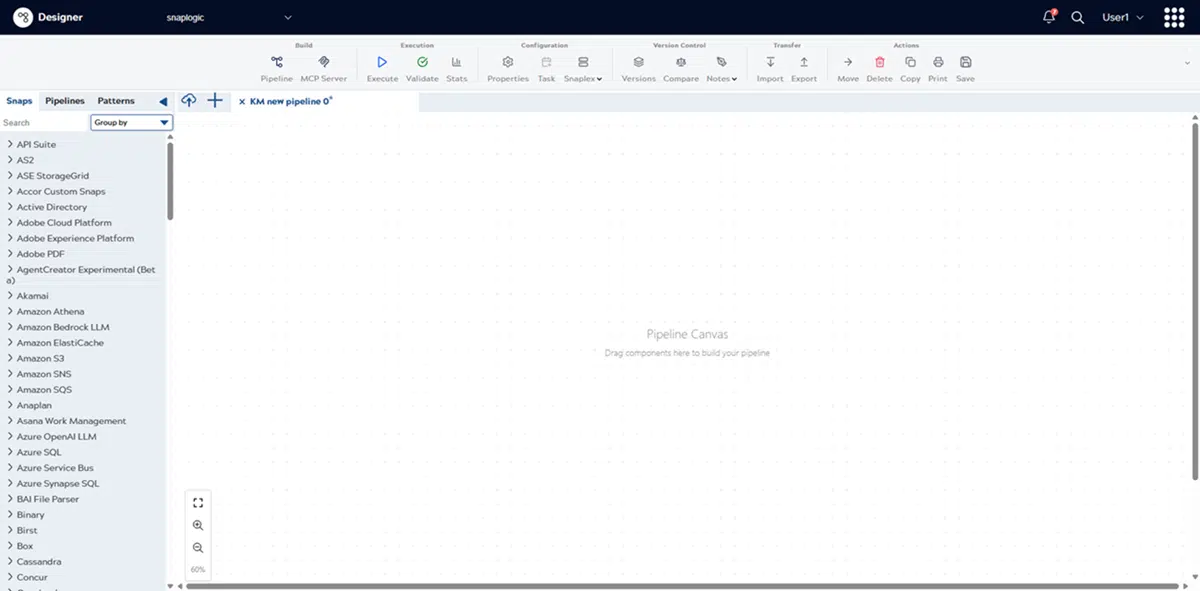
The Designer canvas has been updated with a dot-grid background for improved alignment and spatial awareness, new zoom controls, and a minimap to help you navigate large pipelines quickly.
Start exploring what’s new
The May 2026 release is now available. To enable the Cache Service or learn more about MCP Server configuration, contact your CSM.
Join us on June 10 for a discussion on “Governing AI Agents: Secure Access, Identity, and Control at Enterprise Scale.” Register for the North America broadcast or the EMEA broadcast.