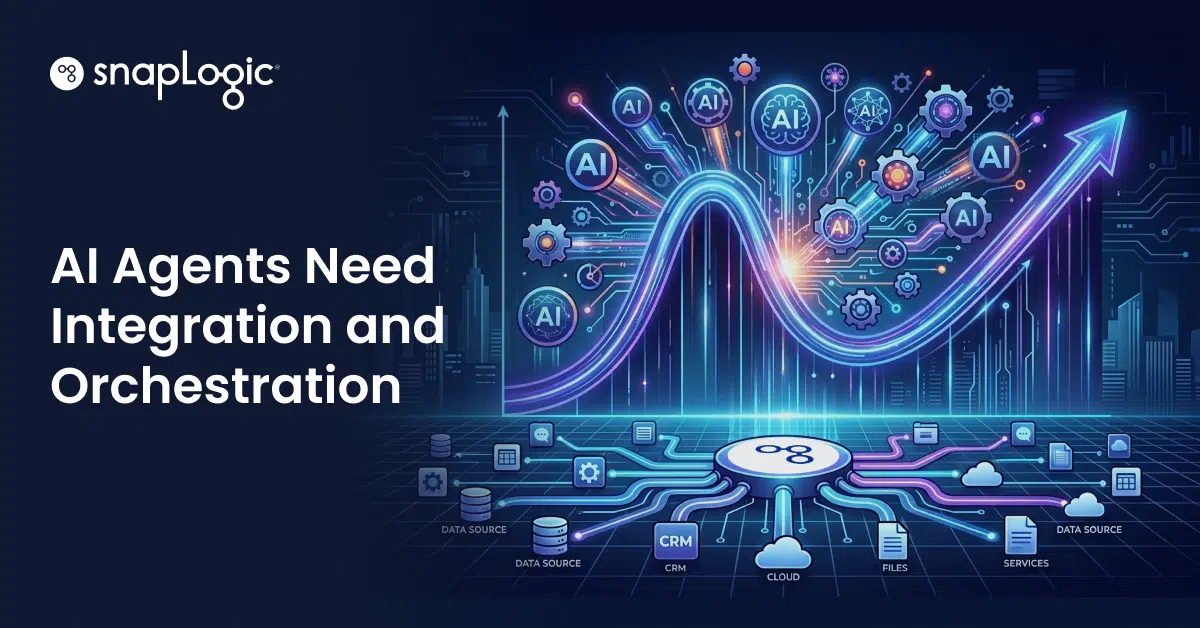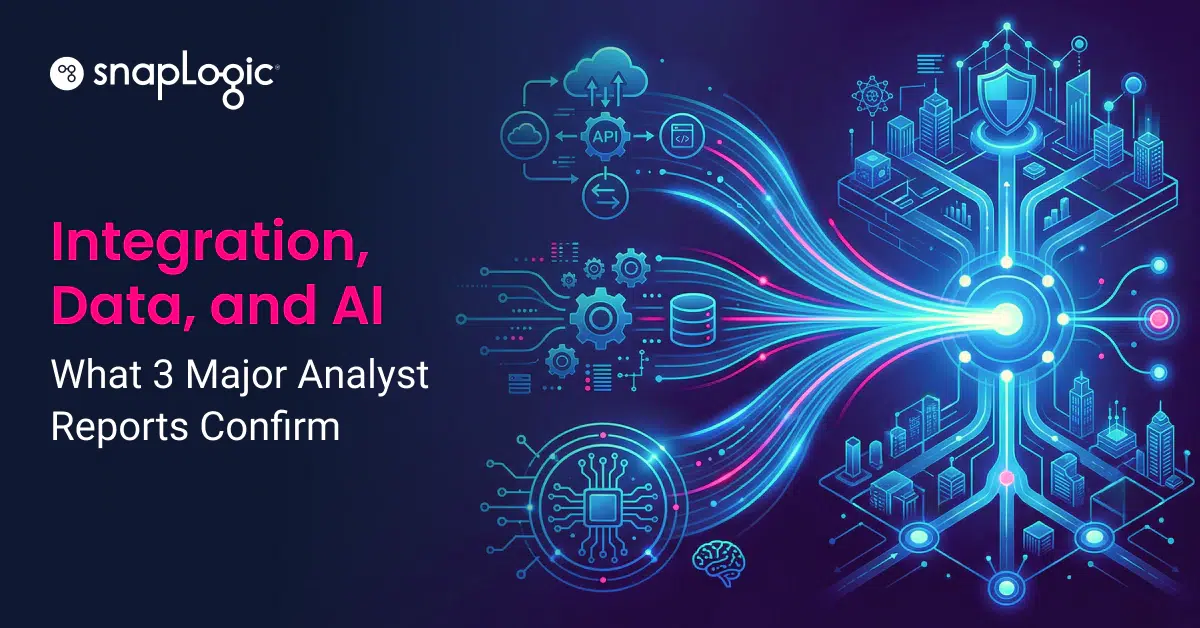



New Gartner data shows enterprise AI agent adoption is at an inflection point. Integration is what determines whether those agents actually deliver.
There’s a moment in every technology cycle when the hype stops being hypothetical and starts becoming real. For AI agents, that moment is now.
Gartner’s April 2026 Hype Cycle for Agentic AI delivers a clear signal: enterprise adoption of AI agents is approaching an inflection point. And the organisations that move first, and move smartly, will define competitive advantage for the next decade.
But there’s a catch. The Gartner data reveals something critical that many AI vendors would rather you overlook: building an agent is the easy part. Making it work inside a real enterprise is where the real battle is fought.
- 17% of organisations have deployed AI agents today
- 42% plan to deploy within the next 12 months
- 22% will follow in the subsequent year
Run the maths: within two years, roughly 80% of enterprises will have AI agents in production. That’s a massive shift. And with that volume of deployment comes a serious challenge that the market hasn’t fully grappled with yet.
From automation to transformation
Gartner is candid about where enterprises currently stand. The majority of organisations deploying AI agents today are using them to automate existing workflows, essentially replicating what humans already do, but faster and without headcount. That’s valuable. But it’s not a transformation.
The real opportunity that Gartner signals is coming is process re-engineering. Not “do the same thing, but with an AI doing the typing.” But rather: “Redesign the process entirely around what agents can do that humans cannot.”
That shift requires something fundamentally different from building another chatbot on top of a single system. It requires deep, reliable connectivity across the enterprise data and application estate.
“Integration and deployment are where agentic value is realized and scaled. Agents rarely operate in isolation.”
Gartner, Hype Cycle for Agentic AI, April 2026
This is not a peripheral observation. It is the central structural challenge of the agentic era.
Four forces driving adoption, and the one shared roadblock
Reading across the Gartner report, four pressure points stand out for enterprises moving toward agentic AI deployment:
- Pressure to grow output without growing headcount: the rise of digital labour as a strategic priority, not just a cost reduction exercise
- The need to integrate disparate systems: decades of technology investment have left enterprises with fragmented data estates that agents need to navigate
- Rapid advances in LLM capabilities: the underlying models are becoming genuinely capable of multi-step reasoning and tool use at scale
- Competitive pressure: first movers are already extracting advantage, creating urgency for those still evaluating
Look carefully at that list. Every single driver has an integration problem at its core. You cannot deliver digital labour if your agents can’t connect to Workday, SAP, Salesforce, and ServiceNow simultaneously.
You cannot integrate disparate systems without an orchestration layer. And you certainly cannot compete if your agents are operating in isolated silos, unable to access the data that makes them intelligent.
“Their impact depends on how well they can connect, collaborate, and build on existing digital investments.”
Gartner, Hype Cycle for Agentic AI, April 2026
Agent sprawl is creating an orchestration gap that enterprises can’t ignore
Here’s the scenario that keeps enterprise architects awake at night:
AI agents are proliferating across business units. Sales has an agent. Marketing has an agent. Finance has an agent. IT has several. HR is building one. The development teams are deploying agents to monitor infrastructure.
Each of these is individually useful. Collectively, without governance, they become a liability.
“Without orchestration, AI agents will sprawl across the enterprise and become chaotic and unmanageable, limiting business impact.”
Gartner, Hype Cycle for Agentic AI, April 2026
This is not a theoretical risk. Gartner is describing something that is already happening inside early adopter organisations and will happen at accelerated velocity as that 42% wave of new deployers arrives over the next twelve months.
The control point in agentic AI is not the model. It is not even the individual agent. The control point is the orchestration layer, which determines what agents can see, what they can do, what they can access, and how they interact with one another and with the surrounding systems.
A fragmented market
Gartner’s analysis of the orchestration and multi-agent coordination space reveals something striking: it is fragmented. There is no dominant vendor. The named players in this space represent an ecosystem that is still forming, still finding its shape.
The current report names a range of specialist and SI-led players, including IBM and Capgemini, as examples, representing an ecosystem that is still in formation. In our view, notably absent is a single dominant platform with the integration depth, API connectivity, and enterprise deployment track record to own the category end-to-end.
That absence represents a market gap. And market gaps of this size, in technology cycles moving this fast, close quickly.
The question enterprises should be asking is not, “Which agent platform should we evaluate?” It is, “Who can connect our agents to the systems and data they actually need, at enterprise scale, with the governance our risk and compliance teams require?“
Why integration is SnapLogic’s home turf
SnapLogic has spent fifteen years solving precisely the problem Gartner has now identified as the defining challenge of the agentic era — data integration, application integration, and API management — delivered through a unified enterprise platform that serves as the connective tissue of the enterprise technology stack.
That is not a pivot. It is the accumulated capability that already delivers the unified integration, orchestration, and governance platform required to operationalize agentic AI at enterprise scale.
SnapLogic’s position is straightforward: the enterprise already has the systems, the data, and increasingly the agents. What it lacks is the orchestration layer that makes them work together. SnapLogic is that layer, built for the complexity, scale, and governance requirements that define real enterprise deployment, not proof-of-concept demonstrations.
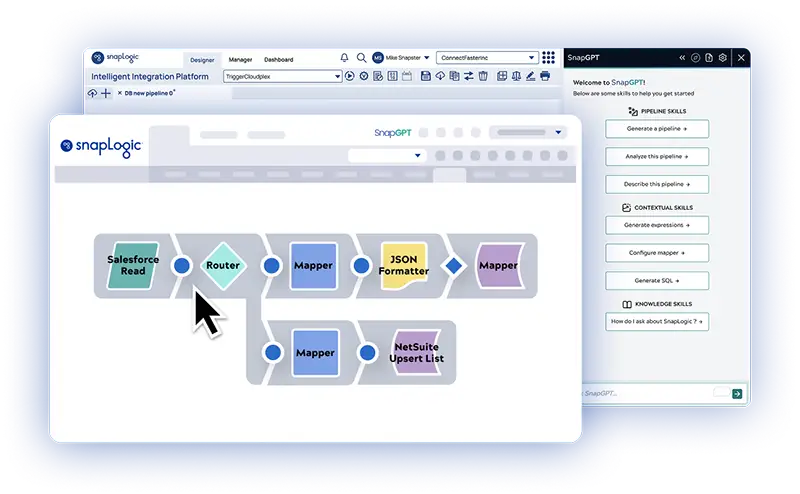
The SnapLogic platform connects agents to hundreds of enterprise systems, not through bespoke integrations built for each use case, but through a unified orchestration layer designed for scale. When an agent needs to pull data from a data warehouse, trigger an ERP workflow, update a CRM record, and log an action in an ITSM system in a single coordinated sequence, that is an integration problem. And that is exactly what SnapLogic was built to solve.
SnapLogic runs on SnapLogic
SnapLogic built an AI agent for its own GTM teams, running on its own Agentic Integration Platform and deployed directly into Slack, where its teams already work.
It is not a reference architecture or a product roadmap slide. It is a deployed, production-grade agentic system running across sales, customer success, and technical operations, a working demonstration of what the platform makes possible, built and operated by SnapLogic before recommending it to any customer. The agent, Jean-Paul, has since become part of the team.
Connected to more than 40 enterprise systems across the business, Jean-Paul delivers real-time intelligence, automates workflows, and supports decision-making at scale. QBR preparation that previously took a full day now takes 20 minutes. Pre-call research that took hours takes minutes.
Jean-Paul exists to answer a question that enterprise CIOs increasingly need answered: “What does agentic AI actually look like when it works?” The answer looks a lot like an enterprise integration platform with agents built on top.
SnapLogic provides the platform on which enterprise teams build, deploy, govern, and scale their own agents, connected to the systems that matter, with the controls that compliance requires.
What enterprise leaders should do
The Gartner data creates a clear imperative. If 80% of enterprises will have AI agents in production within two years, the organisations that deploy effectively will have established orchestration infrastructure before the wave hits. Those who don’t will spend the subsequent years unpicking agent sprawl.
Three actions stand out for enterprise leaders evaluating their agentic AI posture:
- Treat orchestration as a first-class concern, not an afterthought. The agent is the use case. The orchestration layer is the enterprise capability. Fund and resource accordingly.
- Audit your integration estate before scaling agents. Agents are only as intelligent as the data and systems they can access. Gaps in integration become gaps in agent capability.
- Establish governance before sprawl sets in. The 17% who have deployed agents today are already learning this lesson. The 42% arriving in the next twelve months should learn from them, not repeat the experiment.
The window to establish an orchestration-first approach is open. But as the Gartner data makes clear, it will not stay open indefinitely. The enterprises that win in the agentic era will be those that move from agent experimentation to orchestrated, governed, enterprise-grade deployment, and they will need an integration platform capable of supporting that journey.
Meet SnapLogic at Gartner D&A Summit London, May 2026
We’ll be at the summit to talk orchestration, enterprise AI readiness, and what it actually takes to scale AI agents across a real enterprise. Find us to chat at booth #212.