


Boomi and Workato are two of the best-known enterprise iPaaS platforms. Boomi has the larger installed base, a long hybrid and on-premises track record, and broad coverage across integration, API management, and data management. Workato is known for its recipe-based builder, quick time to value for business and IT teams, and an agent platform built around Agent Studio and Enterprise MCP. Boomi tends to suit IT-led teams with hybrid estates. Workato tends to suit cloud-first teams automating processes across SaaS applications.
Each also has well-documented drawbacks. Boomi reviewers point to connection-based pricing, scripting for complex transformations, and a learning curve. Workato reviewers point to unpublished, usage-based pricing, formula complexity, and fit for high-volume data movement.
Enterprises planning agentic AI across many systems often add a third question: which architecture keeps integration, governance, and AI in one place?
Boomi vs. Workato at a glance
| Feature | Boomi | Workato |
|---|---|---|
| Core emphasis | Broad platform for integration, API management, data management, and AI agent management. | Automation, integration, and AI orchestration across apps, data, and processes. |
| Founding and ownership | 2000, privately held, owned by Francisco Partners and TPG since 2021. | 2013, private and venture-backed. |
| Portfolio structure | Multi-product platform built through acquisitions and additions. | One recipe-based platform, with capabilities such as API management, document processing, and agents metered separately. |
| Runtime model | Atoms deployed in cloud, on-premises, or hosted environments. | Cloud platform with an on-prem agent and other private deployment options for hybrid needs. |
| Development style | Low-code, with scripting for complex transformations. | Low-code recipes, with Ruby-based formulas for transformations. |
| AI approach | Agent Studio with Agent Control Tower, plus MCP support. | Agent Studio and Enterprise MCP. |
| Pricing model | Tiered editions priced around connections, quote-based. | Platform edition fee plus usage fees, quote-based. |
| Commonly cited drawbacks | Cost growth as connections increase, scripting for complex transformations, several product interfaces. | Opaque pricing that tracks usage, formula learning curve, depth for bulk data movement. |
What Boomi is and where it fits
Boomi is a privately held integration platform provider with more than 30,000 customers, according to the company. Founded in 2000, acquired by Dell in 2010, and sold to Francisco Partners and TPG in 2021, Boomi has a long history in the iPaaS market and a large connector library.
The Boomi Enterprise Platform covers integration, API management, data management, and AI agent management. Several of those capabilities arrived through acquisitions and product additions, including Boomi Data Integration (formerly Rivery). The platform runs on lightweight runtime engines called Atoms, which customers deploy in the cloud, on-premises, or in hosted environments.
Boomi’s strengths are scale, familiarity, and a long track record. Its Agent Studio and Agent Control Tower can govern Boomi agents and agents from third-party providers, and Boomi supports MCP across the platform. These AI capabilities are a more recent addition to the portfolio.
Boomi drawbacks to weigh
- Connection-based pricing. Boomi licenses editions around the number of connections, and enterprise connectors such as SAP and Oracle sit in a higher-priced tier. Reviewers on Software Advice cite the cost of adding connections as integration scales.
- Scripting for complex transformations. Multi-source joins, deduplication, and incremental processing often require Groovy or JavaScript beyond the visual interface.
- Several product interfaces. Capabilities that arrived through acquisitions bring their own interfaces and configuration models, so teams coordinate across product areas.
- Advanced governance takes expertise. Complex error handling, governance workflows, and performance tuning at high transaction volumes often call for experienced Boomi developers or implementation partners.
- Switching costs. The Atom runtime and connector format are platform-specific, so workflows built there are harder to move later.
- Newer AI layer. Agent features sit on top of a platform built for classic integration, and they span more than one product layer.
What Workato is and where it fits
Workato is a private, venture-backed automation and integration company founded in 2013 by Vijay Tella and three co-founders. Its cloud platform is built around recipes, which pair a trigger with a series of actions, and the company markets connectivity to thousands of applications.
Workato pairs integration with workflow automation and AI orchestration. Agent Studio lets teams build and govern AI agents called Genies, and Enterprise MCP offers managed MCP servers that connect agents such as ChatGPT and Claude to enterprise applications.
Workato drawbacks to weigh
- Pricing is not published, and meters multiply. Workato describes its model as a platform edition fee plus a usage fee. Workflows, API calls, document processing, event streams, and agent actions each carry their own usage metric. Peer review site users describe the platform as expensive and its pricing as hard to forecast.
- Usage grows as automation spreads. Each action in a recipe consumes usage, so high-frequency recipes and loops add up quickly. Workato offers flat-rate High-Volume Recipes for heavy flows, which is another thing to scope with sales.
- Complex transformations use formulas. Workato’s formula mode is Ruby-based, and practitioners report a learning curve before teams are comfortable with it.
- Orchestration depth comes first, bulk data movement second. Comparison articles frequently flag large file, ETL, and high-volume data workloads as areas to test before committing.
- Hybrid connectivity runs through an agent. Workato reaches on-premises systems through its on-prem agent, and its documentation says on-prem connectivity is available on specific pricing plans. Confirm what your plan includes.
- Debugging at scale. Practitioners report that tracing issues through nested recipes and testing with production-sized data takes extra effort.
Architecture and platform structure
Boomi grew by adding capabilities over time. Integration, API management, data management, and AI agent management are all available, and several arrived with their own interfaces, configuration models, and operational tooling. The result is wide category coverage with coordination required between product areas.
Workato is organized around one recipe-based platform, with additional capabilities such as API management, document processing, event streams, and agents layered on and metered separately. The result is a consistent builder experience, with usage tracked per capability.
Both platforms support hybrid scenarios. The practical difference is how teams reach on-premises systems, how many interfaces they manage, and how many usage meters they forecast.
Development experience and time to value
Boomi offers low-code development with a strong connector library. Complex transformations and some operations often call for scripting.
Workato offers a recipe builder that business and IT users can pick up quickly for common SaaS workflows. Complex data transformations use formulas, and governance needs grow as recipes spread across departments.
Teams comparing the two usually weigh who will build and maintain integrations, the mix of cloud and on-premises systems, and how many people outside central IT need to contribute.
Pricing and licensing
Boomi offers tiered editions priced around connections. Cost can grow with the number of connections, enterprise-class connectors, environments, and message volume, plus add-on modules for capabilities such as API management and data management.
Workato combines a platform edition fee with usage fees. Usage is measured in different units by capability, such as tasks or business actions for workflows, API calls, pages processed, events, and agent actions. Workato does not publish prices, so forecasting needs a clear view of recipe volumes and agent activity.
For either vendor, model total cost at your expected scale, including non-production environments, API traffic, and AI workloads.
AI readiness and agentic integration
Boomi introduced agent management through Agent Studio and Agent Control Tower, which can govern third-party agents alongside Boomi-built ones. Boomi Connect gives agents governed access to enterprise applications, and Boomi reports more than 75,000 agents deployed in production. These capabilities span several product layers, each with its own interface.
Workato builds agents in Agent Studio and exposes governed skills through Enterprise MCP. Workato says its Genies act on behalf of verified users through OAuth 2.0, which supports auditability. Agent actions carry their own usage metric, so agent growth shows up on the invoice.
Operations and lifecycle management
Boomi customers manage Atom upgrades directly or use Boomi’s cloud-hosted Atom option. Monitoring and governance across product areas can involve more than one tool.
Workato runs as a cloud service with automatic updates. Teams that need on-premises connectivity install and operate on-prem agents, which can be grouped for high availability.
Which one fits which team
Boomi may be a fit for teams that value a large installed base, hybrid and on-premises deployment, broad connector coverage, and API management, and that can plan for connection-based cost growth and scripting skills.
Workato may be a fit for cloud-first teams where business and IT both build automations, that want a fast start on SaaS workflows, and that can forecast usage and negotiate pricing up front.
What both platforms leave open for enterprise leaders
While Boomi and Workato handle enterprise integration and automation effectively, CIOs and CTOs evaluating platforms for the AI era must consider critical questions around unified architecture, governance, and total cost of ownership:
- Unified vs. fragmented control: Do AI, integration, data movement, and API governance live in one system, or across disparate product layers and usage meters?
- Hybrid runtime flexibility: Can execution nodes run seamlessly in the cloud and inside your own data center under a single control plane?
- Collaborative development: Can business technologists and central IT build together using visual tools and natural-language AI assistance?
- Predictable cost scaling: Does pricing remain predictable as integrations, high-volume data flows, and autonomous AI agents scale?
SnapLogic was built to address these core requirements. As a cloud-native, AI-powered platform, SnapLogic unifies application integration, data integration, API management, workflow automation, and AI agent orchestration within a single control plane and a consistent development experience. Giving enterprise leaders the speed, governance, and cost predictability required for long-term agility.
Integration for the AI era
Boomi and Workato each answer part of the AI-era question. The rest depends on whether integration, data, APIs, and agents work as one system. SnapLogic was built on that premise. Here is how it answers the four questions above:
- One platform, one governance model. Pipelines, APIs, and AI agents are designed, run, and governed in the same place, so teams manage one set of policies and one monitoring view across integrations, pipelines, APIs, and agents.
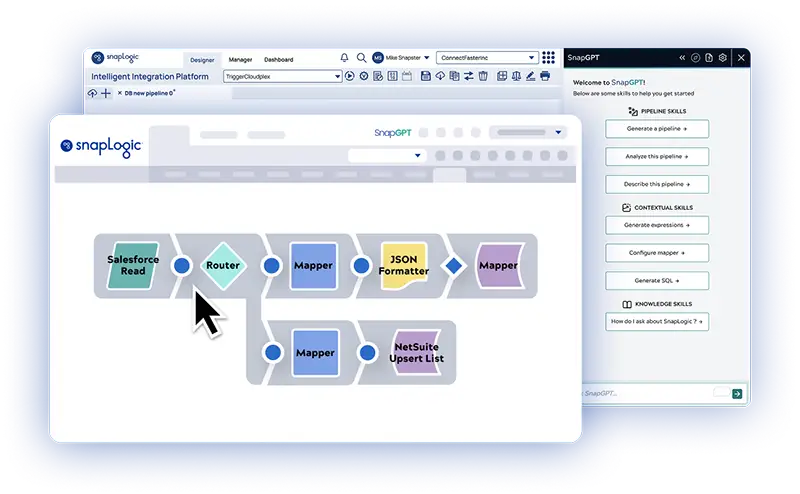
- AI built in. SnapGPT creates pipelines from natural-language prompts. AgentCreator supports low-code agent development. Enterprise MCP turns pipelines into governed tools that agents can call, and the SnapLogic MCP Server gives AI agents governed access to the platform itself.
- Hybrid by design. Execution nodes can run in the cloud or in your own data center, managed from the same control plane.
- Data integration depth. SnapLogic was named a Leader in the 2026 Gartner Magic Quadrant for Data Integration Tools. That matters when agents depend on clean, governed data.
- Predictable cost. Capacity-based enterprise licensing supports growth without a new meter for every connection, environment, or message.
- Continuous delivery. Updates arrive automatically, so teams spend less time planning upgrades.
- Simpler migration. The SnapLogic Intelligent Modernizer (SLIM) analyzes existing integrations, documents data flows and dependencies, and generates SnapLogic pipelines to simplify moves off legacy tools.
Whichever platforms make your shortlist, run the same test on each. Ask how many systems, interfaces, and usage meters your team will manage once agents are in production. For organizations that want that number to stay small, SnapLogic is worth a closer look.
Frequently asked questions
Boomi is a multi-product platform with a large installed base, hybrid Atom runtimes, and broad data and API management. Workato is a recipe-based automation and integration platform focused on speed to build and orchestration across SaaS applications.
Reviewers often cite connection-based pricing that grows as integration scales, scripting for complex transformations, coordination across several product interfaces, and platform-specific switching costs.
Reviewers often cite expensive, unpublished pricing that tracks usage across several meters, a learning curve for formulas, and questions about fit for high-volume data movement. Hybrid connectivity runs through an on-prem agent that depends on your plan.
No. Dell acquired Boomi in 2010 and sold it to Francisco Partners and TPG in 2021. Boomi is now a privately held company.
Yes. Workato connects to systems behind a firewall through its on-prem agent, which makes outbound connections only. Its documentation notes that on-prem connectivity is available on specific pricing plans.
Boomi adds agent capabilities through Agent Studio and Agent Control Tower. Workato adds them through Agent Studio and Enterprise MCP. Teams that want AI agent development, integration, and governance in one platform can also evaluate SnapLogic, which builds AgentCreator, SnapGPT, and MCP support into the same platform that runs integrations.
Workato’s recipe builder is generally quicker for common SaaS workflows, and Boomi typically asks more of technical staff. SnapLogic’s visual designer and SnapGPT aim to serve both business technologists and developers.
Common alternatives include SnapLogic, MuleSoft, and Informatica. SnapLogic unifies application integration, data integration, API management, and AI agent orchestration on one platform. See how SnapLogic compares to other iPaaS vendors.
The SnapLogic Intelligent Modernizer (SLIM) analyzes existing integrations, documents data flows and dependencies, and generates SnapLogic pipelines to speed up migration.
Conclusion: pick the platform your AI strategy will grow on
Boomi and Workato both support enterprise-scale integration, and each carries trade-offs in cost, skills, or platform structure. The better fit depends on your estate, your team’s skills, and how central AI agents are to your roadmap. For organizations that want integration, data, APIs, and AI orchestration governed in one place, SnapLogic offers a unified platform built for that purpose.
See the platform in action
Evaluate the SnapLogic difference for yourself by taking one of our self-guided SnapLogic Product Tours to experience key platform capabilities:
- Platform Overview: Discover the features that power a unified integration experience
- Enterprise MCP: Connect AI agents to any workflow through SnapLogic’s MCP server
- iPaaS: Connect apps and automate workflows to keep enterprise processes running smoothly
- Data Integration: Connect data everywhere it lives to power automation and analytics
Ready to talk? Book a personalized demo with our team of experts.