


The first question a security review asks about an AI assistant is what it can touch. The second is who said so. Teams that can answer both in a sentence move to production. Teams that cannot stay in pilot.
Both answers live in the integration layer. That is where connectivity, access control, and data movement come together, and it is where Pitney Bowes made the platform choices that now support its data and AI work.
Watch the webinar: Modernize with Confidence: How Pitney Bowes built a governed data foundation to get ready for the AI future
Three questions that test a data integration platform
When Pitney Bowes chose a platform to centralize its enterprise data, the data team tested every option against clear criteria. Vishal Shah, Lead Data Architect at Pitney Bowes, discussed the company’s approach in a recent webinar with SnapLogic. Those criteria make good questions for any technical leader to ask about their own platform.
1. Does it reach everything your AI will need?
An assistant is only as useful as the context it can retrieve. List the systems behind your highest-value use cases, including the older ones, and check that your platform connects to each. SnapLogic’s library of pre-built connectors, Snaps, is built for that breadth, which is why Pitney Bowes made connectivity the first filter.
2. Does it run where your governance rules say it must?
The deployment model and data protection decide who owns the controls. SnapLogic runs pipelines in the customer’s environment, so teams keep governance in their own hands.
3. Will enough people use it?
A platform that three specialists can operate limits your AI roadmap to three specialists. Adoption widens the pool of people who can build, review, and trust the data flowing to AI.
The results show what a platform that answers all three can do. SnapLogic connects Pitney Bowes’ systems to its cloud data warehouse, where teams work from trusted datasets, a single source of truth, and multiple customer 360 solutions. Initial reports indicated 500+ users across more than 15 departments and 25+ business applications connected to the warehouse and data lake.
Data recency belongs in the design
Connected data raises the next question: how current does it need to be? Pitney Bowes applies real-time integration to the workflows where minutes matter and keeps batch for the rest.
Salesforce case data flows in real time, so support teams can act the moment a customer opens an issue. IoT data from connected machines lands in an Amazon S3 bucket and loads into the warehouse for immediate action. A machine reporting low supplies can trigger a replacement before the customer feels any downtime.
This design choice carries over to AI. An assistant answering a service question needs current case data. A team that has already decided where freshness matters can serve that need without a redesign.
Integrations become governed tools
Once data is connected, current, and governed, a new kind of consumer can join: the AI assistant.
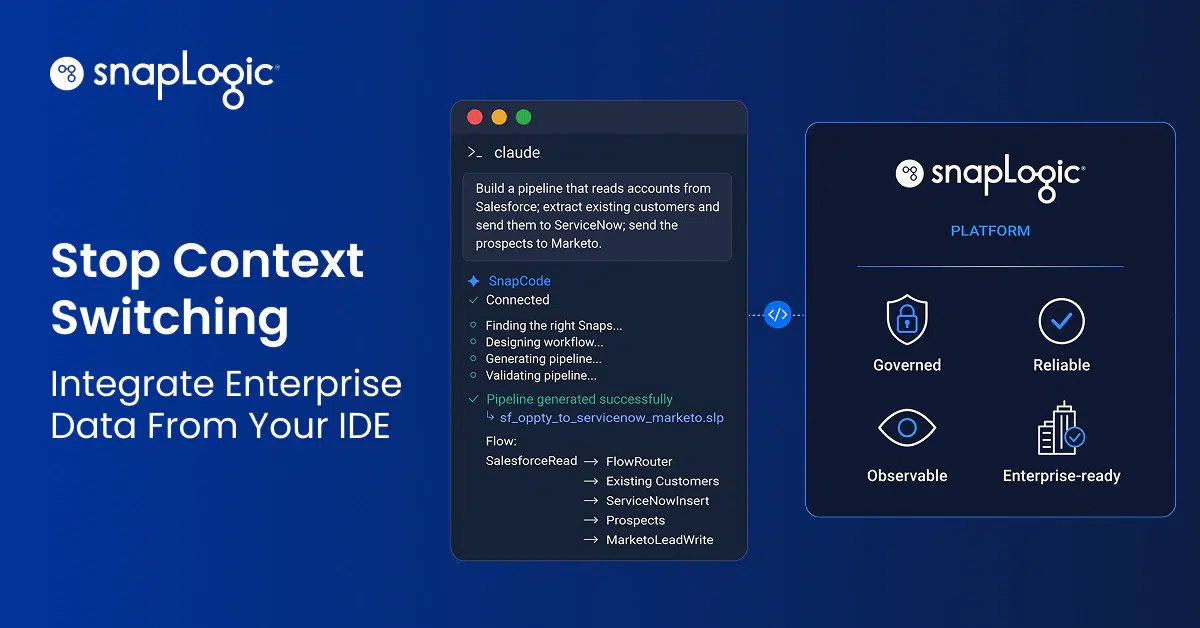
The integration layer makes that step short. Pipelines that already move and validate data can be exposed to an assistant as tools, with the same connections and logic behind them. Nobody has to build a separate AI layer. SnapLogic’s governed MCP access adds the controls security teams look for: the assistant calls the tools it has been given and no others, authentication policies decide who can reach what, and every call passes through the platform that governs the rest of the integration estate. That is the one-sentence answer the security review asks for.
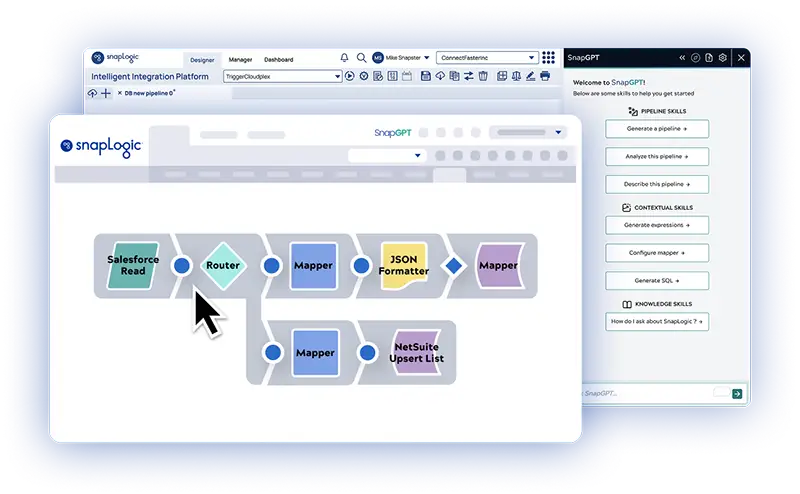
AI-assisted pipeline creation with SnapGPT adds a second benefit. The platform can read the shape of the data and help build the pipeline that moves it, so each new tool for an assistant takes less effort than the last.
Together, these pieces describe a cycle. The foundation supplies connected, trusted data. The platform turns integrations into governed tools. Assistants use the tools, and AI-assisted building adds more of them. Each turn of the cycle costs less than the one before, because connectivity, transformation logic, and access controls already exist.
What this means for your roadmap
Teams often start AI planning with the model and the use case. The integration layer deserves an equal seat at that table. It determines what an assistant can reach, how fresh its answers are, and whether a security review ends in approval.
Start with the questions above. Then pick the first process where a governed assistant could save real time. A good candidate spans several systems, follows clear rules, and produces an answer someone can check.
See it in action. In the on-demand webinar, Vishal Shah explains how Pitney Bowes approached its platform choice, and SnapLogic’s Ravi Krishnan demonstrates a live AI assistant working through governed integrations.