

Key takeaways
- Many digital transformation and AI leaders run integrations they did not build and cannot fully see into.
- Those legacy integrations carry ongoing cost and hold back the data that AI and automation programs need.
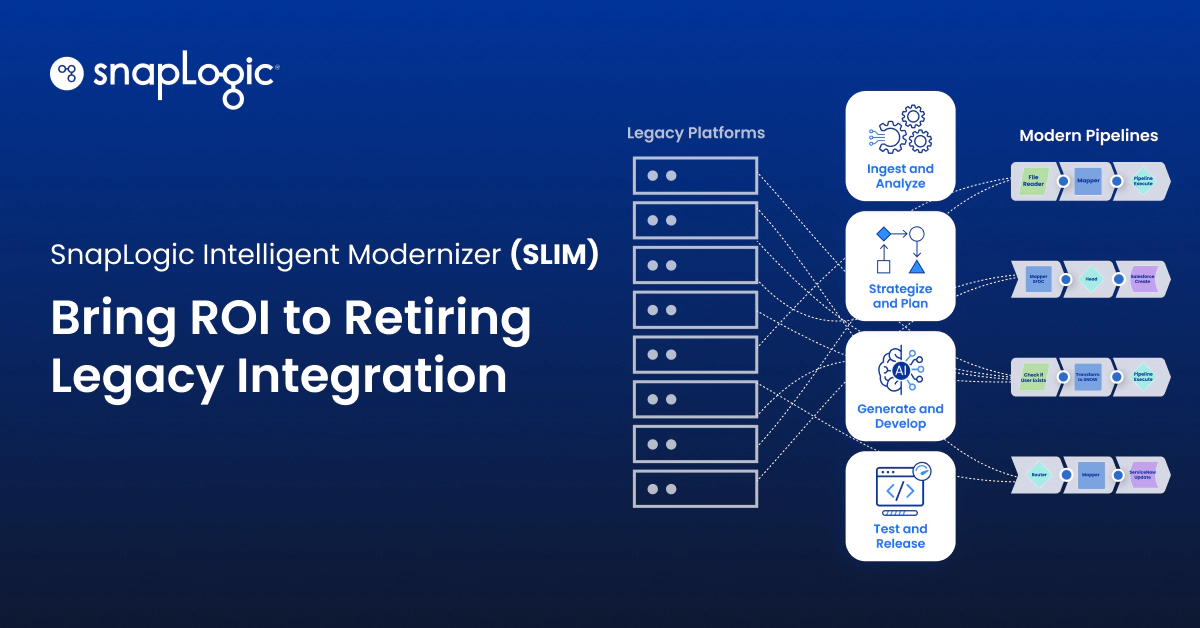
- SnapLogic Intelligent Modernizer (SLIM) uses an agentic engine to analyze that estate, recommend where to start, and generate modern SnapLogic pipelines, with humans guiding the work.
- The return comes from faster analysis, better-informed platform decisions, parallel delivery, and the AI projects that finally get unblocked.
The hidden cost of legacy integrations
If you lead digital transformation or AI, it is almost certain that you did not build the integrations your programs depend on. They likely arrived through reorganizations, mergers, and departures. The platforms they run on are reaching the end of their useful life, and some of the original vendors aren’t even around anymore. Documentation has been lost or is outdated. The actual benefit of the pipelines has become muddled as the business processes they support have morphed over time (or may have vanished altogether).
That situation carries a hidden cost. The legacy platform’s support contract renews every year. Your best people spend their time keeping old flows alive. Meanwhile, your AI agents and analytics projects wait for data locked behind systems nobody wants to touch, and many AI initiatives stall at the proof-of-concept stage for want of data.
Modernization looks like the answer, yet the migration itself appears costly and risky, so it stays on the roadmap for another year — and another, and another. In the best-case scenario, no one notices when a modernization process completes, because the end-user experience (the data being where it needs to be) remains unchanged from the legacy system.
Legacy integration debt continually stalls digital transformation, trapping valuable data and inflating maintenance costs. The SnapLogic Intelligent Modernizer (SLIM) directly targets these migration costs through an agentic engine that accelerates discovery, streamlines execution, and unblocks modern AI and enterprise automation initiatives.
4 strategic advantages of modernizing with SLIM
1. Less time spent working out what you have
Analysis is where migration budgets quietly disappear. SLIM analyzes existing integrations, surfaces missing information, inconsistencies, and similarities, and shows what each integration actually does. It covers different legacy technologies without requiring a purpose-built connector for every source platform, making visible — often for the very first time — exactly what is running in production.
2. A smarter starting point
Large programs often lose money or the chance to build credibility at the start by picking the wrong first target. SLIM assesses how integrations relate to one another and recommends a logical place to begin, including the full context. The result is earlier wins, less rework, and a faster path to the first retired workload.
3. Parallel work that shortens the timeline
Time is the largest line item in any migration. SLIM runs multiple operations concurrently, so analysis and generation move across a large estate at once. Teams can add context and rerun agents to refine results. Migration planning, automated testing, documentation, and pipeline generation sit in the same workflow, which trims repetitive labor.
4. Lower risk through governance
A delayed or failed migration costs far more than the tooling. Organization-level administration, tenant boundaries, configurable personas, role-based access, and explicit status reporting give enterprises control and clear visibility into unfinished work.
“Our customers don’t want black-box modernization. They want speed, but they also want confidence and clarity.”
Jeremiah Stone, CTO, SnapLogic
How SLIM moves a legacy estate to modern pipelines
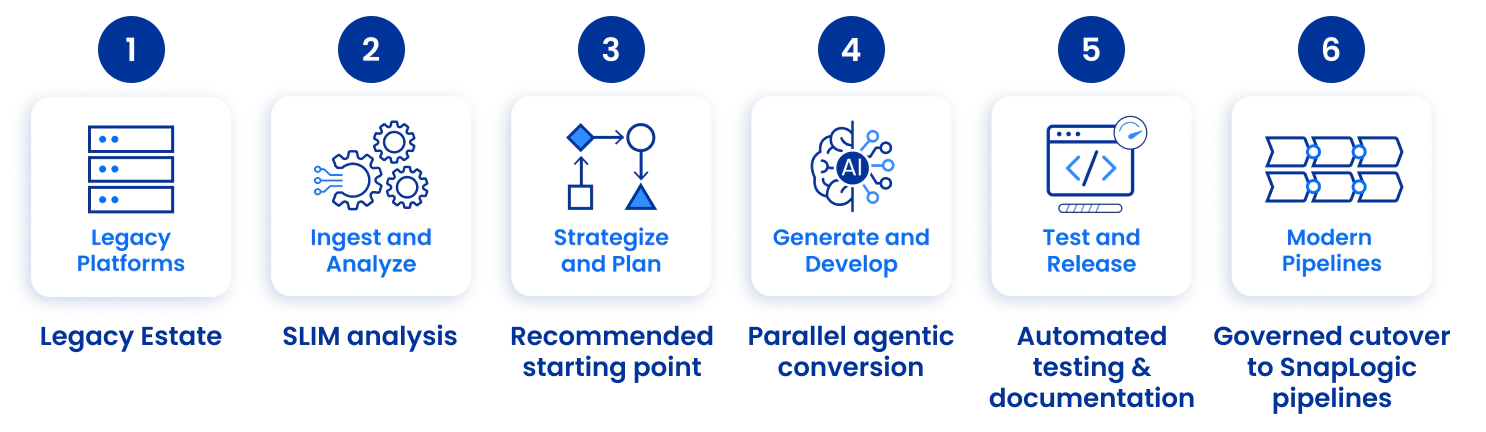
Moving legacy integrations to SnapLogic pipelines follows a structured, six-step process designed to minimize risk and accelerate cutover. The diagram below details each phase of the migration journey, from initial discovery through automated conversion to governed deployment.
Where the savings show up, and the bonus prize
| Cost driver | Typical pain in legacy migration | How SLIM addresses it |
|---|---|---|
| Discovery and analysis | Manual review of undocumented integrations | Agentic workload analysis with gap and inconsistency detection |
| Program sequencing | Unclear where to start | Recommended starting point based on integration relationships |
| Build and test effort | Repetitive rebuild, testing, and documentation | Automated testing, documentation, and pipeline generation |
| Timeline | Serial workstreams | Parallel agentic execution with rerun and refinement |
| Overlap cost | Paying for old and new platforms together | Shorter path to cutover |
| Risk and oversight | Black-box results, limited visibility | Role-based access, tenant boundaries, status reporting |
While these direct cost reductions significantly improve the bottom line, the financial savings are only part of the story. The larger return comes from what modernization unlocks once legacy integrations run on a modern foundation: your teams can shift their full energy toward building new AI capabilities and driving automation for the agentic enterprise.
Building your business case
Start with your own inputs: hours spent on analysis, hours spent on rebuild and testing, months of personnel supporting multiple platforms, and the AI initiatives paused while waiting on a modern foundation. Each shrinks as analysis, sequencing, and generation speed up. Shorter overlap often delivers the biggest gain, because every month saved is a month of double platform spend avoided.
In addition to direct internal savings, legacy migrations incur substantial external costs. Long-running migration projects frequently rely on expensive external consultants, require financing two systems concurrently for multiple years, and force organizations to extend legacy support contracts annually at punitive rates. SLIM directly mitigates these external expenses by accelerating analysis and delivery to shorten project timelines, and providing clear visibility into the integration estate to reduce reliance on external guidance.
Frequently asked questions (FAQ)
SnapLogic Intelligent Modernizer, aka SLIM, is an AI-driven capability that analyzes legacy integration workloads and helps convert them into SnapLogic pipelines.
No. The agentic engine removes the dependency on predefined connectors for each source platform.
It provides recommended starting points, automated logic testing, and governance controls, including role-based access and full documentation of how the source system entities or constructs evolved into SnapLogic assets (i.e., auditability/traceability).
Instead of performing a direct mechanical translation, SLIM uses an intermediate functional representation (source to functional representation to SnapLogic). By interpreting integrations through this intermediate layer, SLIM sheds historical implementation idiosyncrasies and legacy baggage to build clean, SnapLogic-native pipelines aligned with the true intent of the workflow.
Yes. Teams can add context and rerun agents to improve generated results. Users can submit documentation, design guides, or other reference materials, or (in prompt refinement) request changes to the technology stack the integration will work with (e.g., swapping out one technology for another).
Book a demo at snaplogic.com/request-demo.