



The first surprise at the StrategieGipfel IT Management event in Berlin came right away, during the opening keynote. The speaker asked the audience what their level of AI adoption was, and nearly every hand in the room went up. In late 2026, that part is perhaps not so surprising. It was the follow-up question that was more interesting.
Audience members (IT leaders and strategists from across Germany) were asked to rate their respective organisations’ level of AI readiness. A quick eyeball count showed that the average readiness was below 50%. And this gap was to define the next two days of the conference.
Architecture is the homework behind AI success
Across the industry, the conversation around AI is shifting from simple adoption to business cases and how to measure the benefits of AI. This transition moves the conversation from a purely technical domain to an organisational level. This is important because use cases that show real-world value tend to span across technical domains, following the path of business value. As they cross those boundaries, AI use cases show which organisations have not been “doing their homework” in terms of architecture.
In particular, organisations that put an integrated data fabric into place already for earlier initiatives such as Big Data can now reap the benefits in terms of faster and more successful AI outcomes. In contrast, those organisations that did not seize earlier opportunities to review their IT architectures find themselves with a lot of catching up to do before they can even begin implementing AI initiatives at scale.
Another piece of “homework” is a correct understanding of the long-standing division between IT and OT, generic support systems which can be bought off the shelf as opposed to mission-critical ones that should be built or at least extensively customised in-house.
The issue with token costs
Among those organisations which had pushed AI adoption furthest, many reported significant cost pressures around AI adoption, with token costs for naively-architected AI tools already exceeding the cost of human employees. The question they were facing was no longer whether something could be done with AI, but whether it should.
Might the speed, predictability, and yes, lower cost of deterministic logic be a better fit in some cases than the probabilistic logic of generative AI? And how to combine the two approaches?
Security and sovereignty shape the DACH approach
A factor that is perhaps higher up the agenda in Germany, and in the DACH market in general, than in places like the U.S. is privacy and sovereignty. Attendees were uniformly of the opinion that AI agents should not have greater access than the users on whose behalf they were acting, and that the data should remain under their own control — and indeed must do so for legal reasons.
Here again, though, the talk was not of blanket bans, but of sophisticated architectures that could differentiate between legally sensitive or mission-critical applications, which might tolerate greater costs and possibly more limited functionality of local models, as opposed to more generalist use cases, which could rely on commodity models without risk or other negative impact.
To dive deeper into how organizations manage these security and compliance requirements, watch the webinar: Governing AI Agents: Secure Access, Identity, and Control at Enterprise Scale
Factors for AI project success
Here are six key factors that influence the success and failure of AI projects, in no particular order:
- Employee skills: Nobody has ten years’ experience building GenAI tools, let alone agents, so what skills should employers look to develop or hire for?
- Concrete end-to-end use cases: Start with the requirement, not the technology.
- Tech stack: Older technology can be harder to integrate with the latest AI frameworks
- Business case: including where to reinvest savings
- Context: How to give AI agents access to the apps, data, and systems which they require to be useful
- Governance: Both observability/auditability and compliance/enforcement
The key point is that all of these elements of an overall strategy have to be both flexible and measurable. The landscape is changing so rapidly that an overly rigid strategy will need to be discarded entirely once the environment has evolved far enough. A more flexible strategy can evolve as new capabilities emerge and new requirements are clarified. But success can only be reached if those factors can be measured, to understand the direction and speed of travel.
From the keynote to the workshop floor
All of this conversation aligned very well with the interactive workshop I ran on the second day of the event, in which I polled attendees on exactly these questions and then shared examples of SnapLogic customers who had been successful by addressing exactly the same topics that we had just discussed together in the room.
Events like this one are not about vendors pitching their capabilities, but rather about having valuable conversations, so it was good to be able to share the experiences of how other practitioners had been successful, starting long before the technology, with the concrete business needs and the business case for how they could be addressed.
Going back to that opening session, the SnapLogic team would very much agree with StrategieGipfel IT Management attendees that one of the biggest factors in the success of AI initiatives is a concrete, actionable business case. Initial assumptions may need to be revised over the course of the project, but a clear direction is invaluable.
How SnapLogic addresses the factors for AI success
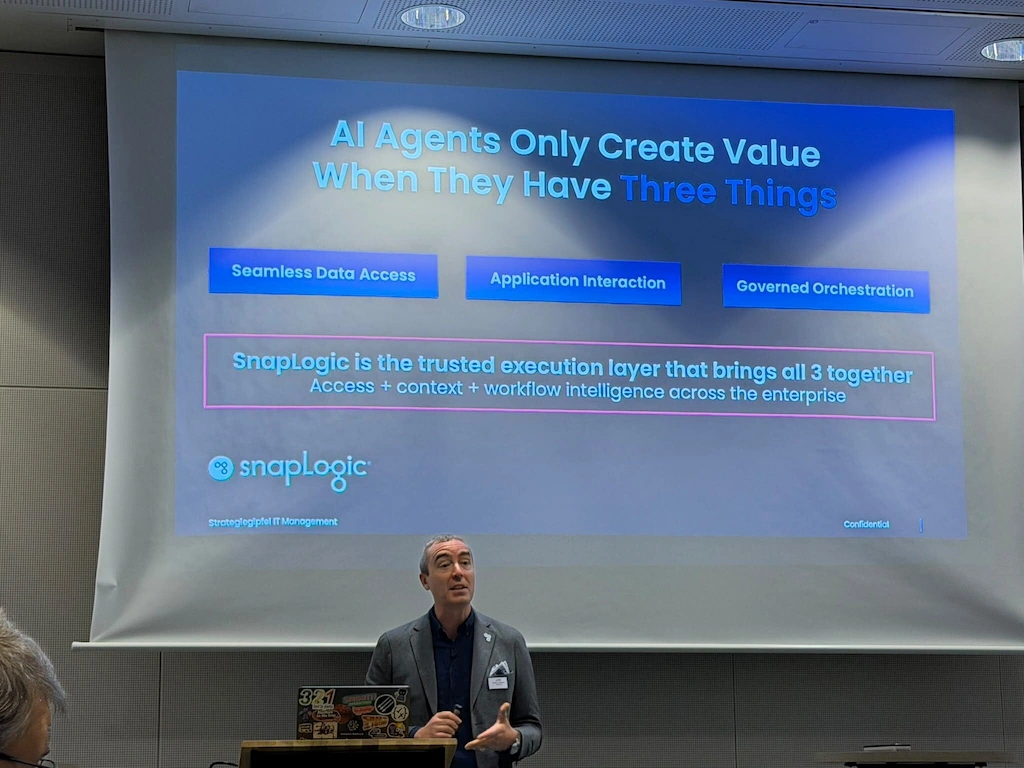
Only then can the technology start to make a difference, and SnapLogic addresses all of those requirements we heard again and again over the course of the two days:
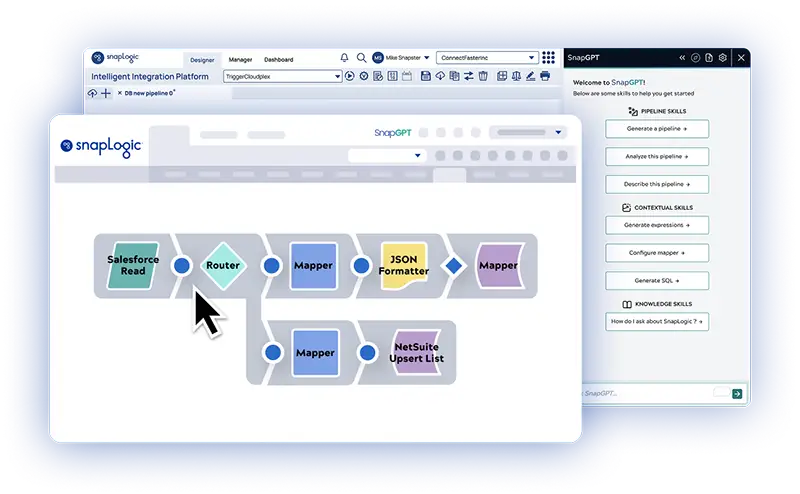
- Employee skills: The combination of a graphical development environment and AI natural-language assistance makes for a very easy on-ramp and consequently short time to value
- Concrete end-to-end use cases: Ready-to-use templates for common requirements
- Tech stack: With 1000+ pre-built connectors (Snaps) and 500+ MCP tools, we can integrate with just about anything, and thanks to the SnapLogic Intelligent Modernizer (SLIM), we can migrate any legacy integrations too
- Business case: Once the business case has been identified, platform features such as the new capabilities in Monitor help to map that business value quickly
- Context: SnapLogic is the data fabric connecting AI agents to the enterprise data, apps, and systems that they rely on to deliver effective and specific results
- Governance: Full governance and policy enforcement make SnapLogic the safe option to implement AI agents in real-world use cases, including on-premises options and deterministic logic where that is the better choice
Because the landscape keeps changing, none of this works as a one-time setup. Teams can start with a single use case, measure the result with AI assistance, and extend the same foundation of connectivity, context, and governance as new requirements appear. That is how a clear initial business case turns into AI that holds up in production at enterprise scale.
Join us at IntegrateAI 2026 in London
The conversations from Berlin continue in London. Join IT leaders and AI practitioners at IntegrateAI on November 17 to compare notes on business cases, architecture, and governance. Save your spot.