



The early adopters figured out what doesn’t work with AI. Thanks to their efforts, repeatable playbooks are emerging that are ripe for rapid implementation.
It’s been nearly four years since the announcement of ChatGPT sounded the starting gun on the race for AI success. But as we heard at the Gartner Application Innovation & Business Solutions Summit in London last week, only 5% of AI technologies have reached production.
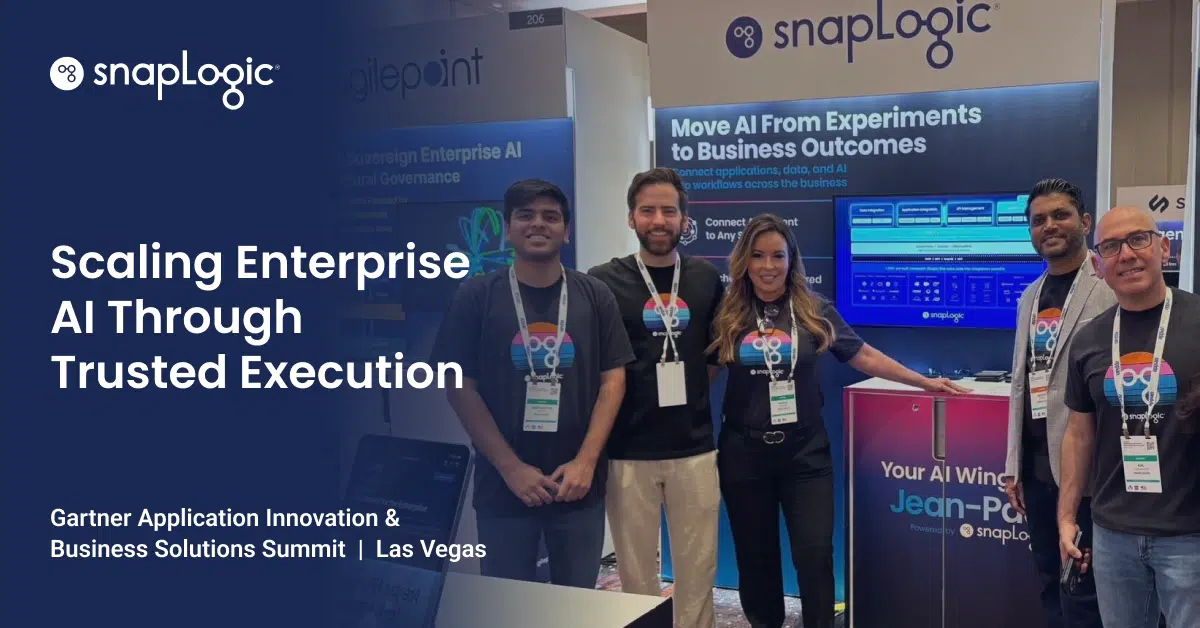
When the SnapLogic team visited the US Gartner App Summit in Vegas in June, they heard that enterprises were moving from AI experimentation toward production, with context, execution, and governance emerging as the critical requirements.
Now it’s September, and what we heard in London is that those requirements haven’t changed, but the market is getting much more specific about how to operationalize them. Enterprises have run their pilots; now they are looking for repeatable playbooks to deliver value at all levels of the stack.
Model power is just one factor for AI success
Gartner analysts noted that a lot of the conversation around AI is still in that exploratory mode, focused too narrowly on the capabilities of the AI models. It makes sense for practitioners to pay attention to the models, because they are the new addition to the calculation, but they are far from being the only factor in whether AI adoption is successful (or not).
There are questions of whether the workflow is a good fit for AI at all, but also about whether people will trust it, or whether the teams in charge of governance will sign off on it. These are all precisely the questions that David Holton, CIO at Cambridge & Counties Bank, had to answer before he could start orchestrating agents to speed up client onboarding for asset finance.
It might seem counterintuitive that the first reference customer in Europe for SnapLogic AgentCreator is from an industry as rigidly regulated as banking, but actually that too is consistent with what Jason Wong and Brent Stewart told us in their opening keynote. Far from being a blocker, they said, governance is actually an enabler for adoption.
It is good governance that enables AI adoption to scale, implementing technology throughout the organization, far beyond the limited sandboxes that early demos lived in.
Governance enables trust
The crucial link between governance and adoption is trust. Governance defines the prerequisites; good governance makes their achievement visible so that people can have confidence in the result. Part of that is focusing not on replacing human workers with AI agents, but on how to optimize the process for partnership between the two.
The question then becomes, “How much more can the human + AI team accomplish together than either could alone?”
This is the “centaur model” of AI — a human riding and guiding a powerful machine — scaled up to the level of teams or entire organisations.
Something like this has always been the positive version of the business case for automation: not euphemistic “headcount reduction,” but the ability to deliver more value by automating away whatever distracts people from what they do best.
We have seen the same sequence that Gartner described play out over and over in our conversations with our own customers. In fact, Gartner’s recommendations match up very closely with the guidelines we distilled from that real-world experience implementing AI in production with our customers. My colleague Sinem has documented them in more depth, but here they are at a high level:
- Point-to-point, manual integration doesn’t scale
- Data readiness first: the foundation AI initiatives actually stall without
- Flip the order: adopt first and deploy second
- Treat MCP and agent orchestration as a governance problem
These recommendations align with what Gartner analysts shared over the course of the two days, especially the rapid evaluation cycle of successful organisations. We heard that the most successful adoption stories, with multiple different use cases in production, are extremely flexible about enabling people outside central IT to suggest use cases, in a continuation of the “citizen integrator” paradigm.
Of course, this flexibility only works thanks to robust governance and guidelines. But once those initial requirements have been addressed, the use cases are continuously assessed and evaluated.
is the best practice recommended by Gartner to close initiatives without a path to production.
I am going to repeat that last one, because there was an audible gasp in the auditorium at that point: if an AI initiative is not showing a clear path to going into production within 90 days, it’s time to shut it down and move on.
This is the only way to get out of the current state, where 90% of AI technologies are stuck in the pilot phase.
Ninety days might seem impossibly short by historic enterprise IT project standards, and closing the initiative entirely may seem abrupt. Still, this rapid cycle time is the key insight late adopters haven’t fully internalised yet.
The value of AI is only partly in rapid delivery; a lot of it is in rapid exploration of what might be newly possible, or what can now be improved. The best time to start rolling out AI projects was a year ago; the second best time is right now. Scope it tightly, roll it out, see what happens, learn from it, and try something else.
Even better, run many of these cycles in parallel. Experiments don’t fail; at worst, they teach us what doesn’t work. Just make sure that you learn whatever lesson there is early on, and don’t get stuck following a path that goes nowhere.
A problem well stated is a problem half solved
Of course, getting something into production is only part of the story. Whatever is delivered should also match the business requirements for whatever process is being automated. That is where that condition above to scope projects tightly comes in.
AI can deliver value at all levels, from the big enterprise RAG project to the tactical improvements delivered by experts in one specific domain. Enterprise IT processes, though, are mostly only designed for the former, top-down large-project approach. The sort of ground-up business-led adoption embodied by the latter is outside the experience of most of these groups.
The problem here is that when humans are the integration layer between different systems and sub-tasks, they are very good at papering over cracks and routing around obstacles. However, these field modifications to the process rarely make it back upstream into the documentation. When it comes to automating parts of the process, that gap between the “process as written” and the “process as implemented” can trip up attempts to automate that process.
This is the other reason why enterprise IT cannot be the sole owner of AI projects. In addition to its breakneck pace of evolution, which makes it entirely unsuitable for the sort of sober technology evaluations IT is used to performing, it also needs to be implemented in situations that are far less sterile and well-defined than the pristine architectures of the past.
Unstructured data, tribal knowledge, and decision processes that were never captured formally mean that the spec itself has to be a living, constantly-evolving document, to match the changes in the real world.
Best practices become worst practices
And that was the third theme which ran through one conversation after another at the Summit: none of this is static. Of course AI (models, interfaces, and harnesses) is evolving under our very eyes, so fast that it can be hard to keep up with the pace of change. But everything else in the picture is moving too, from the technological infrastructure to the business processes themselves.
It’s basically impossible in this environment to predict the future more than a short way out with any fidelity, but we can work to put in place durable standard components with flexible connections between them that can enable that very rapid iteration. This goes both for traditional technology and for the ways of working with it and with the people who rely on it.
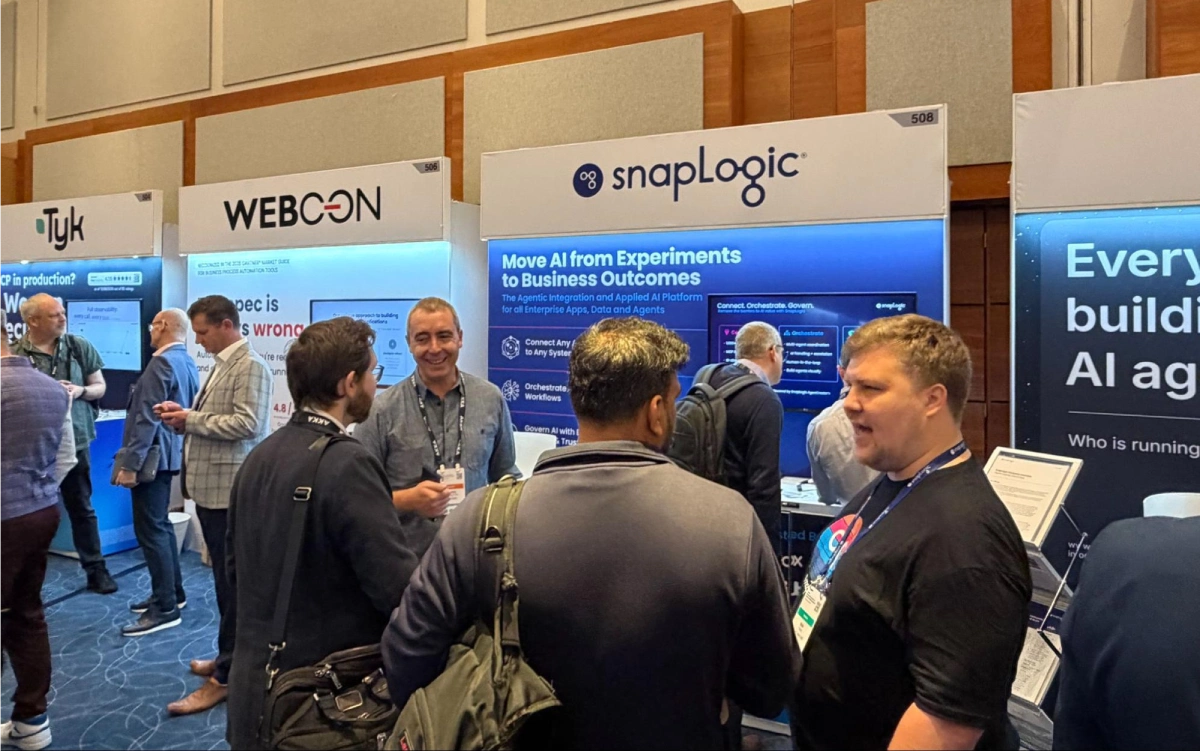
None of this was just Gartner analysts disclaiming their opinions from the stage. Attendees also heard from practitioners who had implemented one part or another of these recommendations, and then fanned out onto the show floor to discuss their own experiences with each other. It is always a privilege as vendors to take part in these conversations, but attendees really appreciated hearing about real-world experiences. Not just the raw metrics of success, but what it took to get there, and some of the twists and turns that we took along the way.
That is what we mean when we say we have repeatable runbooks: they’re not black boxes to be accepted unchanged, but a combination of reusable components, together with hard-won experience in what works, what doesn’t (yet), and which factors (both human and technological) must be included in the calculation.
But the good news is that those repeatable playbooks are beginning to emerge, and to be proven in practice. A one-off might be a fluke, but an industry-specific AI use case that has already been rolled out in production twice and that is being implemented in two more customer environments as I type this is the strongest signal out there right now.
We will be discussing some of those stories in more detail during our IntegrateAI 2026 World Tour, stopping in:
- Dallas, TX on October 6
- San Francisco, CA on October 28
- London, UK on November 17
We hope there is one near enough that you can attend. See you there!