
Enterprise integration is no longer just a back-office concern. It is a foundational capability for automation, analytics, and AI-driven business operations. As integration platforms age, architectural choices made years ago increasingly limit how quickly organizations can adapt.
SnapLogic and Informatica represent two different eras of integration technology. Informatica is closely associated with legacy data integration tools such as PowerCenter, along with newer cloud offerings delivered through Informatica Data Management Cloud. SnapLogic was designed as a cloud native, unified integration platform with built-in AI capabilities.
The comparison between these platforms has taken on new urgency. Standard support for Informatica PowerCenter ends on March 31, 2026, creating a fixed timeline for organizations still running it. This article provides a neutral comparison of SnapLogic and Informatica, with a focus on architecture, modernization strategy, AI readiness, and the implications of PowerCenter’s end of life.
What SnapLogic is and how it is designed
SnapLogic is a cloud native, AI-powered enterprise integration platform. It supports application integration, data integration, API management, automation workflows, and AI agent orchestration within a single unified system.
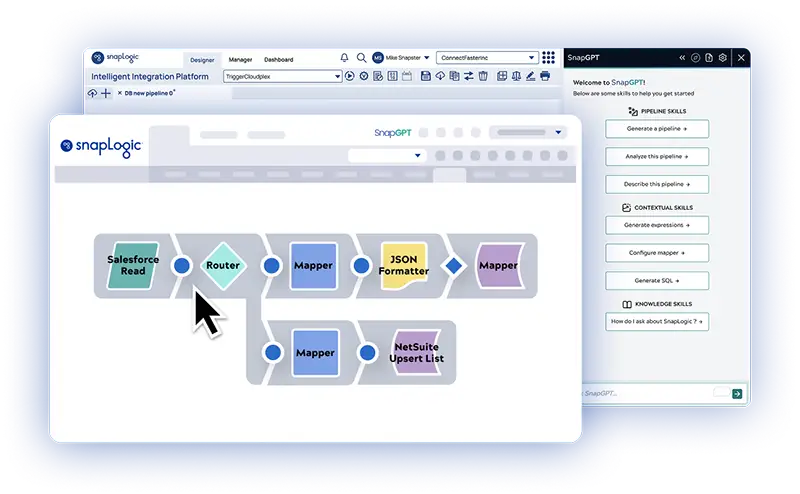
The platform emphasizes low-code development, centralized governance, and continuous delivery. SnapLogic includes native generative AI capabilities such as SnapGPT and AgentCreator, which allow users to create pipelines and AI agents using natural language and visual development tools.
SnapLogic is designed to reduce operational complexity while accelerating integration and automation initiatives across hybrid and cloud environments.
What Informatica is and where PowerCenter fits
Informatica is an enterprise data integration and data management vendor best known for products such as Informatica PowerCenter. PowerCenter has historically been used for batch-oriented ETL workloads in on-premises and early hybrid environments.
Informatica now offers cloud capabilities through Informatica Data Management Cloud. However, many of these offerings are the result of migrating existing technologies to the cloud rather than rebuilding them as cloud native systems.
For organizations still running PowerCenter, lifecycle management has become a central concern. Once standard support ends, customers must rely on paid extended support or operate without ongoing fixes and updates. This milestone is a major driver behind current modernization efforts.
Architectural differences between SnapLogic and Informatica
Architecture strongly influences how integration platforms scale, evolve, and support AI-driven use cases.
SnapLogic was architected as a unified platform from inception. Application integration, data movement, APIs, automation, monitoring, and AI orchestration are delivered through a single control plane with a consistent user experience.
Informatica’s platform reflects its evolution over time. It consists of multiple products with separate interfaces, lifecycle management processes, and deployment considerations. This structure can increase operational complexity and make cross-platform orchestration more difficult.
| Capability | SnapLogic | Informatica |
|---|---|---|
| Platform design | Unified by design | Multi-product portfolio |
| Deployment model | Cloud native with hybrid support | Cloud migrated legacy systems |
| User experience | Single interface | Multiple interfaces |
| Update model | Continuous updates | Scheduled upgrades and EOL cycles |
Why PowerCenter EOL creates a modernization deadline
The March 31, 2026, Informatica PowerCenter end-of-support date represents more than a licensing milestone. After this date, standard updates, security patches, and maintenance fixes are no longer provided.
While extended support options may be available, they primarily delay risk rather than resolve it. Running unsupported or minimally supported integration infrastructure increases exposure to security vulnerabilities, compliance gaps, and operational instability. It also limits the ability to adopt modern capabilities such as real-time processing and AI-driven automation.
As a result, many organizations now view PowerCenter’s end of life as a forcing function. It requires a decision between extending legacy platforms or modernizing integration architecture in a way that supports future needs.
How SnapLogic approaches PowerCenter modernization with SLIM
Modernization paths differ significantly between platforms.
Informatica migrations from PowerCenter to Informatica Data Management Cloud typically follow a lift and shift model. Existing assets are moved with limited refactoring, which often preserves technical debt and complexity.
SnapLogic takes a different approach. Modernization focuses on simplification and optimization rather than replication. Organizations migrating from PowerCenter to SnapLogic commonly report a reduction in integration asset footprint of approximately 40 percent, along with lower total cost of ownership and faster time to value.
The SnapLogic Intelligent Modernizer (SLIM) uses AI-assisted technology to analyze existing PowerCenter assets, document logic, and generate modern SnapLogic pipelines. This can reduce migration effort by up to 50 percent and allows organizations to modernize incrementally rather than through large, high-risk projects.
AI readiness and agent-based integration capabilities
AI readiness has become a core requirement for integration platforms.
SnapLogic includes native generative AI and agent-based capabilities. SnapGPT enables conversational interaction with the platform to generate pipelines and transformations. AgentCreator supports low-code development of AI agents that can reason, act, and orchestrate workflows across systems.
These capabilities are designed to help enterprises operationalize AI while maintaining centralized governance and visibility.
Informatica offers AI-related features, but customers often report challenges deploying AI at scale due to architectural fragmentation and legacy constraints. Unified platforms generally reduce friction for AI orchestration by providing consistent access to data, applications, and policies.
How operational models differ for upgrades and maintenance
Operational overhead is a practical consideration for long-term platform sustainability.
SnapLogic delivers continuous cloud updates without forced upgrades or downtime. New functionality, performance improvements, and security updates are applied automatically.
Informatica customers must plan around scheduled upgrades, product lifecycle transitions, and end-of-support milestones. Managing these cycles increases maintenance effort and can divert resources away from innovation.
Customer outcomes after modernization
Customer outcomes offer insight beyond feature comparisons. For example, after adopting SnapLogic’s platform, Spirent reported measurable improvements in a short period of time, including:
- A 25% increase in business intelligence worker productivity across analytics teams
- A 50% reduction in development time and cost by reusing existing AI application patterns built in SnapLogic
- $144,000 in annual savings by eliminating redundant AI subscription fees for the sales organization
More broadly, organizations that modernize with SnapLogic commonly report:
- Reduced platform maintenance and operational costs
- Faster onboarding and delivery of new integration and automation projects
- Simplified architecture through tool consolidation
- Improved support for AI-driven automation and orchestration
By contrast, organizations that delay modernization often experience growing tool sprawl, higher operational burden, and slower progress on AI initiatives as legacy platforms become harder to adapt and maintain.
“By introducing new architectural concepts into the organization’s existing framework, we were able to modernize our approach and build a stronger, more cohesive foundation. This was a clean-slate moment and an opportunity to reimagine processes in ways that will drive long-term efficiency and growth.”
Hal Hallsson, Principal Enterprise Architect at Bison Transport
What this means for CIOs and CTOs
For CIOs and CTOs, the SnapLogic versus Informatica decision is increasingly time-bound.
The March 31, 2026 PowerCenter end-of-support date introduces operational and risk considerations that extend beyond IT. Decisions made now affect security posture, compliance, cost structure, and the organization’s ability to adopt AI at scale.
Key considerations include:
- Managing risk associated with unsupported or minimally supported systems
- Choosing modernization over short-term extensions of legacy platforms
- Using migration as an opportunity to simplify architecture and reduce tool sprawl
- Ensuring the integration platform can serve as a foundation for AI agents and automation
SnapLogic is often evaluated in this context because SLIM enables a structured, lower-risk migration path while aligning integration infrastructure with cloud native and AI-first strategies.
When organizations choose SnapLogic instead of Informatica
Organizations typically evaluate SnapLogic as an alternative to Informatica when they encounter the following:
- Rising maintenance costs and operational complexity
- Forced migration timelines driven by PowerCenter end of life
- Difficulty enabling AI-driven automation with existing tools
- Fragmented user experiences across multiple integration products
SnapLogic is commonly selected by enterprises seeking a unified platform that supports both immediate modernization needs and longer-term AI adoption.
Conclusion: Integration decisions are shaped by architecture and time
SnapLogic and Informatica reflect different generations of enterprise integration.
Informatica remains rooted in legacy ETL architectures that are being extended into the cloud. The approaching end of PowerCenter standard support has made the limitations of that approach more visible and more urgent.
SnapLogic was designed as a unified, cloud native platform with built-in generative AI and automation capabilities. For organizations prioritizing modernization, reduced complexity, and AI readiness, SnapLogic is often viewed as the more future-aligned option.
As integration becomes central to automation and AI strategy, architectural simplicity and lifecycle timing increasingly determine which platforms can support what comes next.