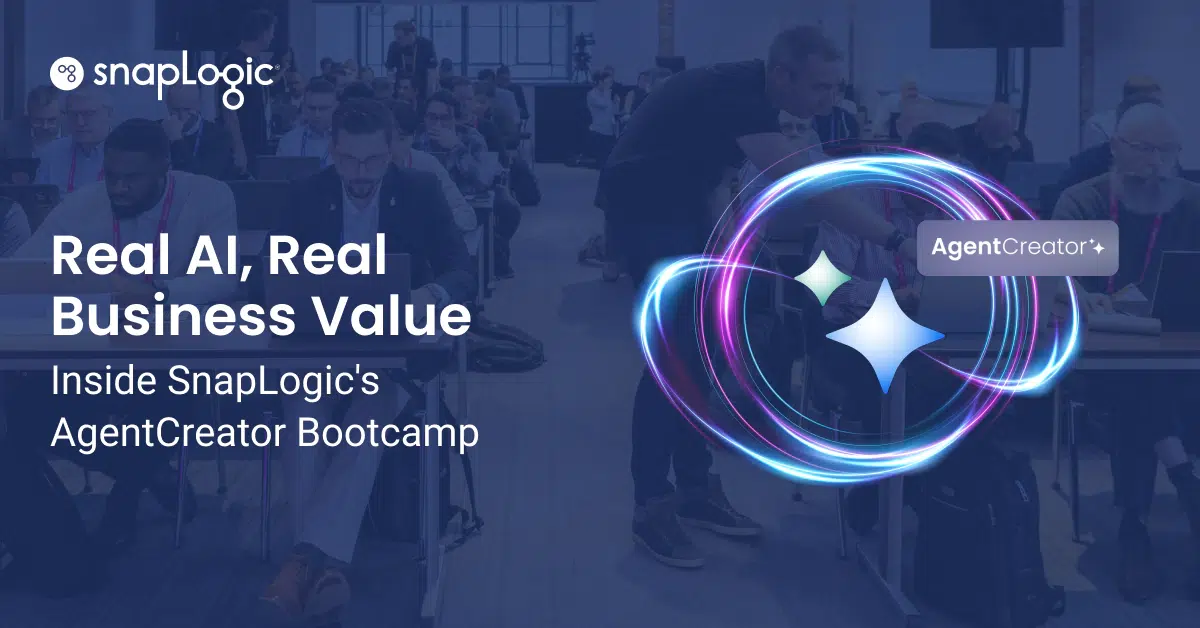



Recently, SnapLogic’s AgentCreator Bootcamp brought together customers, partners, and internal teams to build production-ready agentic solutions. In just three days, teams moved from ideas to working demos, tackling real integration challenges with autonomous agents.
What emerged was more than a showcase of prototypes. It was a practical look at how enterprises are building AI agents for real-world use: grounded in business problems, shaped by technical constraints, and designed to work alongside existing systems.
Three standout agentic use cases
Donor intelligence for mental health (Mind)
One of the projects developed during the bootcamp was a collaboration with Mind, the UK mental health charity.
Mind was dealing with fundraising data from multiple platforms, which arrived in inconsistent formats and often lacked campaign attribution. The agent reconciles those records against Mind’s campaign structure, enriches them with the right attribution, and produces both a clean output file and data quality notes for anything needing human review.
What it showed: Well-designed agents can do more than clean up data; they can make it more useful. In this case, the project replaced a slow, manual attribution process with one that can adapt to new events and campaigns without code changes, and showed that LLM workflows are more effective when broken into smaller child pipelines rather than a single overloaded one.
Student accommodation intelligence (Unite Students)
Another strong agent built during the bootcamp came from Unite Students, the UK’s largest provider of purpose-built student accommodation. It showed how AI can improve customer interactions while still respecting clear boundaries.
The solution combined personalized recommendations with an email-based assistant that kept track of user context across interactions. That made the experience feel more seamless and responsive, while also making it easier for users to get relevant answers.
What made it especially effective was its built-in guardrails. The agent was explicitly restricted from sharing information tied to the wrong user, helping protect privacy and maintain trust. The addition of multilingual support also made the experience more accessible to a wider audience.
What it showed: The value of customer-facing agents is not just convenience. It is the ability to create more responsive, accessible experiences without compromising trust or control.
Multi-agent monitoring and reporting (Planview)
A third standout agent built during the bootcamp came from Planview, an enterprise work management platform, and focused on producing structured health reports delivered via email.
It brought together monitoring signals and supporting metadata, then turned that information into structured health reports for channels like email and Slack. Instead of requiring teams to manually sift through large amounts of data, the agent helped surface what mattered most.
The design was just as important as the outcome. Rather than sending everything into a single reasoning step, the workflow first reduced and summarized the data, making the final output more efficient and scalable.
What it showed: The real value of agentic AI is often in reducing noise and surfacing insight. Well-designed agents help teams focus faster, act sooner, and manage complexity more effectively.
Build your own AI Agent with SnapLogic AgentCreator
What the bootcamp made clear
Across these examples, a few themes stood out.
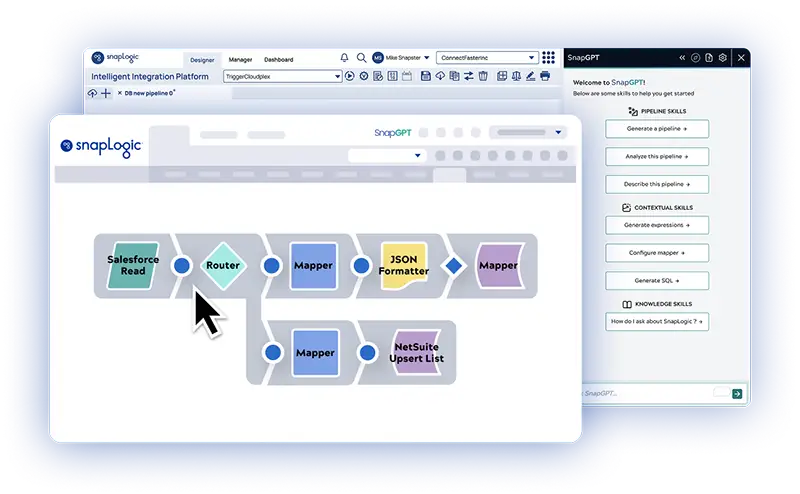
- Hybrid architectures work best. The strongest solutions combined agents with traditional SnapLogic pipelines. Agents handled reasoning and natural language interaction, while pipelines handled transformation, routing, and orchestration.
- Simplicity improves reliability. Teams that broke problems into smaller components built more dependable solutions than those trying to solve everything in one large prompt.
- Guardrails are essential. Production-ready agents need clear boundaries around data access, behavior, and downstream actions.
- Enterprise constraints shape design. Token limits, email security policies, HTTPS requirements, and other infrastructure realities directly influence how these systems must be built.
- Memory makes agents more useful. Agents that can reference prior interactions, decisions, or resolutions are far more valuable than stateless systems.
From bootcamp lessons to business value
This bootcamp was not about speculative AI. It showed what organizations can build now with real data, real constraints, and production-oriented use cases.
The teams that succeeded followed the same pattern: start with a real business problem, design for production from day one, and use agents alongside traditional integration patterns rather than as a replacement.
Ready to build your own production-ready AI agents? Join the next AgentCreator Bootcamp and get hands-on experience designing, building, and testing real-world agentic solutions. The next session takes place May 18–20, 2026, and SnapLogic’s AgentCreator Bootcamp hub is the place to sign up and watch for additional upcoming sessions.