


GenAI is already fundamentally transforming data integration, automation, and workflow optimization for businesses.
SnapLogic’s recent webinar, “Using AI to Design, Build, and Govern Enterprise Integrations,” hosted by Dominic Wellington, Product Marketing Director for Data and AI, and featuring Roger Sramkoski, Senior Technical Product Marketing Manager, was packed with insights on how their AI-powered tools, particularly SnapGPT, are empowering enterprises to design, build, and govern integrations faster and smarter.
For those evaluating SnapLogic, this discussion offers several compelling reasons to consider SnapGPT, AgentCreator, SLIM, and related solutions. From reducing manual, time-intensive tasks to enabling elevated operational standards, these are the key takeaways that showcase SnapLogic as a leader in the AI-driven integration space.
1. Accelerating enterprise data integration
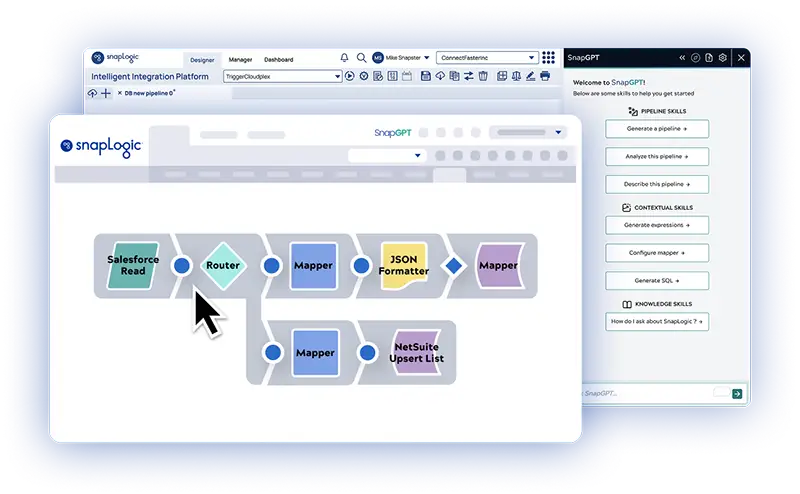
SnapGPT is the centerpiece of SnapLogic’s AI innovation, offering users an intuitive way to create data pipelines in seconds rather than days. It has been proven to dramatically reduce time-to-value for customers, with users reporting up to three hours saved daily on complex tasks.
Enterprises stand to benefit significantly from these efficiency gains, especially in industries like financial services and pharmaceuticals, where speed and accuracy are mission-critical.
A snapshot of SnapGPT’s capabilities
- Pipeline generation: simplifies creating pipelines in plain English, eliminating the need for extensive technical knowledge
- Expression authoring: complex expressions, SQL queries, and scripts can be generated effortlessly, saving valuable development hours
- Documentation output: for compliance-heavy environments, SnapGPT automates documentation creation, traditionally a tedious and error-prone process
These features emphasize scalability and ease of use, enabling enterprises to tackle increasingly complex integrations without adding to their workload.
2. Simplifying Day 1 and Day 2 tasks
Dominic highlighted the difference between “Day One” and “Day Two” tasks for SnapLogic users. Day One tasks, such as setting up initial data connections and basic workflows, are streamlined for new users. Day Two tasks address more advanced use cases, such as troubleshooting, optimizing undocumented pipelines, and generating deeper insights.
For buyers, this distinction is critical: SnapGPT is tailored for every stage of the journey, making it accessible for new adopters and indispensable for experienced integration teams that regularly tackle nuanced, repetitive issues.
Key benefits for users:
- For beginners: SnapGPT provides clear instructions to get pipelines operational quickly
- For advanced users: it scales with expertise, offering troubleshooting capabilities and nuanced workflow enhancements that save hours of tedious work
3. AI-driven solutions that grow with your business
SnapLogic’s commitment to evolving its AI capabilities ensures that enterprises won’t outgrow its tools. Having pioneered AI integrations with “Iris” back in 2017, SnapLogic has continued improving its AI offerings, and SnapGPT represents a significant leap forward.
Dominic shared the iterative improvements SnapLogic has planned for SnapGPT over the next two years:
- Recent enhancements: pipeline analysis, conversational memory, and multi-expression generation
- Upcoming innovations: source citations for generated queries, enhanced reasoning, and even image-to-pipeline functionality
These advancements set SnapLogic apart, demonstrating its ability to synergize cutting-edge AI technologies with real-world enterprise needs.
“Bottom line, these aren’t flashy features. They’re the daily tasks that save time, reduce errors, and keep businesses running efficiently.”
Dominic Wellington, Product Marketing Director for Data and AI
4. Meeting regulatory standards with SnapGPT
Regulated industries require more than just effective integrations. They demand compliance-ready solutions that are reliable, comprehensive, and secure. SnapGPT delivers on this promise by automating traditionally time-intensive processes, such as error handling, operational documentation, and adherence to naming conventions.
Throughout the webinar, Roger demonstrated how SnapGPT helps users line up workflows with production standards. From analyzing pipelines for disabled or duplicate components to providing detailed documentation for audit trails, SnapGPT mitigates human error while ensuring core compliance standards are met.
For buyers in regulated industries, this feature alone could be a game-changer, reducing risks while saving significant time and overhead.
5. Unlocking the potential of GenAI across organizations
SnapLogic isn’t stopping with SnapGPT. Dominic introduced several existing and upcoming technologies that leverage AI’s power to drive broader enterprise transformation.
AgentCreator: building AI agents with SnapLogic
Enterprise buyers looking to capitalize on agentic workflows will find AgentCreator, SnapLogic’s generative AI toolkit, especially intriguing. This solution lets users build AI agents directly within SnapLogic by transforming data pipelines into actionable workflows. Features such as data flow control and observability safeguards ensure these AI agents interact securely and efficiently within existing systems.
SnapLogic Intelligent Modernizer (SLIM): transforming legacy integrations
For businesses grappling with legacy tools and outdated integrations, SLIM offers a much-needed modernization framework. SLIM analyzes, clusters, and documents legacy systems, enabling their seamless migration to SnapLogic. Buyers looking to future-proof their infrastructure will appreciate how SLIM reduces both complexity and risk when upgrading legacy setups.
6. Practical and experienced partner for integration teams
The SnapLogic ecosystem combines innovation with practicality, targeting everyday pain points for integration teams. Roger’s demonstration underscored the product’s ability to simplify what would otherwise be lengthy developer tasks, whether it’s debugging regex patterns, standardizing merchant aliases, or ensuring production-ready pipelines.
In his words, SnapGPT isn’t about flashy features but solutions that “add up to hours of saved time and fewer errors in production.” By focusing on daily integration tasks and scaling to meet enterprise demands, SnapLogic’s AI tools ensure consistency, security, and reliability, even in the most complex environments.
7. Commitment to collaboration and knowledge sharing
Beyond the tools, SnapLogic fosters a strong sense of community and collaboration. Dominic directed attendees to SnapLogic’s Integration Nation Community Slack channel and a curated YouTube playlist to explore common SnapGPT use cases.
Why SnapLogic stands out for enterprise AI
SnapLogic understands AI’s potential to revolutionize enterprise data integration and is fully committed to helping organizations harness this power. Whether you’re a first-time user setting up basic pipelines or an enterprise seeking advanced automation, SnapLogic offers solutions tailored to your needs, today and tomorrow. Book a demo to learn more.