


AI-powered code assistants, copilots, and “vibe coding” tools have dramatically changed how software gets built. With a simple prompt, teams can now generate application logic, UI components, and workflows in minutes. It’s no surprise that many engineering leaders are asking: Do we still need low-code platforms in an AI-first world?
According to Gartner’s October 2025 report, “Why AI Won’t Replace the Need for Low-Code Application Platforms,” the answer is a clear yes. AI will not replace low-code platforms. Rather, it will amplify their value. And for enterprises focused on scale, security, and long-term maintainability, low-code platforms combined with AI are becoming essential.
At SnapLogic, we see this shift firsthand as organizations move beyond experimentation and look to operationalize AI across the business.
AI accelerates development but also introduces risk
Gartner highlights a critical tension: while AI code assistants and vibe-coding tools accelerate asset creation, they often operate outside governed environments. This leads to growing challenges around:
- Architectural consistency
- Code reuse and maintainability
- Security, compliance, and auditability
Left unchecked, AI-generated code can increase technical debt, expand the attack surface, and create opaque logic that’s difficult to explain or govern, especially in regulated industries.
This is where low-code platforms play a vital role. They provide the abstraction, structure, and guardrails needed to ensure AI-generated components are secure, reusable, and aligned with enterprise standards.
Low-code as the governed foundation for AI
Rather than being displaced by AI, Gartner makes it clear that low-code platforms are evolving into the governed, composable foundation for AI-powered solutions.
Low-code platforms:
- Minimize the total amount of code that must be written and maintained
- Enforce reusable patterns, visual models, and design-time constraints
- Embed governance through access controls, audit logs, and validation frameworks
AI enhances this model by making it easier to generate application scaffolding from high-level requirements. while the platform ensures those outputs remain secure, explainable, and scalable.
“Ultimately, vibe coding accelerates typing. Low-code application platforms accelerate engineering.”
Gartner report, October 2025
Where SnapLogic fits: AI, low-code, and integration at scale
SnapLogic extends this low-code-plus-AI model beyond applications into enterprise integration, automation, and orchestration, where complexity is often highest.
Our iPaaS offers:
- Low-code, visual development for building and managing integrations and workflows
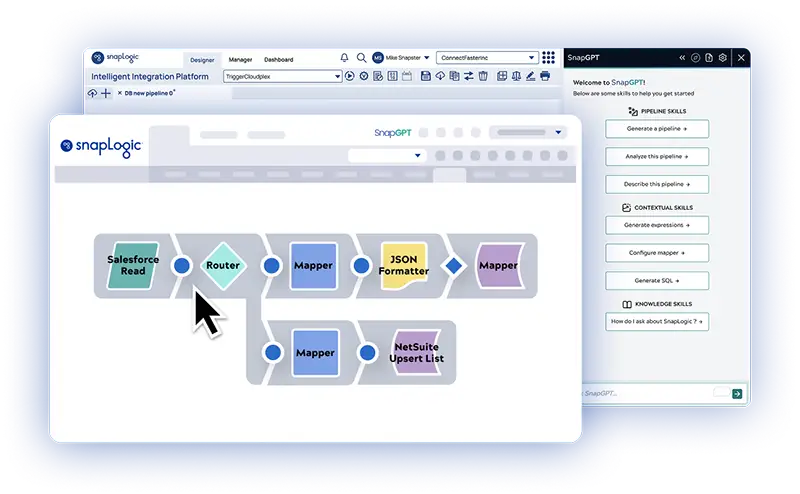
- AI-powered assistance to accelerate pipeline creation, mapping, and orchestration
- Built-in governance and security to ensure AI-driven automation operates safely across systems
- Reusable components and patterns that reduce duplication and long-term technical debt
This approach allows organizations to safely combine AI agents, assistants, and prompt-driven workflows with the reliability and control enterprises require.
AI assistants and agents work best inside platforms
Gartner recommends activating AI assistants within low-code platforms, not alongside them in isolation. Platform-native AI ensures that prompts, generated logic, and agents operate within defined boundaries for reuse, security, and integration.
SnapLogic enables this by allowing teams to:
- Use AI to translate natural-language requests into integration and automation workflows
- Orchestrate multistep processes across applications, data, and AI services
- Connect external AI agents through governed APIs and connectors
This “prompt, refine, deploy” model widens the contributor base, empowering analysts and business users, while freeing experienced engineers to focus on architecture, performance, and scalability.
The path forward: AI + low-code
Gartner’s strategic planning assumption reinforces the direction enterprises are heading: by 2028, AI-assisted development will be standard across both traditional and low-code environments.
The organizations that succeed won’t choose between AI and low-code. They’ll combine them — using AI for speed and creativity, and low-code platforms like SnapLogic for governance, reuse, and enterprise-scale execution.In an AI-driven future, low-code isn’t optional. It’s the control plane for turning AI innovation into sustainable business outcomes.