


For years, enterprise technology treated intelligence as the finish line. If systems could predict better, recommend faster, or summarize more clearly, progress was assumed. Artificial intelligence fit neatly into that model. It sat above existing processes, advising humans who still made the final call and pulled the operational levers.
That era is ending.
What’s emerging now is not AI as advisor, but AI as actor. Agents no longer just surface insight. They initiate change. They open tickets, move data, trigger workflows, and increasingly act without waiting for a human to approve every step. Once intelligence crosses that line — from interpretation into execution — the architecture beneath it stops being a background concern and becomes the main event.
The inflection point that pushed the industry over this threshold is the Model Context Protocol (MCP). To understand why, and what comes next, we need to look beyond what MCP enables and focus on what it disrupts.
MCP collapsed the distance between intent and action
MCP’s appeal is straightforward. It provides AI models with a clean, standardized way to interact with external tools. Instead of brittle, one-off integrations, agents can discover and invoke capabilities dynamically. Swap out a model and keep the same tools. Add a new tool without retraining the agent. For developers, this feels liberating.
And it is, at first.
What MCP really does is collapse the distance between intent and action. Every barrier that once slowed execution (e.g., API contracts, orchestration logic, approval workflows, human checkpoints, etc.) now feels optional. If something can be exposed as an MCP tool, it probably will be.
Inside enterprises, this leads to a quiet land grab. Teams rush to MCP-enable what they own: a workflow here, a script there, a database query wrapped just enough to look like a tool. None of these choices is reckless in isolation. Most are pragmatic, even smart. The problem is that they’re made locally, without a shared understanding of what the system is becoming as a whole.
That’s how architectural problems always begin, not with bad decisions, but with reasonable ones made without coordination.
As MCP adoption accelerates, the question shifts from “Can agents do more?” to “Who decides how their actions unfold?”
Integration is becoming the nervous system for AI
In the human body, reflexes are shortcuts. They bypass conscious thought to keep us safe and responsive. But reflexes aren’t autonomous. They operate within a tightly governed nervous system that decides when to fire, how to act, and when suppression is necessary.
MCP services behave like reflexes. An agent invokes them, something happens, and the system responds. The issue isn’t that reflexes exist—it’s that enterprises are creating too many of them, too quickly, without centralized coordination.
An agent is unaware that two MCP services interact with the same downstream system. It doesn’t understand that one action assumes another has already occurred. It can’t feel system load, operational risk, or regulatory exposure. It only sees options and probability-weighted reasons to choose among them.
Without coordination, reflexes don’t create movement. They create twitching.
This is where integration quietly reasserts itself. Integration has always been the enterprise’s nervous system: the layer that sequences actions, manages dependencies, enforces policy, and ensures that execution behaves predictably even when inputs change. As AI agents begin to act, that role becomes more critical, not less.
And when coordination is missing, the consequences don’t arrive all at once. They accumulate.
How AI turns familiar problems into systemic risk
The most dangerous infrastructure problems don’t announce themselves. They grow slowly, under the cover of success.
Early MCP sprawl looks like momentum. Teams celebrate faster enablement. Agents grow more capable each week. Demos impress executives. Metrics improve, briefly. Then the long tail forms.
Multiple MCP services encode slightly different versions of the same business rule. Agents call them interchangeably. Data states diverge, failures don’t propagate cleanly, and retries stack. Human operators are pulled in to reconcile outcomes that no single team owns end-to-end.
When something breaks, it’s no longer obvious where to look. Logs are scattered. Ownership is diffuse. Explanations become narrative rather than factual: the agent reasoned that this was the best action. That’s not a root cause. It’s a shrug.
Distributed systems have always been hard. AI makes them harder by removing predictability at the call site. Traditional systems fail in known ways, along defined paths. Agent-driven systems discover execution paths at runtime. Decisions are probabilistic. The same input can produce different actions on different days. That variability is acceptable only if it’s contained.
Without a control layer, variability leaks directly into systems of record. The more autonomy agents gain, the more fragile the enterprise becomes. This is why security teams, compliance leaders, and operations organizations are starting to slow things down. That’s not because they’re anti-AI, but because they recognize uncontrolled execution when they see it.
Which brings us to a familiar but newly urgent conclusion.
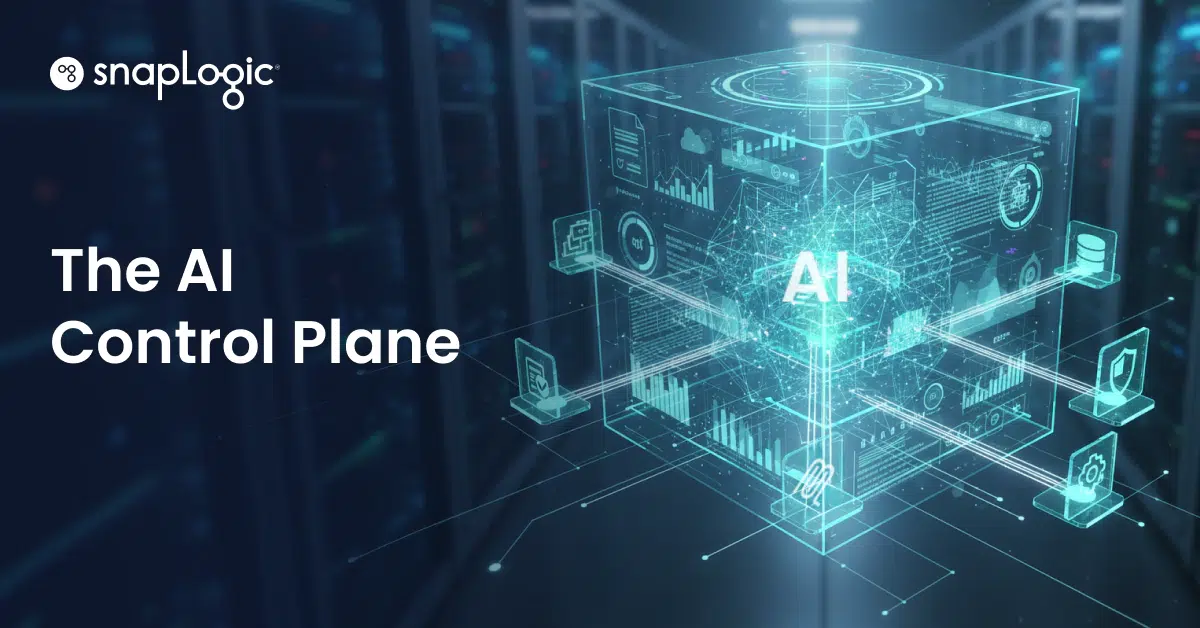
Integration is the AI control plane
For years, middleware was treated as legacy thinking. It was something to be replaced by APIs, event streams, and cloud-native primitives. Integration platforms survived, but rarely as strategic assets. AI changes that calculus.
When agents need to act across systems, someone has to decide how those actions unfold, not just technically, but operationally:
- In what order do systems get touched?
- What happens if step three fails?
- What data is masked?
- What policies apply?
- Who gets notified?
These are not questions MCP answers. They’re questions integration layers have answered for decades. What’s different now is the caller.
When integration services are exposed as MCP endpoints, enterprises stop exposing raw mechanics and start exposing capabilities. Instead of giving AI ten different ways to manipulate customer data, the enterprise gives it one governed way to onboard a customer. Instead of dozens of billing actions, there’s one “resolve billing issue” capability. The complexity doesn’t disappear. It’s absorbed.
This is what a control plane does. It centralizes decision-making about execution so the rest of the system doesn’t have to improvise. Agents remain flexible. Execution becomes stable. Autonomy becomes governable.
Coordination is what turns intelligence into trust.
Why this moment will matter in hindsight
Every major platform shift follows the same arc. Early success gives way to complexity. Complexity demands coordination. Coordination gives rise to infrastructure that looks familiar, but is smarter, more abstracted, and more central. The cloud needed control planes. Microservices needed service meshes. APIs needed gateways.
AI needs a nervous system.
The difference this time is speed. MCP compressed years of architectural evolution into months. Enterprises don’t have the luxury of rediscovering these lessons slowly. They can let AI execution emerge organically (e.g., accepting sprawl, risk, and eventual retrenchment) or they can treat integration as the control plane that makes autonomy viable at scale. One path optimizes for velocity today. The other optimizes for survival tomorrow.
In hindsight, MCP won’t be remembered as the moment AI learned to use tools. It will be remembered as the moment enterprises realized that execution is the hard part. And that intelligence without coordination is just another form of instability.
The AI control plane won’t trend on social media. But it’s forming now, under real pressure, in real systems. And as always, the infrastructure that matters most is the infrastructure you only notice when it’s missing. Because in complex systems, whether biological or digital, intelligence is optional. Coordination is not.
Learn more about Agentic Integration, and book a demo to see it in action.
Explore the AI control plane series
Part 1: Middleware is the new control plane for AI
Understand how MCP reshapes enterprise architecture and collapses the distance between intent and action.
Part 2: What a real AI control plane looks like before MCP sprawl sets in
Learn the execution primitives, governance, and oversight that ensure autonomous systems run safely and predictably.
Part 3: How to run the AI control plane without turning autonomy into chaos
This post provides a practical operating model for scaling AI agents, managing risk, and building trust in production.
Part 4: Making Trust Visible: The Foundation for Agentic Scale
How to build a trust fabric through capabilities, auditable decision records, and tiered control to safely govern AI agents in the enterprise.
Part 5: The Governance Engine: How Enterprises Maintain Control Over Agentic AI
Explore building a scalable governance system and capability catalog to maintain control, auditability, and durability over autonomous AI agents.
Part 6: The Enterprise Rollout: Hybrid Execution and the Path to Operational AI
Understand the migration path and architectural pattern of centralized governance with distributed execution to achieve operational AI across hybrid enterprise environments.