


Continuing my series on the AI control plane, in Part 1, Middleware Is the New Control Plane for AI, I explained why the Model Context Protocol (MCP) is such a pivotal shift in enterprise architecture. MCP shrinks the distance between intent and action by giving AI models a standardized way to discover and invoke tools across systems.
In Part 2, What a Real AI Control Plane Looks Like (and How to Build One Before MCP Sprawl Builds Itself), I explored why MCP alone does not make a control plane. MCP solves the “N×M” problem of connecting models to tools, but it does not define how actions are governed, monitored, or constrained once agents operate in production.
This post builds on that foundation by tackling the next question: how do enterprises actually operate the AI control plane? The risk is not that MCP fails, but that MCP succeeds while the enterprise does not adapt its operating model. MCP is evolving into infrastructure under the Linux Foundation’s Agentic AI Foundation (AAIF), making this moment critical for moving beyond experimentation into governed, production‑grade autonomy.
Capabilities first, not tools
A common pattern in early MCP adoption is to expose whatever team owns directly as a tool: scripts, queries, workflows, or microservices. That approach accelerates initial progress but creates fragmentation because it exposes mechanics rather than business meaning. Tools describe what can be called; enterprises care about what should happen.
The AI control plane should expose capabilities that represent business outcomes you are willing to stand behind. A capability is not “update customer record” or “apply discount.” It is “resolve a billing issue” with defined sequencing, retries, approval gates, and built-in audit logging.
This shift from tools to capabilities is a prerequisite for coordinated, governed execution: it ensures agents invoke high‑level, predictable actions rather than stitching atomic operations together in unpredictable ways.
Treating capabilities as products means they must have ownership, clear contracts, observable behavior, versioning, and rollback plans. This is where integration becomes execution infrastructure: what was once plumbing now carries the semantic weight of business logic backed by governance and traceability.
Defining where policy enforcement belongs
Once capabilities are the unit of execution, the next question is where guardrails are enforced. In a live system, decentralizing policy enforcement leads to fragmentation and inconsistent outcomes.
A pragmatic operational pattern that enterprises adopt is:
- Agents decide intent, interpreting user goals into structured tasks.
- The control plane enforces policy, determining what actions are allowed, under what conditions, and with which approvals.
- Workflows execute deterministically according to governed patterns, not ad‑hoc sequences.
- Systems of record remain stable and predictable, with execution confined to controlled paths.
This ensures that agents never call systems like Salesforce or billing endpoints directly. The only reliable path in production is through a governed capability that enforces enterprise policy by default.
When policy enforcement can be bypassed, it eventually will be, which undermines operational reliability.
Manage autonomy with execution tiers
A control plane must also define how autonomy is scaled. Not all actions carry the same risk. Enterprises benefit from organizing operations into tiers that reflect blast radius and governance needs.
A common tiering structure includes:
- Read‑only context operations, such as search and metadata retrieval
- Reversible actions like creating tickets or draft documents, which require basic observability
- Production changes such as deployments, access grants, refunds, or discounts, which demand policy checks and approvals
- Irreversible or regulated actions, such as data deletion or sensitive exports, require strong approvals and audit trails
MCP provides authorization at the transport layer, but it does not define these enterprise policies. Execution tiers make policy explicit and enforceable at runtime.
Organizing the control plane team
Where does governance live? Successful enterprises treat the control plane as a platform function rather than a project. This team does not build every capability, centralize all business logic, or become a queue for requests. Instead, its mandate includes:
- Publishing and maintaining the capability catalog with clear ownership, versioning, and documentation.
- Defining policy enforcement primitives such as identity, scopes, approvals, and audit processes.
- Ensuring execution guarantees like idempotency, retries, and compensating actions.
- Providing observability with end‑to‑end traces that answer questions about what occurred, why, and with what impact.
- Certifying capabilities for different execution tiers based on governance requirements
Think of this function as building paved roads, not gated checkpoints: teams can move quickly along safe, governed paths without creating friction for every action.
A disciplined capability lifecycle
Most systemic failures in autonomous systems do not stem from bad intent. They come from reasonable local decisions that compound because there is no consistent process guiding how capabilities evolve.
A disciplined capability lifecycle ensures that capabilities are introduced, tested, and scaled with transparency and control:
- Capabilities begin with a proposal that defines intent, tier, downstream systems, and data classes involved.
- In a sandbox certification phase, teams replay historical scenarios and document failure modes
- Limited release involves a scoped rollout by business unit, region, or dataset
- During promotion, tier upgrades require stricter checks around policy, approvals, and logging
- Continuous validation ensures outcomes remain stable over time, with drift detection and regression testing on prompts and behavior
This lifecycle embeds clarity at every stage, preventing reasonable choices from turning into enterprise‑wide risks.
Success metrics that matter
Early AI programs measure activity: how many tools were exposed, how many tasks agents completed, or the estimated time saved. These metrics are easy but misleading. In production, success is measured by controlled outcomes that indicate whether the control plane is functioning as intended.
Key indicators include:
- The percentage of agent actions routed through governed capabilities
- Compliance with approval rules for higher‑tier operations
- Mean time to explain an outcome across systems and actors
- Change failure rates stemming from capability updates
- Downstream system impacts, such as tickets, refunds, or access changes
- Risk‑adjusted automation rates, measuring autonomy scaled by tiered governance rather than raw volume
These metrics show whether autonomy is safe, accountable, and predictable rather than simply active.
Safe failure paths
When agents encounter failure, their instinct is often to try alternatives. This improvisation may be useful during exploration, but it is dangerous in production. Unbounded fallback behavior leads to duplicated actions, partial updates, and inconsistent states.
A simple operational rule helps contain this risk: if a Tier 2 or Tier 3 action cannot be completed through a governed capability, execution should move to a routed human workflow. Agents should not attempt alternative tool paths on their own. This rule is a policy decision, not a technical limitation, and it ensures autonomy remains reliable and accountable.
Regaining control as MCP adoption accelerates
As MCP adoption spreads, autonomy can outpace governance if left unchecked. A few decisive steps help restore control:
- Freeze the publication of raw tools as production endpoints to prevent ungoverned capabilities from becoming de facto paths.
- Stand up a capability catalog with ownership, tier, and versioning to create enterprise‑wide visibility.
- Select one high‑impact Tier 2 workflow and implement it end-to-end in the governed model. This becomes a model example: a paved road for teams to follow.
Once these are in place, organizations can turn the momentum of MCP adoption into structured, predictable execution rather than uncontrolled sprawl.
MCP is a connector, not the control plane
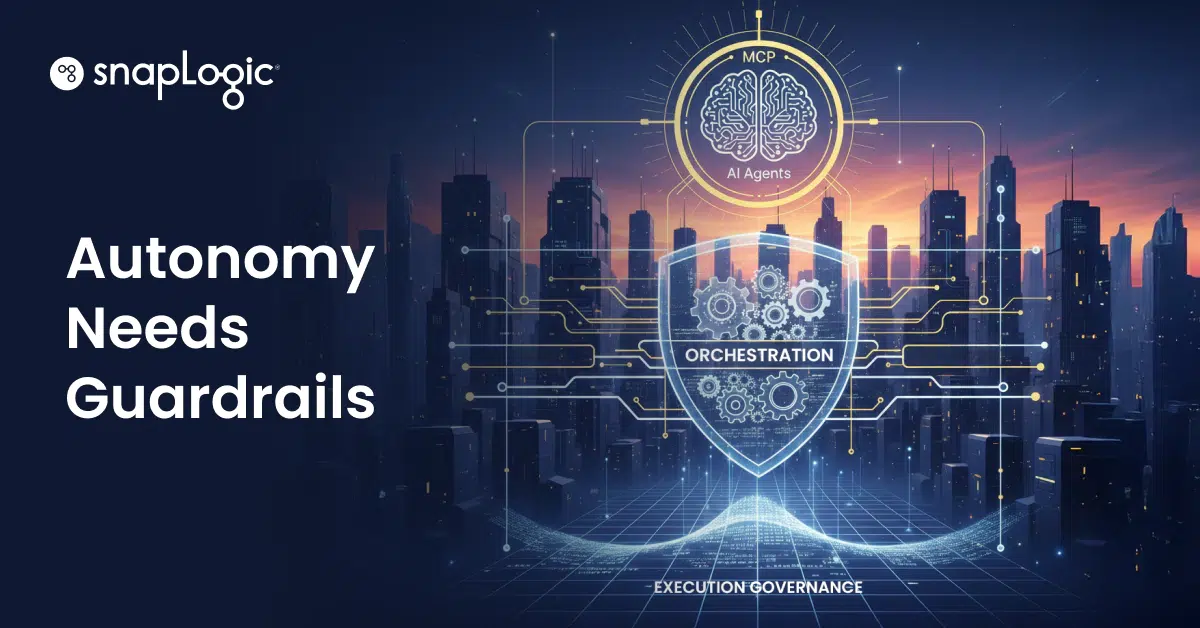
It is critical to understand that MCP is not the control plane itself. MCP is a connector standard that enables the discovery and invocation of capabilities. It does not enforce governance, guarantee safe execution, or provide accountability.
The AI control plane is the system that determines which actions are allowed, under what conditions, with what visibility, and with what oversight. Without it, organizations risk decentralization, operational limits, and reactive centralization after incidents. The control plane avoids that cycle, transforming MCP from a technical enabler into a dependable operational foundation.
Trust is the real prize
Enterprises have always struggled to execute change reliably across systems while maintaining governance, visibility, and scale. SnapLogic was built to solve these challenges, and that foundation naturally extends to the AI control plane. The platform enables capabilities rather than scripts, policy enforcement at runtime, deterministic orchestration, end‑to‑end observability, and human oversight where it matters.
In an AI‑driven enterprise, autonomy is not the hard part. Trust is. The organizations that succeed will not be those with the most agents or the most tools. They will be those who build an execution layer they can rely on to turn intelligence into action safely and predictably.
Running the AI control plane is about creating a system where autonomous action is reliable, accountable, and scalable, moving from experimentation to operational excellence. To take the next step toward a governed, production-grade AI control plane, book a demo with SnapLogic today.
Explore the AI control plane series
Part 1: Middleware is the new control plane for AI
Understand how MCP reshapes enterprise architecture and collapses the distance between intent and action.
Part 2: What a real AI control plane looks like before MCP sprawl sets in
Learn the execution primitives, governance, and oversight that ensure autonomous systems run safely and predictably.
Part 3: How to run the AI control plane without turning autonomy into chaos
This post provides a practical operating model for scaling AI agents, managing risk, and building trust in production.
Part 4: Making Trust Visible: The Foundation for Agentic Scale
How to build a trust fabric through capabilities, auditable decision records, and tiered control to safely govern AI agents in the enterprise.
Part 5: The Governance Engine: How Enterprises Maintain Control Over Agentic AI
Explore building a scalable governance system and capability catalog to maintain control, auditability, and durability over autonomous AI agents.
Part 6: The Enterprise Rollout: Hybrid Execution and the Path to Operational AI
Understand the migration path and architectural pattern of centralized governance with distributed execution to achieve operational AI across hybrid enterprise environments.