



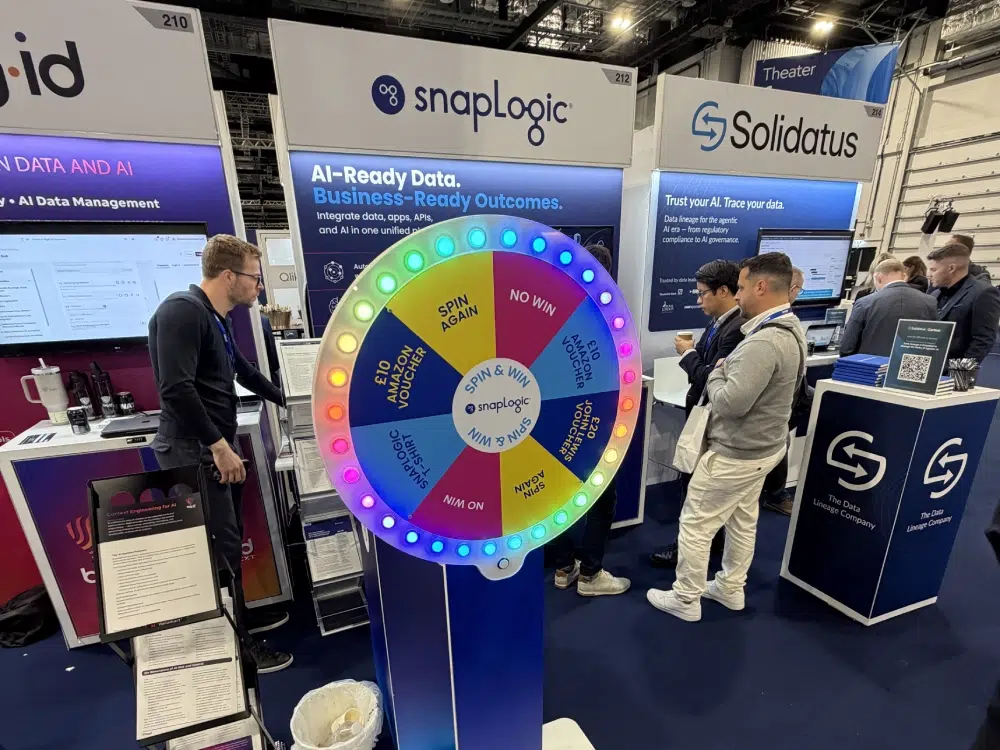
Last week, SnapLogic attended this year’s Gartner Data & Analytics event in London. As the name indicates, this is very much a hometown crowd for us, sharing the same concerns and priorities that we have ourselves. The conversations were interesting and rewarding, whether with existing customers eager to learn about our recent activities or with individuals we had not previously had the opportunity to work with.
The pressure to prove AI value
The theme of the event was clear right from the opening keynote, which brought home the rising pressure to deliver real value that can be measured with concrete returns on the investments that companies have already made in AI.
As the slides had it:
“Thanks to AI, we have everyone’s attention.
The downside is, we have everyone’s attention!”
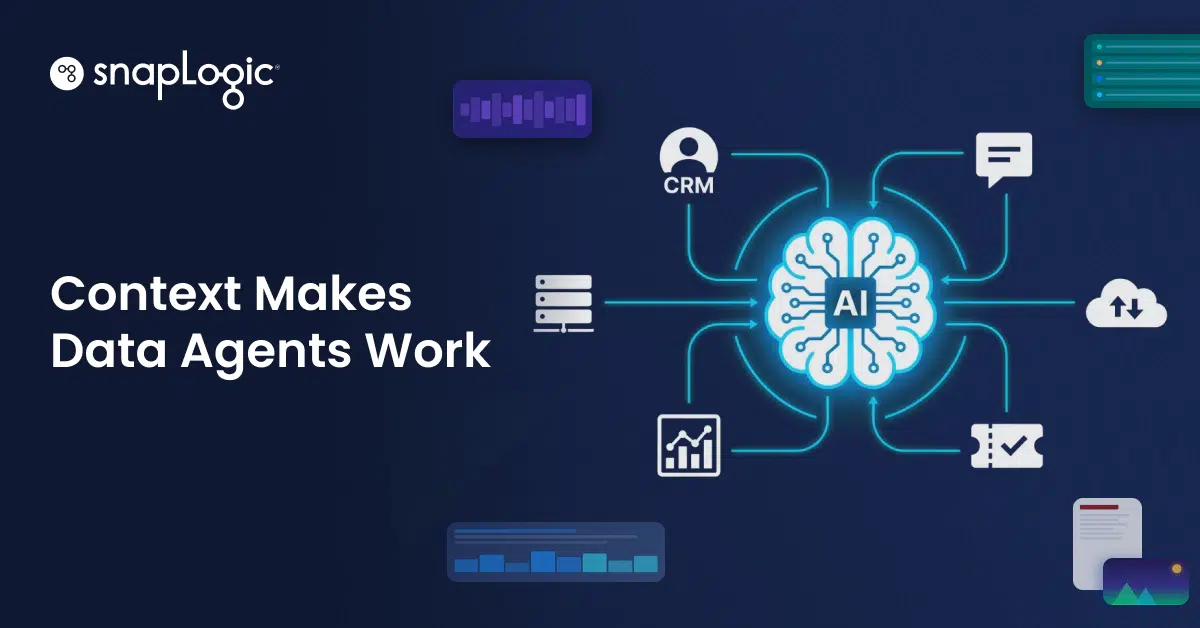
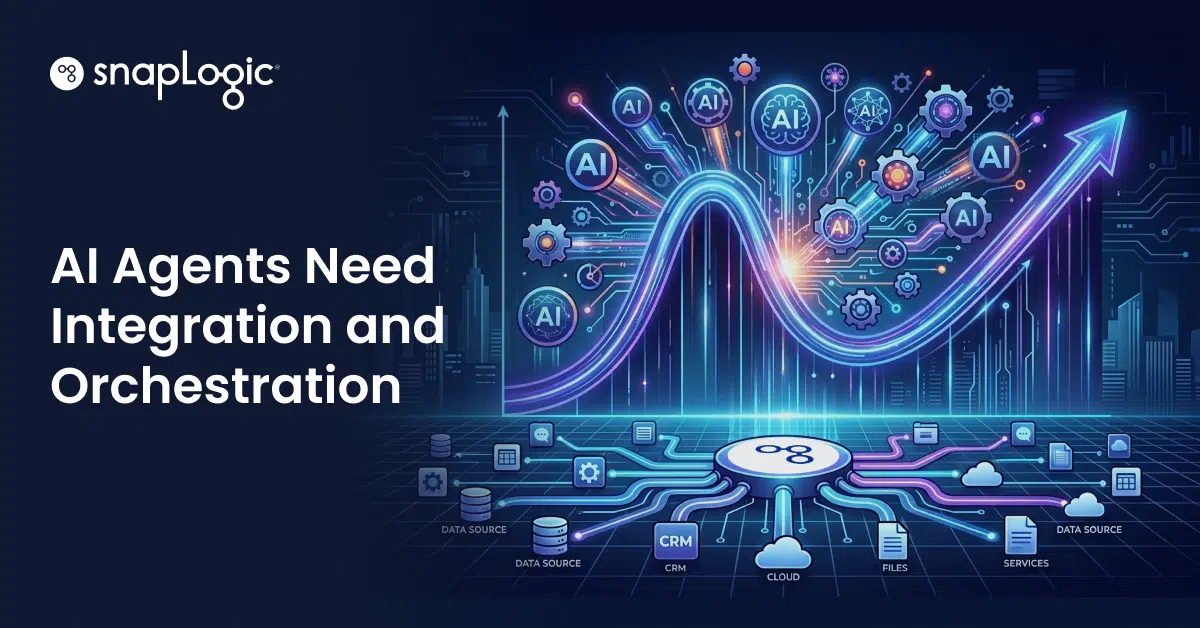
For too many organisations, AI is still an expensive experiment. The missing link is the connection to systems, apps, and data, which are used to run the business today. Without the context that those integrations bring, agents will be unable to act in any real sense.

Integration as the missing link: the CCB story
This was also the point that I was able to make in telling the story of what we have been able to build together with Cambridge and Counties Bank. If you were not at the show, you can watch David Holton, Chief Transformation Officer of the bank, tell the story at AgentFest earlier this year.
The bottom line is that true return on investments (ROI) requires careful process and architecture design. The combination of integration with core business systems, new flexible agentic AI capabilities, and predictable deterministic logic provides human experts with what they need to take advantage of new opportunities and provide new outcomes.
From human-in-the-loop to human-in-the-lead
The most interesting terminology shift was the move from “human in the loop” to “human in the lead.” Users are no longer just an escalation step for error handling, or worse, expected to identify errors without slowing down processes that now operate at machine speed.
This reframing matters because it changes how organizations think about process design from the ground up. Rather than bolting human oversight onto an automated workflow as a safety net, the goal becomes designing processes where humans are equipped with the right context to make better decisions faster. AI handles the volume and the pattern recognition; people provide the judgment, accountability, and strategic direction that machines can’t replicate.
Instead, process redesign can supply the ambient context that both human and AI users need to operate effectively. The organizations getting this right aren’t just automating existing workflows. They’re rethinking what those workflows are for, and who or what is best placed to own each step.
Recommended reading: The Era of AI Execution Has Arrived: Recapping AgentFest 2026
Governance is a lagging capability
An issue repeatedly raised by both Gartner analysts and attendees is that governance is a lagging capability in the AI domain. This means that exciting new capabilities struggle to reach production due to fears of unwanted consequences. In fact, for the first time now, IT capabilities are evolving faster than the business can absorb.
This brings me back to one of the points that David from CCB makes when he tells the story of our joint project. He advises his peers to focus the new AI capability on capacity constraints in the existing situation. Success means connecting AI to a measurable strategic objective: targeting high-friction workflows with clear ROI.
This tight feedback loop with the real world ensures that impact is prioritised over experimentation, and that projects do not get stuck in open-ended experimentation. Not that there is anything wrong with learning. But at some point, it becomes more productive to learn by iterating on something that is already working, and deriving feedback from its impact and its reception.
Why the data integration market is growing faster than expected
This theme also came up in Gartner’s predictions for the next five years of AI: cost pressures won’t stop AI, but tool siloes and cutting corners on semantics will prevent value realisation. SnapLogic customers have a leg up here, with an agent-enabled abstracted data fabric overlaying their entire landscape and closing the gaps between previously disconnected systems.
This holistic and interconnected view must also include what has been described as the “dark matter” of business processes: unstructured data that sits idly in files (e.g., PDFs, spreadsheets, CSV files, and the like) all across the enterprise IT landscape.
This is the reason why a Gartner presenter shared that the data integration market is growing at 13.4%, way above the company’s estimate from last year’s market share report on data integration software of around 6% growth: IT leaders everywhere have realised that a complete view of their data in context is an absolute requirement for success in the high-priority domain that is AI.

The case for federated, distributed approaches
It is, of course, not possible to achieve this view with a single centralised system, due to the time required to implement it and the inevitable disruption that follows. After all, the existing systems were chosen to support particular business needs, and are presumably still doing so if they are still in place.
Gartner recommends distributed and federated approaches rather than centralisation, because of the risk. They report that the combination of distributed data management with federated data governance unlocks 3x better outcomes.
This very point was then specifically quoted back to me by a current SnapLogic customer. They are planning a further expansion of their usage for precisely this reason, underlining the alignment between this high-level objective and the concrete capabilities of our platform.
Start with the customer, not the process
I will close with an excellent piece of advice from the last presentation I attended at the event: start with the customer, not the current process. After all, that process was built around realities and limitations that may no longer apply.
A better frame to view this through would be:
- What data do we need to create new types of customer value?
- How can we most efficiently gain access to that data while respecting all the relevant security, governance, and compliance requirements?
The organizations that keep these questions at the center of their AI strategy are the ones most likely to move from experimentation to lasting impact.
From experiment to enterprise: the integration imperative
The thread running through every conversation at Gartner Data & Analytics London was clear: the era of AI experimentation is giving way to the era of AI accountability. Organizations are no longer asking, “Can AI do this?” They’re asking, “What is it actually delivering?“
The answer, consistently, comes back to integration. AI without context is AI without impact. Whether it’s connecting to the systems of record that run the business, surfacing the unstructured “dark matter” sitting in files across the enterprise, or designing processes where humans are genuinely in the lead, the organizations seeing real returns are the ones that treated integration as a strategic priority, not an afterthought.
The CCB story makes this concrete: measurable ROI comes from pairing AI capability with deliberate architecture, targeting high-friction workflows, and building tight feedback loops with real-world outcomes. Governance and a customer-first lens on process design aren’t constraints on ambition. They’re what turns ambition into results.
For those still navigating this shift, the advice is simple: don’t start with what AI can do. Start with what your customers need, the data required to serve them, and the systems that already hold it. That’s where the value lives.
Join us on June 10 for a discussion on “Governing AI Agents: Secure Access, Identity, and Control at Enterprise Scale.” Register for the North America broadcast or the EMEA broadcast.