



The September 2026 release focuses on four priorities: accelerating SnapGPT build workflows, giving AI agents a comprehensive toolkit to execute actions across enterprise systems, expanding our Amazon Bedrock RAG capabilities with native Managed Knowledge Base ingestion and retrieval, and refining day-to-day productivity in the SnapLogic platform’s Designer and Monitor.
Together, these enhancements enable enterprise teams to scale AI adoption, automate complex operational processes, and achieve faster time-to-value safely across their infrastructure. Here’s what’s new.
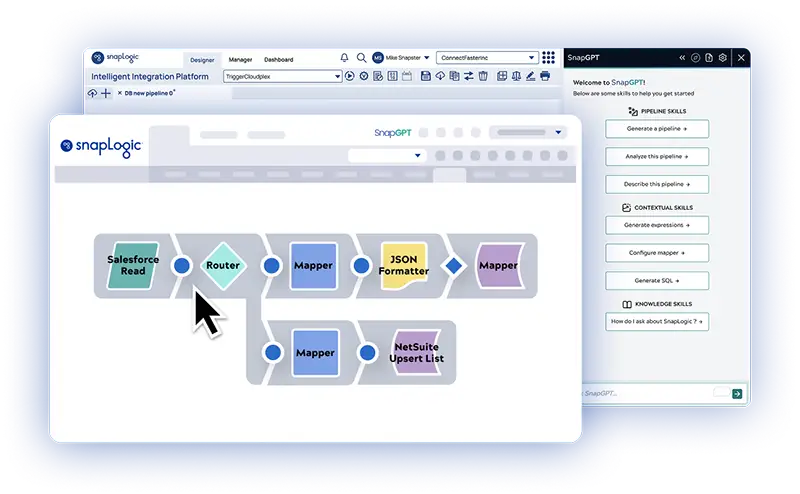
Create agents and MCP servers using natural language generation with SnapGPT
SnapGPT can now generate complete agent and MCP Server pipelines directly from natural language prompts. Describe what you want built, and SnapGPT produces the pipeline structure itself, rather than a starting point you still have to assemble by hand.
The SnapGPT panel also got a set of usability upgrades: persistent chat history so past conversations can be pinned, searched, and renamed instead of re-explained, a resizable detach mode so the panel can float anywhere on screen while you work the canvas, and refreshed skill descriptions that make it clearer what SnapGPT can actually do for a given task.
One more addition worth knowing about: AI-generated pipeline summaries can now be saved directly to the Notes field in the Info tab. That keeps documentation attached to the pipeline itself instead of living somewhere else that eventually goes stale.
Zero-code MCP tooling
This release adds 545 new prebuilt agentic tool pipeline patterns across 44 enterprise services, including Snowflake, Workday, Salesforce, and SAP S/4HANA. These patterns make it easier to expose enterprise capabilities as tools through an MCP Server, reducing the custom integration work typically required for authentication, error handling, and edge cases.
With this library, agents can start acting on new systems faster, and scaling from one connected service to many requires far less repetitive integration work. AI Observability now supports bulk MCP log downloads, so you can export complete fleet request logs for specific time windows in one action instead of pulling them piecemeal.
The SnapLogic MCP Server also gained 15 new tools that cover diagnostics and administration, plus new tools to manage large file uploads and execution controls. Together, these let agents monitor runs, check environment health, and manage uploads and executions without leaving the MCP session, closing the gap between an agent that can trigger automation and one that can actually operate it.
AgentCreator and Amazon Bedrock Managed Knowledge Bases
Three new Amazon Bedrock Snaps extend SnapLogic’s existing Bedrock RAG capabilities with native support for Amazon Bedrock Managed Knowledge Bases. MKB Ingest Documents enables pipelines to load enterprise content directly into a managed knowledge base, while MKB Retrieve and MKB Agentic Retrieve provide semantic and multi-step retrieval against that content.
Teams can build support chatbots grounded in their own documentation, document-based Q&A, and scheduled knowledge base refreshes without needing to deploy separate retrieval infrastructure.
Tool-pipeline timeouts are now configurable per individual pipeline. Long-running operations can get more time, and fail-fast scenarios can be tightened up, tuned to the actual workload instead of one common setting.
Designer and UI usability
The Execution Statistics panel in the SnapLogic platform now has a direct “Open in Monitor” link and a one-click option to download standard or full runtime logs, cutting out the tab-switching that used to slow down debugging. Designer also shows real-time avatars of teammates currently viewing the same pipeline, helping teams coordinate when multiple users may be working in the same pipeline. This one needs to be enabled by your Customer Success Manager (CSM).
Editing informational fields like Label, Notes, and Tags no longer triggers revalidation, which makes small documentation edits noticeably faster on larger pipelines.
Monitor and platform enhancements
API metrics history in Monitor now extends to 45 days, providing a broader timeframe to identify trends and diagnose issues that might not appear within a shorter lookback window. Note that your CSM must enable this feature for your account.
The Asset Catalog’s Related Assets table now shows “Last Used” timestamps for referenced accounts and pipelines, useful for anyone auditing what’s actually still active versus what’s quietly gone stale.
The Cache Service has expanded to cache Ultra and ground Triggered Tasks locally on Snaplex nodes, reducing control-plane latency and adding resilience during high-frequency runtimes or traffic spikes.
More to come
This release highlights our continued commitment to expanding AI capabilities, streamlining workflows, and enhancing operational control. To explore the full list of features, enhancements, and patches included in this release, check out the full September 2026 Release Notes from SnapLogic.
SnapLogic is on tour! Join us for IntegrateAI 2026 in your nearest city:
- Dallas, TX | October 6 | Register for Dallas
- San Francisco, CA | October 28 | Register for San Francisco
- London, UK | November 17 | Register for London