



Enterprise productivity depends on how effectively systems, data, and workflows operate together. As organizations rely on an expanding portfolio of applications, productivity increasingly reflects the quality of integration across those systems. Manual work, inconsistent data, and disconnected workflows introduce friction that slows execution and reduces operational efficiency.
Core business processes such as quote-to-cash, customer onboarding, supply chain coordination, and financial reconciliation rely on timely, accurate information flowing between applications. When enterprise systems are not integrated, delays and errors propagate across teams, affecting customer experience, revenue recognition, and business agility. In this context, application integration becomes a foundational capability for sustaining productivity at scale.
Organizations that unify applications and data through modern integration platforms reduce manual effort, accelerate workflows, and enable teams to focus on higher-value work. These improvements translate into measurable productivity gains across IT and business functions.
What is enterprise productivity in the context of integration?
In an enterprise environment, productivity reflects how efficiently people, processes, and systems work together to execute business operations.
From an integration perspective, productivity improves when applications exchange data automatically, workflows advance without manual intervention, and teams operate with consistent, real-time information.
Integration platforms contribute to enterprise productivity by reducing redundant tasks, minimizing delays between systems, and enabling coordinated execution across departments.
What is an enterprise integration platform?
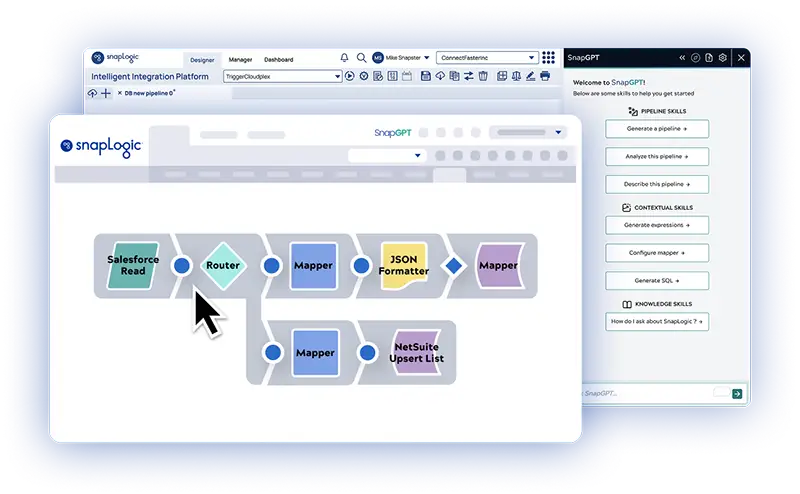
An enterprise integration platform is software that connects applications, data sources, and workflows across an organization. These platforms support application integration, data integration, API management, and workflow automation, enabling systems to exchange information reliably at scale while maintaining governance, security, and operational consistency.
Enterprise integration platforms are commonly used to orchestrate business processes that span multiple systems and teams.
Why application integration affects enterprise productivity
Modern enterprises operate across ecosystems that include CRM, ERP, finance, HR, marketing automation, customer service platforms, and data platforms. When these systems are integrated, events in one application automatically trigger actions in others. Records remain synchronized, approvals move efficiently, and teams work from shared context.
Integrated application workflows improve productivity in several ways:
- Automation reduces manual effort: Routine tasks such as data entry, approvals, and notifications are executed automatically.
- Operational alignment improves: Teams rely on consistent, real-time data across systems.
- Governed self-service becomes possible: Low-code and no-code tools enable business users to build workflows while IT maintains security and compliance standards.
Together, these capabilities increase throughput, reduce errors, and improve operational reliability.
Types of enterprise integration platforms
The enterprise integration platform market supports a range of organizational needs, from large-scale, mission-critical environments to localized, departmental automation. Understanding these categories helps organizations align platform selection with productivity objectives.
Enterprise integration platforms
Enterprise integration platforms are designed for complex environments with large application portfolios, long-running workflows, and strict governance requirements. These platforms prioritize scalability, reliability, security, and centralized management. They typically combine application integration, data integration, API management, and workflow automation within a single platform.
Top platforms include:
- SnapLogic: a cloud-native, AI-ready iPaaS with prebuilt connectors, low-code pipelines, and workflow automation designed for enterprise-scale productivity.
- MuleSoft Anypoint Platform: focuses on API-led connectivity for complex enterprise architectures.
- Dell Boomi: provides a broad connector ecosystem with hybrid and multi-cloud support.
- Workato: combines integration and business process automation with strong collaboration between IT and business teams.
- Informatica IICS: supports advanced integration scenarios with an emphasis on data integration and governance.
- Oracle Integration Cloud, IBM App Connect, and TIBCO Cloud Integration: offer enterprise-grade integration and API-driven workflows aligned with large application ecosystems.
Lightweight and no-code automation platforms
Lightweight and no-code platforms focus on rapid implementation and team-level automation. These tools support simpler workflows with minimal setup and are commonly used for departmental use cases where scale and centralized governance requirements are lower.
Examples include Zapier, Make, Celigo, Tray.io, and Jitterbit.
Platform selection depends on organizational scale, integration complexity, security requirements, and productivity goals.

How integration platforms improve productivity outcomes
Modern integration platforms unify application integration, data movement, and workflow automation. This unified approach allows organizations to:
- Reduce repetitive manual work
- Accelerate operational cycles
- Improve collaboration between IT and business teams
- Respond more quickly to changing business requirements
As systems become connected and workflows automated, integration platforms function as productivity enablers rather than standalone technical tools.
Examples of productivity improvements from integration platforms
Organizations using enterprise integration platforms consistently report productivity improvements, including reduced manual data handling, faster onboarding and order-to-cash cycles, and increased capacity for innovation-focused work.
SnapLogic highlights measurable outcomes through customer results. A Forrester Total Economic Impact™ study found that SnapLogic improved integration efficiency by enabling data engineers and developers to focus on higher-value activities, delivering productivity benefits valued at $1.7 million.
“Using a modern integration platform, we significantly reduced development time. Business users can create integrations across applications, including in remote locations. This approach optimized resources and improved overall productivity.”
General Manager of Enterprise Integration
Frequently asked questions about enterprise integration platforms
An enterprise integration platform connects applications, data sources, and workflows across an organization while supporting governance, security, and scalability.
They improve productivity by automating workflows, synchronizing data across systems, and reducing manual effort, enabling faster execution and fewer errors.
CRM, ERP, finance, HR, marketing automation, customer service platforms, and data platforms are commonly integrated.
Enterprise platforms support large-scale, governed environments, while no-code tools typically focus on simpler, team-level automations.
Governance ensures integrations meet security, compliance, and operational standards as environments scale.
Summary: enterprise integration and productivity impact
Enterprise integration platforms support productivity by connecting applications, automating workflows, and enabling reliable data flow across systems. By reducing manual effort and improving operational alignment, these platforms help organizations execute faster, improve accuracy, and maintain governance as complexity increases. Strategic application integration functions as a multiplier for enterprise productivity and long-term operational effectiveness.