


Quick answer: What is the best iPaaS for manufacturing?
The best iPaaS for manufacturing is one that unifies data across MES, ERP, PLM, and supply chain systems; supports AI-native and agentic integration; and delivers enterprise-grade governance at scale. SnapLogic is a leading choice for global manufacturers because of its AI-ready, agentic architecture, prebuilt manufacturing connectors (Snaps), and unified control plane, enabling digital transformation from the shop floor to the supply chain.
In today’s competitive manufacturing landscape, operational excellence is non-negotiable. Many global enterprises still struggle to achieve true digital transformation because critical data remains trapped in siloed systems, including Manufacturing Execution Systems (MES), Product Lifecycle Management platforms (PLM), Enterprise Resource Planning systems (ERP), and supply chain platforms.
The result? Reactive firefighting, wasted working capital, slower concept-to-cash cycles, and lost opportunities to optimize production and fulfillment.
Integration Platform as a Service (iPaaS) has emerged as a key enabler of Industry 4.0 — the fourth industrial revolution characterized by smart factories, IoT connectivity, and AI-driven operations. By connecting disparate systems, automating workflows, and supporting AI-driven orchestration, iPaaS helps manufacturers unlock actionable insights, improve efficiency, and accelerate innovation.
This blog explores why a modern, AI-driven iPaaS is essential for the factory of the future, compares leading enterprise iPaaS platforms, and highlights why SnapLogic is consistently chosen by enterprises seeking predictable, high-velocity operations.
What is iPaaS? (And why does manufacturing need it?)
iPaaS is a cloud-based platform that connects disparate applications, data sources, and systems. This enables automated data flows and workflow orchestration without the need for custom point-to-point integrations.
For manufacturers, this means connecting the operational technology (OT) layer (factory floor systems, IoT sensors, MES) with the information technology (IT) layer (ERP, CRM, PLM, analytics) — a convergence known as OT/IT integration. Without this, manufacturers cannot achieve real-time visibility, predictive maintenance, or AI-driven production optimization.
Key terms defined:
- MES (Manufacturing Execution System): software that tracks and controls production on the factory floor in real time
- ERP (Enterprise Resource Planning): business management software integrating financials, supply chain, operations, and HR
- PLM (Product Lifecycle Management): systems managing a product’s lifecycle from design through manufacturing to disposal
- Industry 4.0: the ongoing digital transformation of manufacturing, characterized by smart factories, IoT, AI, and cyber-physical systems
- Agentic integration: AI-driven orchestration where autonomous agents handle complex, multi-step integration workflows with minimal human intervention
Breaking down data silos
Manufacturing leaders, from VP of Operations to VP of Quality, are tasked with improving efficiency, driving AI adoption, and increasing resilience. These objectives are difficult to meet when data remains siloed, delaying decision-making and reducing visibility across the enterprise.
The core value proposition is clear: SnapLogic helps manufacturing leaders achieve enterprise-wide visibility and real digital transformation, turning fragmented operations into a predictable, high-performance system.
Common integration challenges in manufacturing:
- Shop floor data (MES, SCADA, IoT) disconnected from ERP and supply chain systems
- Manual reporting processes creating lag between production events and decision-making
- No unified data model across plants, geographies, or business units
- AI initiatives stalled because clean, connected data pipelines do not exist
- Compliance and traceability gaps due to siloed quality and genealogy data
Top manufacturing use cases powered by iPaaS
A top-tier iPaaS must solve the unique challenges of the manufacturing vertical. The most impactful use cases that manufacturers should evaluate when selecting an iPaaS platform include:
1. Enterprise-wide visibility
Predictive, real-time analytics across production, supply chain, fulfillment, and customer experience provide a single source of truth. This allows leaders to make instant decisions about production mix, global inventory, and capital usage, eliminating the blind spots that cause reactive firefighting.
2. Global manufacturing and fulfillment predictability
Eliminate reactive firefighting by leveraging AI to:
- Optimize component availability and redundancy across global supplier networks
- Align inventory turns to global demand forecasts with real-time signal integration
- Implement predictive and preventive maintenance to avoid unplanned downtime and reduce waste
3. The digital loop
Connect customer insights from CRM to engineering and production. This closed-loop integration ensures that field feedback drives product improvements, which are rapidly implemented on the factory floor, extending product life, reducing defects, and supporting continuous improvement (Kaizen) initiatives.
4. Quality and regulatory compliance
Automate audit-ready factory production records, regulatory submissions, and genealogy reporting to accelerate batch releases and reduce operational friction. For regulated industries such as life sciences manufacturing, pharmaceutical production, and defense, this is non-negotiable.
5. Smart factory and IoT data integration
Modern factories generate enormous volumes of data from IoT sensors, robotics, and edge devices. An AI-native iPaaS ingests, normalizes, and routes this data in real time — feeding digital twins, predictive models, and operational dashboards without custom code.
Top enterprise iPaaS solutions for manufacturing: a comparison
Enterprise manufacturers rely on iPaaS platforms to unify data, connect systems, and scale automation. When evaluating the best iPaaS for manufacturing, the leading platforms typically considered include:
| Platform | Strengths for Manufacturing | Considerations | Best for |
|---|---|---|---|
| SnapLogic | AI-native, agentic integration, unified control plane, prebuilt manufacturing Snaps, SnapGPT embedded AI | Enterprise-focused; best value at scale | Global manufacturers needing AI-driven orchestration and OT/IT convergence |
| MuleSoft (Salesforce) | Large connector library, strong API management, Salesforce ecosystem integration | High implementation complexity and cost | Salesforce-centric manufacturers |
| Boomi | User-friendly low-code, strong SMB presence, broad connector library | Less mature agentic AI capabilities | Mid-market manufacturers |
| Azure Integration Services (Microsoft) | Deep Azure/Microsoft ecosystem integration, strong governance tools | Requires significant Microsoft stack investment | Microsoft-first IT environments |
| SAP Integration Suite | Native SAP S/4HANA integration is strong for SAP-centric processes | Limited value outside the SAP ecosystem | Manufacturers running a full SAP landscape |
While all these platforms support enterprise manufacturing integration, SnapLogic stands out for its AI-native architecture, agentic orchestration, and unified control plane. This makes it ideal for global manufacturers who need more than connectivity. They need intelligent automation at scale.
SnapLogic’s capabilities: the difference maker
For manufacturing, the best iPaaS minimizes operational friction, removes AI-specific blockers, and delivers governance at scale.
SnapLogic excels across five key dimensions:
Agentic integration: Validate, clean, and make data available for workflows, integrations, AI initiatives, and business processes across the entire manufacturing lifecycle. Autonomous agents handle complex orchestration without constant human intervention.
AI-ready platform: LLM-agnostic architecture allows connection to any AI model, whether OpenAI, Anthropic, Azure OpenAI, or proprietary models. Augmented AI pipelines multiply human operator impact, creating a virtual AI workforce for your operations team.
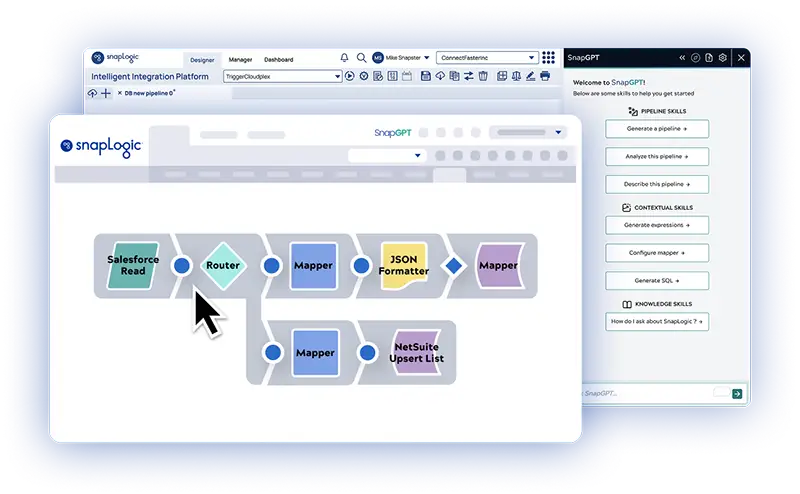
Prebuilt connectors and pipelines (Snaps): Simplify connections to MES, ERP, PLM, WMS, and supply chain systems, with embedded AI (SnapGPT) keeping data products real-time. Hundreds of Snaps eliminate the need for custom connector development.
Robust API management: Securely connect complex global supply chains with real-time monitoring for predictive maintenance and prevention of unplanned outages. Full API lifecycle management from design to retirement.
OT/IT convergence: Bridge the gap between operational technology (factory floor, IoT, SCADA) and information technology (ERP, CRM, analytics), enabling the real-time data flows that smart factory initiatives require.
By unifying data, automating workflows, and orchestrating processes across multi-cloud environments, SnapLogic delivers the enterprise acceleration and agility needed to achieve competitive advantage and market dominance.
The future of manufacturing integration
Integration isn’t just middleware. Integration is the execution layer for automation and AI in Industry 4.0. Platforms that enable enterprise-wide visibility, real-time insights, and agentic orchestration will define the next era of smart manufacturing.
SnapLogic’s AI-native, agent-ready iPaaS helps manufacturers:
- Break down data silos between MES, ERP, PLM, and supply chain systems
- Orchestrate AI-driven workflows with agentic integration capabilities
- Improve supply chain and production predictability through real-time data
- Enable continuous improvement across operations with closed-loop feedback
- Accelerate IoT and digital twin initiatives with normalized, real-time data pipelines
For enterprises pursuing the factory of the future, SnapLogic provides a unified, modern approach that transforms fragmented processes into a high-velocity, AI-powered operation.
Frequently Asked Questions (FAQ)
The following questions are commonly asked by manufacturing IT leaders and operations executives evaluating iPaaS solutions.
The best iPaaS for manufacturing depends on your specific stack and scale. For global enterprises needing AI-driven orchestration and OT/IT convergence, SnapLogic is a top choice due to its agentic integration architecture, prebuilt manufacturing connectors, and LLM-agnostic AI platform. Other strong options include MuleSoft for Salesforce-centric organizations and SAP Integration Suite for SAP-heavy environments.
iPaaS stands for Integration Platform as a Service. In manufacturing, it refers to a cloud-based platform that connects factory floor systems (MES, SCADA, IoT) with business systems (ERP, CRM, PLM) to enable real-time data flows, workflow automation, and AI-driven production optimization.
iPaaS is foundational to Industry 4.0 by enabling OT/IT convergence, connecting operational technology (sensors, robotics, edge devices) with information technology (ERP, analytics, AI models). This connectivity is what makes smart factories, digital twins, and predictive maintenance possible at scale.
Agentic integration uses AI agents to autonomously manage complex, multi-step integration workflows (such as automatically reconciling supplier data discrepancies, routing quality exceptions, or triggering supply chain responses to demand signals) without constant human intervention. SnapLogic’s agentic platform is purpose-built for this level of automation.
Both are enterprise-grade iPaaS platforms. SnapLogic differentiates with an AI-native, agentic architecture and embedded SnapGPT, making it better suited for manufacturers investing in AI-driven automation. MuleSoft has a larger connector library and stronger Salesforce ecosystem integration. SnapLogic typically offers a lower total cost of ownership for complex, multi-system manufacturing environments.
Yes. A modern iPaaS like SnapLogic provides prebuilt connectors (Snaps) for leading MES, ERP (SAP, Oracle, Microsoft Dynamics), and PLM platforms (PTC, Siemens, Dassault). These prebuilt integrations dramatically reduce implementation time compared to custom API development.
SnapLogic integrates with a broad range of manufacturing systems, including SAP S/4HANA, Oracle ERP, Microsoft Dynamics, Salesforce, MES platforms, SCADA systems, IoT data streams, WMS (Warehouse Management Systems), quality management systems, and supply chain platforms. SnapGPT enables natural language pipeline creation for new integrations.
See SnapLogic in action
Reading about architecture and AI readiness is one thing. Seeing it in action is another. Explore the SnapLogic Platform Tour to experience:
- Unified integration across apps, data, and APIs
- Embedded generative AI with SnapGPT for natural language pipeline development
- Low-code AI agent development for manufacturing workflows
- Centralized governance and monitoring across global plant operations
- Cloud-native execution across hybrid environments (cloud, on-premise, edge)
Take the SnapLogic Platform Tour and see how a purpose-built, AI-native iPaaS can transform manufacturing operations — from the factory floor to the boardroom.