




Microsoft BizTalk Server has powered enterprise integration for decades. It helped organizations connect complex back office systems and automate critical processes long before cloud and SaaS became the norm. With Microsoft confirming BizTalk Server 2020 as the final release and mainstream support scheduled to end in 2028, many organizations now see this moment as a strategic inflection point.
Today’s enterprises operate in a constant state of change. SaaS sprawl, API driven ecosystems, real-time data expectations, and AI-powered automation have redefined what integration needs to deliver. Integration is no longer just about moving data between systems. It is about enabling intelligence across the business by connecting applications, data, and workflows that allow AI to learn, adapt, and act.
As a result, many organizations are reevaluating BizTalk and looking toward modern integration platform-as-a-service (iPaaS) solutions to support what comes next. The focus is shifting from maintaining legacy integration infrastructure to building a foundation that supports cloud-scale, real-time operations and AI-driven innovation.
BizTalk solved yesterday’s integration problems
BizTalk was designed for stability and control in a primarily on-premises world. It excelled at connecting ERP systems, managing B2B and EDI workflows, and orchestrating long-running, message-based processes.
For its time, that model worked well. Integration patterns were predictable. Change happened slowly. Infrastructure was planned years in advance.
Modern integration environments look very different. Business teams expect new applications to connect in weeks, not months. Data needs to move in real time across cloud platforms. AI initiatives depend on clean, accessible, well-governed data flows. These demands expose the limits of a centralized, monolithic integration backbone.
How modern iPaaS changes the integration model
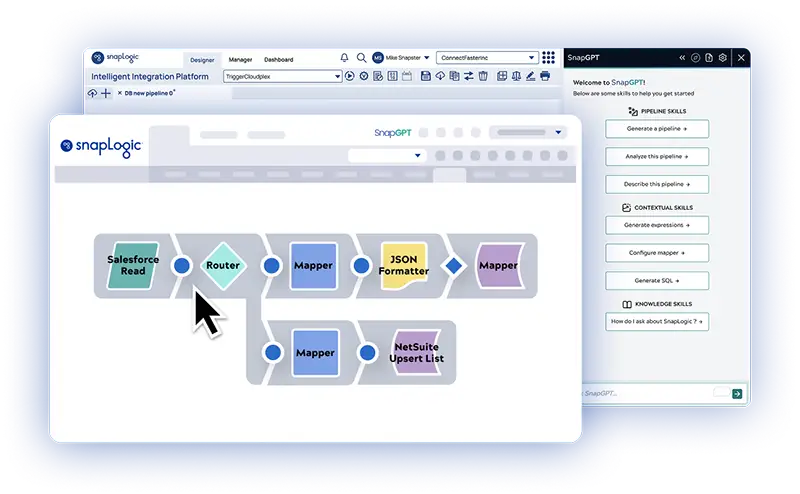
Today’s iPaaS is built for continuous change. They are cloud-native, modular, and designed to support hybrid environments where on-prem systems coexist with SaaS and cloud services.
Instead of focusing only on message movement, an iPaaS enables API led, event-driven, and real-time integration patterns. They provide prebuilt connectors for hundreds of applications, elastic scalability, and platform-managed operations.
Most importantly, iPaaS aligns integration with business outcomes. Teams can move faster, experiment safely, and adapt integration flows as requirements evolve. This shift turns integration from a bottleneck into a catalyst for innovation.
Why migrating from BizTalk is harder than it looks
Many organizations underestimate the complexity of moving away from BizTalk. The challenge is not simply replacing technology. It is untangling years of embedded business logic and operational dependencies.
BizTalk environments often contain undocumented rules hidden inside orchestrations, maps, and pipelines. What appears to be plumbing frequently represents mission-critical decision logic. Over time, point-to-point integrations accumulate, creating dependencies that are difficult to trace.
Custom schemas and transformations add another layer of complexity. XSLT maps and proprietary structures rarely translate cleanly to modern platforms. They must be rethought and redesigned rather than lifted and shifted.
There is also a human factor. BizTalk often works reliably, even if it is slow and expensive to maintain. Teams are understandably risk-averse, especially when integration failures can disrupt core business operations.
The result is that many migration efforts stall because they focus on technology replacement without addressing integration strategy, process design, and operating models.
Why lift and shift approaches fail
Treating BizTalk migration as a one-time infrastructure project is a common mistake. Modern iPaaS platforms are not cloud-hosted versions of legacy integration tools. They expect API-first thinking, event-driven workflows, and composable architectures.
Without reimagining how integration supports the business, organizations simply recreate old constraints on new platforms. This leads to disappointing outcomes and missed opportunities to modernize how teams work.
Successful migrations focus on incremental modernization. They prioritize high-value use cases, enable hybrid coexistence, and gradually shift integration ownership closer to the business.
Reframing BizTalk replacement for today’s enterprise
The most effective BizTalk replacement strategies are framed as evolution, not disruption. This is not about ripping and replacing systems overnight. It is about enabling the business to move faster without breaking what already works.
For IT leaders, the conversation centers on agility, scalability, and readiness for AI and automation. For business leaders, the focus is on removing integration bottlenecks that slow growth and innovation.
Modern integration platforms make it possible to support new digital initiatives while reducing operational overhead. They allow organizations to modernize at their own pace and align integration investments with strategic priorities.
Integration is the foundation for what comes next
BizTalk connected systems in a stable world. Modern iPaaS platforms enable change in a dynamic world.
As enterprises invest in AI, automation, and new digital experiences, integration becomes more than plumbing. It becomes a strategic foundation for adaptability and growth.
For organizations still relying on BizTalk as their primary integration backbone, the biggest risk is not change. It is standing still while the business moves on.
SnapLogic helps enterprises modernize integration with a cloud native, AI-powered platform designed for speed, scale, and continuous evolution. By shifting integration from a constraint to a capability, organizations can build what comes next with confidence.