



The financial industry has always been a pioneer in the adoption of new technology in the pursuit of efficiency and a competitive edge. That push to investigate new technological possibilities interacts in interesting ways with the sheer scale of many of these organizations, which means that there is also pressure to standardise and systematise the new technology as quickly as possible.
All of this means that it’s always worth talking to people in the finance industry, both to understand their own projects and as leading indicators of developing themes that will be affecting other industries in the near future.
What we heard at FIMA
In this spirit, the SnapLogic team was out in force at FIMA, an event dedicated to data management in the financial industry. Many of the organisations represented at the event are of course, SnapLogic customers already, such as Voya Financial.
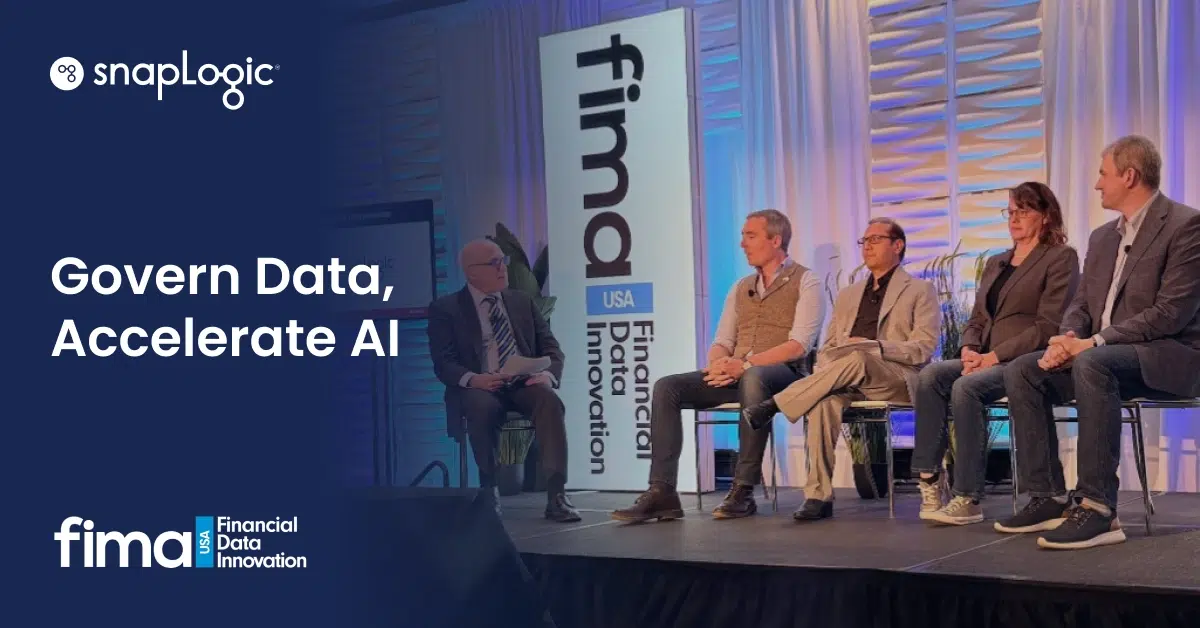
Kevin Hickey, who works for Voya as the VP of Architecture for Digital, Data, and AI, and I were on a panel talking about “Metrics that Matter: Operationalizing Data Governance for Measurable Enterprise Outcomes.” In actual fact, all but one of the companies represented on the panel are already SnapLogic customers!
Kevin has been working with SnapLogic for some years now to implement a technological transformation across all of Voya’s businesses. Some key factors in his selection of SnapLogic:
- The platform’s alignment with his existing and planned future technological estate, from mainframes to Azure cloud and Databricks
- Robust set of connectors, including advanced patterns like ELT, critical for his lakehouse project with Databricks
- Developer experience: easy to use, scalable, and performant
From technical debt to data debt
Many other organisations at FIMA 26 had similar goals. And in fact, one of the early takeaways for me was about the shift in the conversation from “technical debt” to “data debt.” Many organisations have been trying to treat legacy modernisation as platform convergence, replacing individual solutions with a single source of truth.
This sort of rationalization rarely works, so the end result is all the pre-existing complexity, with an additional incomplete overlay over the top.
There is also a perception that modernization competes with new initiatives such as AI. But as Kevin and I discussed during our panel, that is actually the opposite of the real situation. In fact, the rush to implement new AI-powered services is acting as a catalyst to existing initiatives, integrating and normalising data between existing systems.
Long-running projects to make data accessible across technical and organizational boundaries are receiving a sudden new impetus as organisations understand their relevance to their AI ambitions.
Unlocking the “dark matter of data”
Part of the reason is that most past data integration projects would focus (understandably enough!) on visible data, what is already known to exist in applications, databases, and other repositories. However, much of the information that is used day-to-day for companies’ operations is what we might call the “dark matter of data.”
In the same way that dark matter is thought to constitute a far larger proportion of the universe than all of the visible matter, huge amounts of institutional knowledge are locked up in PDF files, spreadsheets, and the like. AI offers the possibility of opening up access to all of this dark matter, via techniques such as Retrieval-Augmented Generation (RAG).
Governance as an accelerator, not a speed bump
The flipside of the talk of potential benefits of AI was the conversation about the need to manage risk by ensuring that controls and guardrails are in place to ensure AI alignment and compliance in this heavily regulated industry.
Here again, though, there has been an interesting shift in the conversation, from governance bodies (whether internal or external) being seen as speed bumps slowing down delivery of new capabilities, to governance accelerating to move at the speed of technological evolution — while of course maintaining the levels of control and oversight that are required to have.
After all, it is not a question of whether these technologies will be used, but only of how responsibly and transparently they will be adopted. Some interesting quotes I heard during the event:
- “Data chaos leads to knowledge chaos”
- “Garbage in, disaster out”
- “Adopting AI on top of an unmanaged data infrastructure is like strapping rockets to a horse-and-buggy: it’ll be spectacular, but not in a good way”
These sentiments powerfully underscore the reality that without a foundation of robust data governance, AI adoption is unlikely to deliver safe and beneficial outcomes.
Managed data is a strategic asset
The consensus was that the intrinsic value of the huge amounts of data managed by the institutions represented at FIMA was determined by its management and what it enables. Unmanaged data is an expense, both directly in the storage it takes up and indirectly, in the effort required to comply with all of the various attendant regulations.
But properly managed, it becomes a real asset, especially when it is enriched with context from across the organisation — including (especially) unstructured data.
How SnapLogic helps financial institutions
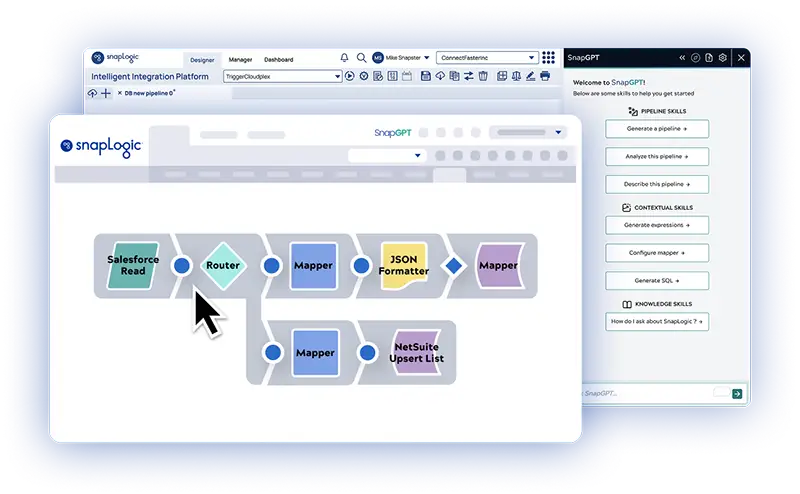
These, of course, are all themes that SnapLogic has been focused on for years. Our long-time customers, like Voya, are ready to take advantage of new emergent opportunities because they already have complete visibility across all of the data, apps, and systems that run their business today. This means that there is no gap between their AI ambitions today and the data reality that underpins them.
The good news is that because SnapLogic integrates and extends the systems that are already in place, without the need for a lengthy (and risky!) migration as a first step, we can help to avoid many of the dead ends and lengthy detours which would otherwise be required, and get you ready to deliver concrete, real-world benefits based on a solid data strategy — whether in AI, or in whatever other domain will have the greatest benefit for you and your users.
And of course, if you do need to migrate off your legacy integration middleware, we can help with that too! The SnapLogic Intelligent Modernizer (aka SLIM) is the key to rescuing valuable integrations, developed over years or perhaps even decades, from the obsolete platforms they are stuck on — and doing it fast, without open-ended risks.
To discover how SnapLogic can accelerate your journey to a data-driven, AI-ready future, take a self-guided platform tour or book a personalized demo today.