



Integrating the Modern Biopharma Enterprise
How top pharma and biosciences organizations unify clinical, regulatory, and commercial data to accelerate patient access.

Why data is holding pharma and biosciences back
Pharmaceutical and life sciences companies are sitting on an extraordinary opportunity. McKinsey estimates that 75-85% of pharmaceutical workflows can be enhanced or automated by AI agents. This figure could compress timelines, reduce compliance risk, and fundamentally accelerate the path from discovery to patient.
The science is ready. The AI is ready. What’s holding the industry back is the data.
Fragmented systems, compounding risk
Clinical trial data is scattered across incompatible systems (EDC, EHR, lab databases, CROs), forcing manual aggregation for regulatory submissions and leaving commercial launch decisions based on outdated information, especially as global pharma companies often manage 400 or more applications. This drives maintenance debt, compliance exposure, and delays that amount to a board-level financial risk, since a single month’s delay can cost millions in deferred revenue.
Why AI fails without integration
Fragmented data slows operations and makes AI unreliable. Conflicting clinical data (e.g., between EDC and EHR) prevents AI from learning reliable patterns. Batch pipelines introduce significant lag to drug safety models, making predictions outdated. Ungoverned, point-to-point integrations create compounding compliance risk for every new AI deployment, especially where regulators require full audit trails.
What this looks like on the ground
The consequences of fragmented data are not just theoretical; they translate into tangible, daily roadblocks for key teams across the organization.
- A medical science liaison spends her first hour manually pulling together data from three disconnected systems before a hospital meeting
- A regulatory affairs team spends days harmonizing exports from lab, manufacturing, and quality platforms across multiple sites, with a tight submission deadline
- A data science team pauses weeks of modeling work after discovering that two source datasets cannot be joined without manual reconciliation.
This is not an IT problem. It is a competitive and clinical disadvantage that touches every trial, every submission, and every patient waiting for a therapy.
Did you know? Gartner found that 63% of data leaders say their organizations either do not have, or are unsure if they have, the right data management practices to support AI.

The unified data fabric
In the pharmaceutical and life sciences industry, fragmented data is a competitive liability that compounds across trial delays, regulatory lag, and missed commercial opportunities.
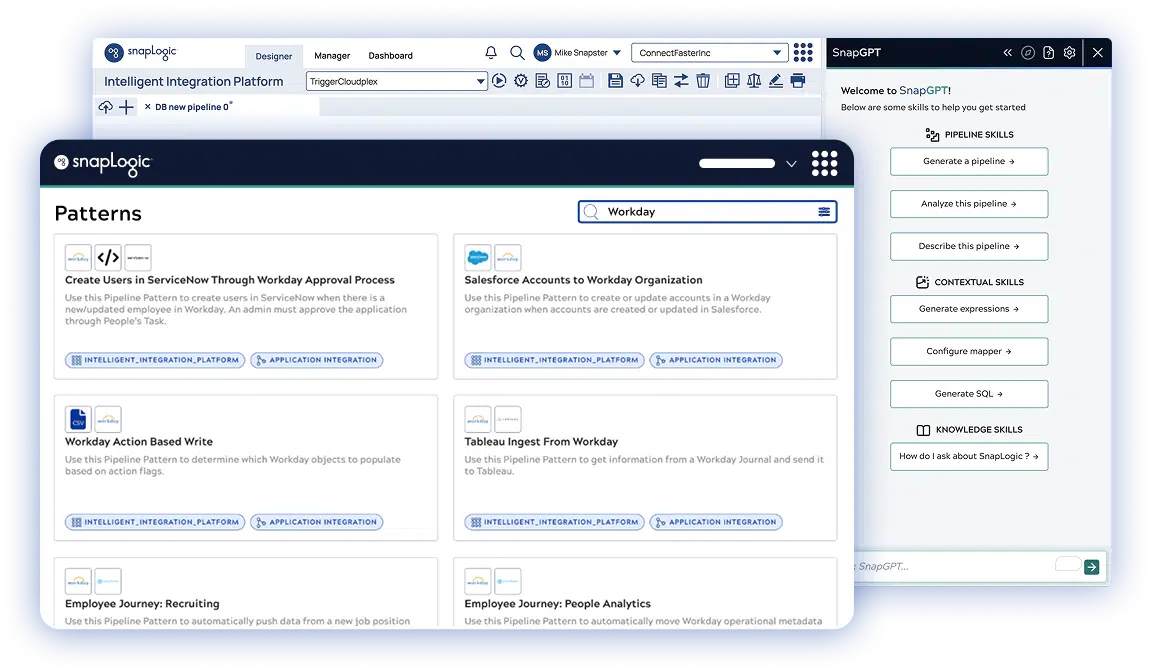
SnapLogic’s agentic integration platform closes that gap. With over 1,000 ready-to-use connectors, organizations can build pipelines up to 4x faster, automate workflows across clinical and manufacturing data, and provide a reliable foundation for AI and ML projects. Self-service tools put integration directly in the hands of the teams that need it. This way, clinical, regulatory, and commercial data flows freely, and every team moves faster.
- Unified clinical and regulatory data pipelines
SnapLogic connects EDC systems, including Medidata and Veeva Vault, EHR feeds, lab systems, and regulatory submission platforms through a single auditable integration layer. Pre-built Snaps for clinical data standards reduce both build time and compliance risk simultaneously. - Automated compliance and audit trail
Every data transformation is automatically logged, creating complete lineage for GxP compliance and regulatory audit readiness. From raw clinical data to final regulatory submission, every pipeline action is fully traceable. - Real-time commercial intelligence
SnapLogic connects CRM platforms, including Veeva CRM and Salesforce, specialty pharmacy data, payer systems, and field force tools to give commercial teams live market intelligence, from prescriber patterns to formulary status.
SnapLogic platform capabilities
- AI-powered integration automation: agentic workflows that self-orchestrate across apps and data
- Pre-built Snaps for 1,000+ enterprise systems, including Epic, Cerner, Veeva Vault, Medidata, SAP
- Low-code/no-code designer for business and technical teams
- FHIR R4, HL7 v2.x/v3, and healthcare interoperability standards natively supported
- Real-time and batch processing at enterprise scale: handles 15,000+ production pipelines
- Multi-cloud support: AWS, Azure, GCP, plus hybrid and on-premise deployment
Measurable business outcomes with integration
The value of integration is only realized when it translates into tangible outcomes. For pharmaceutical and life sciences organizations, that means faster trials, cleaner data, lower operational costs, and the ability to move quickly when it counts. Here is where SnapLogic delivers.
Faster clinical trials and regulatory compliance
Manual data reconciliation across CROs, internal systems, and regulators can be a major source of delay in clinical development. SnapLogic removes that bottleneck with audit-ready data lineage and built-in FDA and EMA compliance coverage, cutting data errors, shortening trial timelines, and lowering regulatory risk.
Interoperability and EHR integration
SnapLogic connects Epic, Cerner, and any API-accessible EHR system through native FHIR R4 and HL7 v2/v3 support, cutting patient data latency and reducing the cost and fragility of custom middleware. The result is faster care coordination, fewer integration failures, and true interoperability across systems.
Supply chain and manufacturing visibility
Connecting MES, procurement, logistics, and ERP systems in a single integration layer gives supply chain teams real-time visibility into disruptions and the ability to respond as they happen. Stockout rates fall, fulfillment risk drops, and on-time delivery improves, directly lowering the cost of goods.
Modernization and enterprise consolidation
SnapLogic compresses multi-year post-merger integration timelines to months. It helps teams migrating off Informatica, MuleSoft, or Talend cut infrastructure costs up to 70% and development time by 60%, all without a large team of specialist developers to manage the transition.
The common thread across all of these outcomes is the same: when data flows freely and reliably across an organization, every team makes better decisions faster. That is the foundation SnapLogic is built to provide.
Industry leaders transforming operations
Pharmaceutical and biosciences organizations are already achieving significant business value with SnapLogic, from drug discovery and clinical development to manufacturing and commercial operations. These examples illustrate the breadth and depth of SnapLogic’s impact across the industry.
Global pharmaceutical company
Before partnering with SnapLogic, one of the world’s largest pharmaceutical companies struggled with integration tool sprawl across its global operations. Too many disconnected tools were slowing teams down and putting critical drug release windows at risk, where even a single month’s delay means millions in lost revenue.
By replacing Informatica and Talend with SnapLogic as a single unified platform, the company achieved sustained 20% annual growth.
“We have all these systems with data that need to come together, and the demand is too high for us to scale manually. Researchers want data now. We’re leveraging SnapLogic not just to build data integrations, but to empower self-service, so people can move quickly while we maintain the balance of staying heavily regulated.”
– Enterprise Data & Platform Leader, Global Pharmaceutical Company
Healthcare and medical device company
A healthcare and medical device company successfully addressed focus areas, including Cloud Migration, Oracle ERP, and replacing MuleSoft for integration.
This resulted in significant improvements, including:
- 60% reduction in integration development time compared to their previous solution
- 200% improvement in business user adoption
- 70% decrease in infrastructure costs
PARTNER SPOTLIGHT
SnapLogic and Slalom combine best-in-class integration technology with deep life sciences consulting expertise to help pharmaceutical and biosciences organizations modernize faster, without sacrificing the strict compliance these companies require. SnapLogic’s unified platform connects clinical, laboratory, and operational systems with built-in governance, and Slalom brings the life sciences expertise to ensure deployments are fast, compliant, and built to scale.
The playbook: how to get started
The steps below reflect how leading pharmaceutical and biosciences organizations typically sequence their SnapLogic deployment, starting with the highest-friction data workflows and expanding from there across clinical, safety, and commercial op
Step 1
Map your clinical data ecosystem
Start by inventorying your systems for your top therapeutic area and flagging the manual handoffs between CROs, EDC platforms, and regulatory submission systems.
Step 2
Identify a successful AI pattern
Target high-volume processes that involve intensive data lookups, and where contextual reasoning can drive decision-making.
Step 3
Expand to pharmacovigilance
Connect your safety database with EHR feeds and case management platforms to enable real-time signal detection and automate adverse event reporting workflows.
Step 4
Connect commercial to medical
Integrate CRM, patient data, and real-world evidence into a shared data foundation, so commercial and medical affairs teams work from the same information.

SnapLogic fast start
Most customers see their first integration running within days, not months. SnapLogic’s pre-built Snaps and agentic templates dramatically reduce time-to-value for pharmaceutical and biosciences organizations.

Next steps for your integration journey
Ready to move beyond your integration debt? See how SnapLogic helps pharma and biosciences organizations integrate everything, from clinical trial data to commercial intelligence, faster than you thought possible.