





Integrating the Modern Financial Institution
How financial institutions are using Agentic Integration to unify systems, accelerate compliance, and power AI at scale

The data traps blocking AI and operational excellence in BFSI
Disparate core banking systems, siloed risk data, and manual compliance workflows have turned integration into a strategic liability in the Banking, Financial Services, and Insurance (BFSI) sector.
What was once a back-office IT concern now directly impacts customer experience, regulatory standing, and competitive position. It consumes budgets that could fund AI and digital transformation. Institutions that treat integration as a maintenance task are ceding ground to digital-native competitors who treat data connectivity as a growth engine.
Fragmented systems, compounding risk
Legacy core banking platforms were not built to connect with modern CRM systems, cloud data warehouses, or fintech APIs. Most institutions rely on brittle point-to-point connections as a result. Each new compliance mandate adds further integration dependencies to systems already struggling to keep pace.
Why AI fails without integration
Fragmented data slows operations and makes AI unreliable. Siloed and inconsistent data produce untrustworthy model outputs. Batch ETL lag means fraud models miss current attacks. Without a complete customer view, AI decisions lack context. Without data lineage and audit logging, regulatory exposure increases.
What this looks like on the ground
For banks, insurance companies, and financial services firms, these scenarios illustrate the high cost of data and application silos.
- A relationship manager opens three systems before a client call and still has no reliable view of the client
- A credit decision that should take minutes takes days because records must be manually reconciled across platforms
- A compliance report is assembled from spreadsheets last updated by someone who left months ago
- A fraud alert fires too late because the model was trained on incomplete data
The common thread is latency. Critical data exists across the organization, but reaches decision-makers too late for meaningful action.
Did you know? According to nearly 60% of the AI leaders and representatives surveyed by Deloitte, the main challenges in adopting agentic AI are integrating with legacy systems and addressing risk and compliance concerns.

The solution: a unified data fabric
SnapLogic addresses the integration complexity that creates strategic liability for financial institutions. It provides the unified data fabric and agentic AI needed to connect core banking systems, cloud environments, and analytical tools while enabling intelligent real-time decision-making.
Its separated control plane and data plane architecture is particularly significant for regulated institutions. The control plane handles orchestration and platform management in the cloud. Customer data, transaction records, and regulated workloads remain physically within the institution’s own environment. Financial institutions get the agility of a modern cloud platform without compromising on data residency, security, or compliance.
- Unified core-to-cloud integration layer
A single agentic integration platform connects core banking systems, CRM, data warehouses, payment networks, and fintech APIs through a library of more than 1,000 pre-built Snaps. No custom middleware required. - Real-time compliance and risk data pipelines
Pre-built Snaps for regulatory reporting systems, KYC/AML platforms, and audit databases deliver automated audit-ready workflows. Every pipeline execution is captured by SnapLogic Monitor with full observability across records processed, errors, throughput, and exportable logs for internal audits and regulatory examiners. - AI-powered financial workflows
SnapLogic’s agentic integration layer enables intelligent self-initiating workflows that sense, reason, and act across systems. Built with enterprise-grade controls including audit trails, data lineage, role-based access, and human approval gates, it satisfies both the CTO and the Chief Risk Officer.
SnapLogic platform capabilities
- AI-powered integration automation with agentic workflows that self-orchestrate across apps and data
- Pre-built Snaps for 1,000+ enterprise systems, including core banking, payments, and compliance platforms
- Low-code/no-code designer accessible to both business and technical teams
- Enterprise-grade security certified across SOC 2, SOC 3, ISO 27001, GDPR, and PCI DSS
- API Management 3.0 with unified API lifecycle management, OAuth 2.0, JWT, mTLS, and Git integration
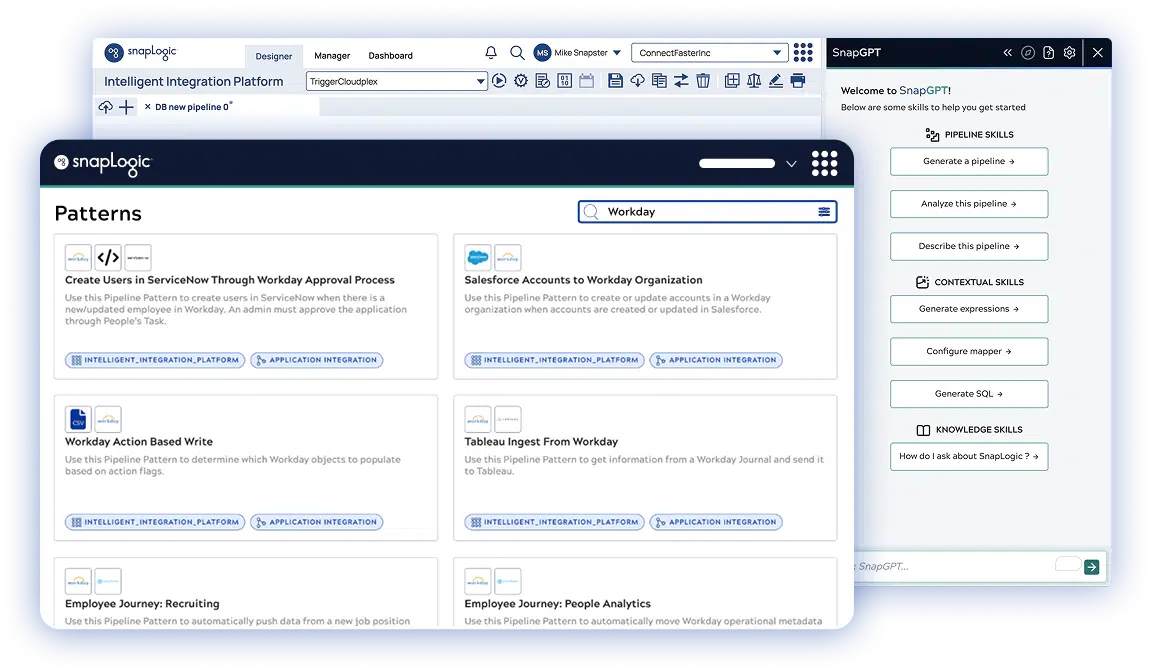
- SnapGPT, a natural language copilot that compresses pipeline development from days to hours
SnapLogic by the numbers: One top-tier investment firm runs over 9,400 integration pipelines on the SnapLogic platform, while another has logged more than 292,000 pipeline execution hours.
Measurable business impact in BFSI
SnapLogic connects data across the financial services value chain to deliver measurable impact in compliance, customer operations, and AI readiness. The use cases below represent the most common areas where customers see immediate results.
Open banking and API connectivity
Scale API exposure and consumption across partners and digital channels. SnapLogic’s managed API layer connects core banking systems to external partners and fintechs using pre-built REST and API Snap Packs. Integration development compresses from days to hours. Teams handle growing request volumes without increasing headcount.
Cloud migration and AI-ready infrastructure
Migrate legacy data to cloud platforms accurately and without disruption. Pre-built connectors and agentic pipelines validate, transform, and deliver transaction histories and customer records to Snowflake, Databricks, and Azure. The result is a clean, governed data foundation that institutions need to build and scale AI quickly.
Automated compliance reporting
Automate regulatory data pipelines for KYC/AML, GDPR, CCPA, and beyond. SnapLogic connects transaction monitoring systems, general ledgers, and audit platforms into continuous reconciled data flows. Audit-ready outputs are produced automatically. Manual effort drops and reporting timelines improve across every deadline.
Real-time fraud detection and risk intelligence
Act on fraud signals as they emerge. SnapLogic unifies data across core banking, payments, and customer systems with external threat intelligence feeds into real-time pipelines. Fraud detection models identify threats as they happen. Institutions operate with AI-powered risk intelligence rather than reactive batch processing.
SnapLogic by the numbers: Financial institutions using SnapLogic have reduced pipeline development timelines from days to hours, scaled annual integration request capacity by up to 7x, and automated compliance data flows that previously required weeks of manual assembly.
Industry leaders transforming operations
Financial institutions across banking, insurance, investment management, and financial software are already achieving significant business value by deploying SnapLogic to modernize their integration infrastructure. These examples are drawn from published case studies and verified customer records.
Large national bank (OEM/embedded)
SnapLogic is embedded inside a large national bank’s virtual card payment product. Commercial customers need to extract data from their ERP systems and map it to the bank’s specifications, but many lack the internal resources to accomplish this.
SnapLogic provides a no-code integration layer, enabling the bank to onboard end customers at scale, without custom development work each time.
Insurance firm
A major insurance firm is expanding its use of platform automation across both production and sandbox environments. The team has credited SnapLogic directly with boosting developer productivity and driving a major internal initiative.
With pipeline execution volume on the rise, SnapLogic has become the backbone of the company’s internal integration platform, empowering teams across the organization to build and continuously spin up new pipelines.
Cambridge & Counties Bank sees 3x asset finance business growth with AI automation
“I’m looking to break that direct relationship between income growth and cost growth, but not by replacing humans in that interaction, by effectively automating the non-value-added tasks. And I think the agentic AI capability really allows us to do that.”
– David Holton, CTO
PARTNER SPOTLIGHT
Cognizant and SnapLogic have formed a strategic partnership to accelerate AI adoption and modernization for banking, insurance, and capital markets institutions. Cognizant brings deep financial services domain expertise. SnapLogic provides the agentic integration platform. Together, they deliver a proven model that connects core banking, payments, compliance, and data systems into an AI-ready, governed data foundation. Implementation risk is reduced, and time-to-value accelerates for institutions that need to move quickly without compromising on security or compliance.
The playbook: how to get started
Moving from recognizing the integration problem to achieving real-time financial intelligence requires a clear path. This four-step playbook gives financial institutions a rapid, actionable roadmap to prioritize their highest-impact data silos and deploy agentic integration solutions quickly.
Step 1
Audit your integration debt
Map all point-to-point integrations between core banking, CRM, risk, and reporting systems. Identify the highest-risk manual data flows.
Step 2
Identify a successful AI pattern
Target high-volume processes that involve intensive data lookups and where contextual reasoning can drive decision-making.
Step 3
Build your open banking API layer
Use SnapLogic’s REST and API Snap packs to expose core banking data through PSD2/open banking APIs, enabling fintechs, partners, and digital channels.
Step 4
Scale to customer experience
Once the data foundation is in place, extend to real-time personalization, fraud detection, and next-best-action using SnapLogic’s agentic workflows.

SnapLogic fast start
Most customers see their first integration running within days, not months. SnapLogic’s pre-built Snaps and agentic templates dramatically reduce time-to-value for Banking and Financial Services operations.

Next steps for your integration journey
Ready to move beyond your integration debt? See how SnapLogic helps financial institutions integrate everything from core banking systems to the executive dashboard, faster than you thought possible.