



Integrating the Modern Technology Enterprise
How software and tech companies are using Agentic Integration to unify systems, accelerate product delivery, and power AI at scale.

The data traps blocking AI and operational excellence in tech
Fragmented systems, compounding complexity
As tech companies scale through product expansion, M&A, or global growth, integration debt compounds across the business. APIs proliferate without governance, pipelines break silently, and engineering teams spend more time maintaining custom integration logic than building products.
Every acquisition and new product line adds more systems and data sources, and over time, this technical debt becomes structural, driving up the cost to simply keep fragmented systems running.
Why AI fails without integration
AI needs clean, current, and connected data. Fragmented systems force teams to assemble that data by hand before any model can use it. Engineering time shifts away from building and into plumbing, projects stall at the data preparation stage, and AI delivery slows for every team waiting on it.
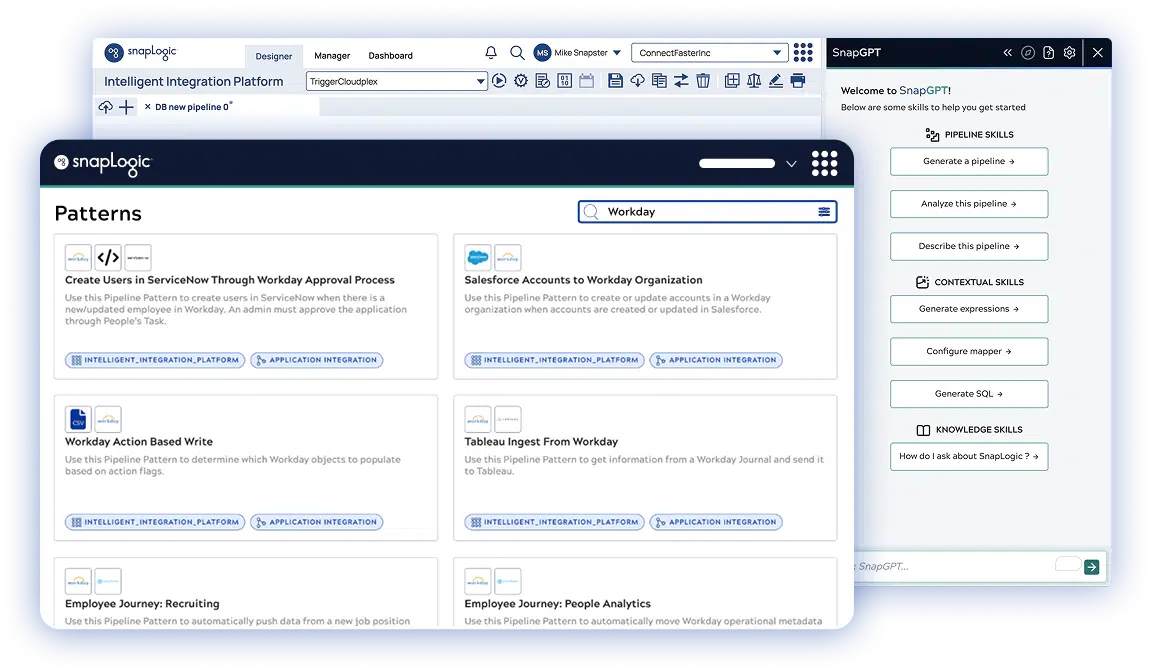
SnapLogic’s Agentic Integration Platform connects the full technology stack and orchestrates intelligent workflows. It handles exceptions, routes decisions, and triggers automated actions without human intervention.
Where disconnected systems create friction
Integration debt appears differently depending on one’s role in the organization. Across a typical technology company at scale, it might look something like this:
- Product manager needs a 360-degree customer health score, but the data is split across Salesforce, Gainsight, Snowflake, and product telemetry, with no automated way to unify it
- Finance team is closing the books manually, reconciling subscription revenue across three billing platforms that don’t sync with the ERP
- DevOps engineer maintains 14 custom integrations between the CI/CD pipeline, ticketing system, and deployment tools, each one a point of failure
- Customer success team receives churn alerts days after the warning signals first appeared in product usage data
Did you know? According to Gartner, 63% of organizations either do not have or are unsure whether they have the right data management practices for AI.

The solution: a unified integration fabric for technology companies
SnapLogic’s Agentic Integration Platform gives technology companies a single, governed layer through which all data moves, connecting SaaS platforms, cloud infrastructure, internal APIs, and data warehouses in real time. Its low-code, AI-assisted design lets both technical and non-technical teams build and maintain integrations at scale, avoiding the technical debt that slows teams down.
- Unified product-to-revenue integration layer
Connect product telemetry, CRM, billing, and support data into a single operational view. Sales, customer success, finance, and engineering teams can work from consistent, real-time data without custom pipeline maintenance. - Real-time customer intelligence and retention signals
Surface product usage signals, support interactions, and billing events into customer health dashboards and CRM systems in real time. Identify churn risk, expansion opportunity, and engagement patterns before they become business decisions. - AI-powered developer and operational workflows
Automate onboarding flows, provisioning pipelines, release notifications, and incident response with SnapLogic’s agentic capabilities. AI agents handle exception logic, routing, and orchestration across the technology stack so your teams can focus on higher-value work.
SnapLogic platform capabilities
- Low-code, AI-assisted pipeline builder with 1,000+ pre-built connectors called Snaps for SaaS, cloud, and data platforms
- Agentic Integration layer for autonomous workflow orchestration and exception handling
- Real-time and batch processing with sub-second latency options
- Enterprise-grade governance, lineage, and access controls
- GenAI pipeline builder (SnapGPT) for natural-language integration authoring
SnapLogic by the numbers: One global software company automated 4,200+ integration pipelines across 14 business units, reducing integration development time by 60%.
Measurable business impact in software and technology
Integration challenges in tech show up as slow releases, inaccurate revenue recognition, delayed churn detection, and AI limited by fragmented data. SnapLogic addresses each with purpose-built patterns and agentic orchestration that deliver measurable outcomes.
Customer 360 and retention intelligence
Unifying product usage, support, billing, and CRM data into one customer view improves net revenue retention. SnapLogic connects Salesforce, Gainsight, Zendesk, and telemetry systems, keeping health scores current so success teams see churn risk and expansion signals early.
Enterprise customer onboarding and provisioning
The time from signature to go-live drives customer satisfaction. SnapLogic automates provisioning across identity providers, CRM, HR systems, and product backends, with full audit trails and error handling, which reduces onboarding time and manual setup wor
Developer productivity and CI/CD pipeline integration
Engineering teams spend significant time maintaining tooling integrations, connecting Jira to ServiceNow, deployment events to Slack, and GitHub Actions to dashboards. SnapLogic replaces glue code with governed pipelines, monitors pipeline health, and triggers escalation workflows when SLAs are at risk.
Revenue operations and subscription billing automation
SnapLogic automates subscription data flow between billing platforms (Zuora, Stripe, Chargebee), ERP systems (SAP, NetSuite, Oracle), and reporting tools, meaning less time spent on manual reconciliation and close. Finance teams get a real-time view of ARR, churn, and expansion revenue.
SnapLogic by the numbers: A SaaS platform provider cut time to onboard new enterprise customers from 6 weeks to under 5 days using SnapLogic’s automated provisioning workflows
Technology leaders transforming operations
Global enterprise software company
Managing more than 20 acquired product lines, each with its own data model and customer record system, this company used SnapLogic to build a governed integration fabric connecting all product backends to a single CRM and billing platform. This resulted in a unified customer view and a reduction in monthly billing reconciliation effort by 80%.
High-growth SaaS platform
Competing against product-led growth rivals, this developer tools company needed to move faster on enterprise onboarding. By automating provisioning across 11 internal systems covering contract signature, identity, tenant setup, and welcome orchestration, they cut average onboarding time from 6 weeks to 4 days and improved new customer NPS by 22 points.
How Spirent saw a 90% reduction in integration platform maintenance costs, and more
“SnapLogic streamlines integration into a centralized, user-friendly platform that can securely connect all our systems — whether legacy tools or cloud-based applications — unlike its competitors. It’s already saving us money and time in multiple demonstrative ways. The ability to more easily build our own LLM apps with low code using AgentCreator was the icing on the cake.”
– Matt Bostrom, VP of Enterprise Technology
PARTNER SPOTLIGHT
Accenture and SnapLogic have formed a strategic partnership to accelerate AI adoption and modernization for technology and software companies, combining Accenture’s industry expertise with SnapLogic’s Agentic Integration Platform to deliver a proven model that connects SaaS applications, cloud infrastructure, data pipelines, and engineering systems into an AI-ready, governed data foundation, reducing implementation risk and accelerating time-to-value for companies scaling through growth, M&A, or multi-cloud complexity.
The playbook: how to get started
Moving from integration debt to AI-ready infrastructure requires a clear sequence. This four-step playbook outlines how technology and software companies can use SnapLogic to automate critical pipelines, unify data, and build the foundation for real-time product experiences and intelligent workflows.
Step 1
Audit your integration debt
Map all point-to-point integrations between core engineering systems, CRM, billing, and data platforms. Identify the highest-risk manual data flows.
Step 2
Identify a successful AI pattern
Target high-volume processes that involve intensive data lookups and where contextual reasoning can drive decision-making.
Step 3
Build your internal API layer
Use SnapLogic’s REST and API Snap packs to expose data through governed APIs, enabling internal teams, partners, and customer-facing applications.
Step 4
Scale to customer experience
Once the data foundation is in place, extend to real-time personalization, usage-based insights, and next-best-action using SnapLogic’s agentic workflows.

SnapLogic fast start
Most customers see their first integration running within days, not months. SnapLogic’s pre-built Snaps and agentic templates dramatically reduce time-to-value for technology and software operations.

Next steps for your integration journey
Ready to close your integration debt? See how SnapLogic helps technology companies connect everything, from data pipelines to AI workflows, faster than you thought possible.