


Only 5% of AI projects make it all the way into production success. SnapLogic users have improved their own chances of success, and at IntegrateAI, they shared what they learned along the way.
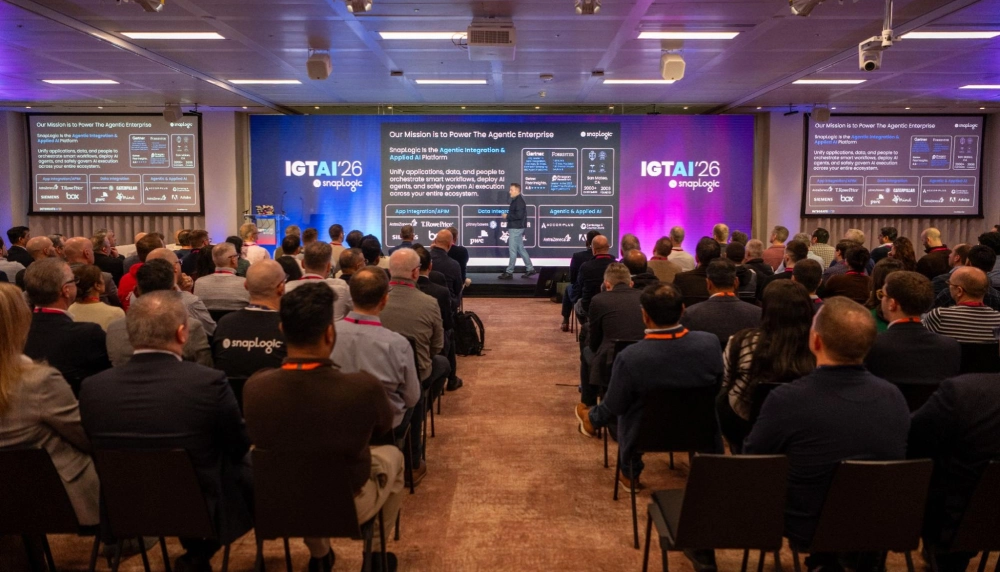
With the London event delivered, the IntegrateAI show is over for another year, making this a good time to look back on the whole tour and especially on the questions that we had on the eve of the London event.
The AI value gap: 76 on readiness, 48 on value realization
SnapLogic’s CMO, Dayle Hall, opened the day by sharing some of the results from our latest research, the 2026 Agentic Enterprise Readiness Index. This is a survey of 1000 IT decision-makers, exploring how ready enterprises are to scale agentic AI.
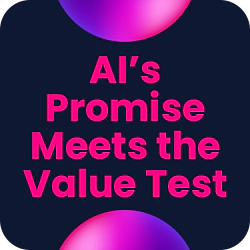
The key finding is that while the overall enterprise readiness score was a respectable 76/100, the actual Value Realization score was just 48/100, showing that companies are struggling to map their AI efforts to real, concrete value. In fact, the problem is so bad that 54% have abandoned agentic AI projects entirely because the business value was unclear, a rate which is explained by the fact that 48% struggle to measure AI ROI.
Wondering about your score? Take the Agentic Enterprise Readiness Quiz, an interactive assessment where you can benchmark your own readiness against your peers across five dimensions and receive a readiness score that is specific to your situation, including recommendations for what to do next.
From building AI to operating it
These results lead to an obvious question: what can we do to help organizations close that gap, achieve success with their AI efforts, and measure that success in practical ways?
Jeremiah Stone, SnapLogic CTO, was on hand to deliver one part of the answer, with the ongoing evolution of the SnapLogic agentic integration platform to add features that are specifically designed to move the focus from building AI capabilities to operating and managing them.
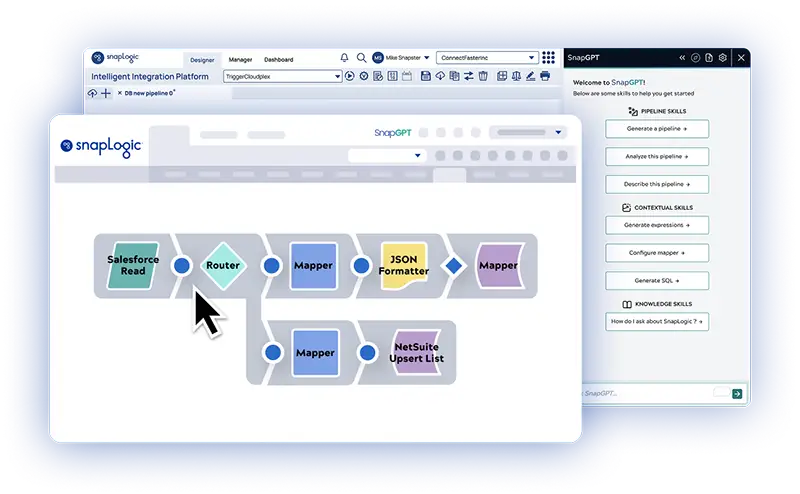
Just to underline that he was talking about real functionality that is ready for users to rely on, Jeremiah proceeded to give a whirlwind live product demo of the Discovery Hub, our new MCP registry, alongside SnapGPT, expanded SnapCode agent-building capabilities, and even a preview of upcoming self-healing capabilities.
Start with value
- Most projects that missed production failed the value test, not the deployment test.
- Don’t automate a broken process. Throwing AI at everything leaves you with a faster version of the same problem.
- “Handing out tokens does not create adoption.” – Melanie Nickson, Emirates
The whole chain: SnapLogic and Honeycomb partner on observability
Because SnapLogic was born as an integration platform, we are particularly aware of the fact that no application, task, or process lives in isolation. During IntegrateAI, we heard from customers running thousands of pipelines and processing billions of documents, and each of those integrations spans multiple business-critical departments, processes, and systems.
And because of that, understanding the performance and troubleshooting any failures requires observing the entire rich chain of events across all of the systems and infrastructure elements that are involved in the process. Jeremiah was joined on stage by Colin Burke, Field CTO at observability pioneer Honeycomb, to announce a new partnership between SnapLogic and Honeycomb, combining SnapLogic’s integration, orchestration, and governance capabilities with Honeycomb’s advanced observability features.
Together, we’re helping enterprises gain end-to-end visibility into AI agent activity across connected systems, troubleshoot issues faster, and scale agentic AI with confidence.
Bringing the whole company along: lessons from Emirates
From product to practice, the conference then turned to how organizations put these capabilities to work.
First, SnapLogic president Molly Matthews was joined on stage by Melanie Nickson, VP of IT Business Platforms at Emirates, to talk about how to bring a huge and complex company along on the journey to building an agentic enterprise.
While a technological change away from legacy platforms was one of the recommendations, now that is enabled and facilitated by new AI capabilities, most of the conversation was focused on “hearts and minds” change management with employees.
Build the foundation before scaling
- Multi-system integrations need predictable economics to avoid budget overruns.
- Your integration team is your AI team. The architects already know where the information lives, how it flows, and what the business needs.
- “AI ROI at the speed of integration.” (Jeremiah Stone, CTO, SnapLogic) Use AI tools to deliver value faster.
Pilot to production: Cambridge & Counties Bank and Siemens Healthineers
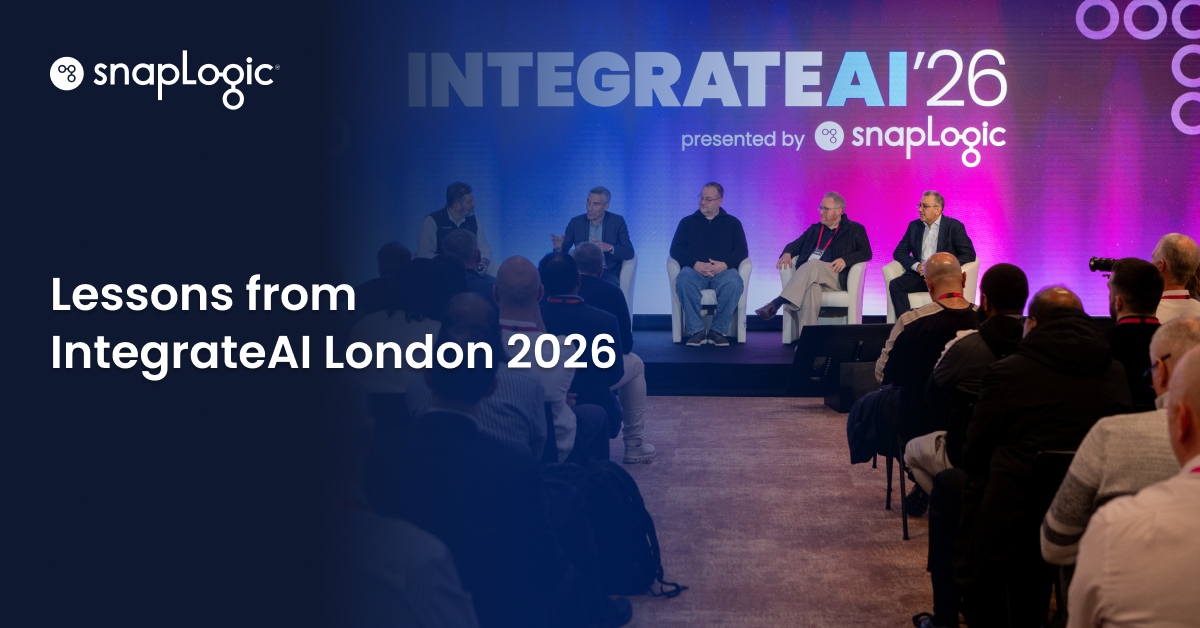
This focus on business factors continued for the rest of the morning, first with SnapLogic users who had transformed their businesses and created new opportunities with the capabilities of the platform, and then with a panel session discussing industry trends and experiences more generally.
David Holton, Chief Operations Officer at Cambridge and Counties Bank, is a returning speaker: last year at Integreat ‘25 he shared the beginning of his journey to reimagine the bank’s asset finance offering with agentic AI, and this year he was back to tell us how that had worked out in production.
Stefan Henkel, CIO of Siemens Healthineers, is also a returning speaker, an industry thought leader driving business agility through composable enterprise systems and automation, and a long-standing user of SnapLogic. He sees AI as a core lever to improve how healthcare is provided, and shared a recent example of a shared context layer that makes documentation for medical devices available across all AI services.
The composable architecture that enables Healthineers to access these sorts of shared services quickly is more important to success, in his experience, than the specifics of this or that AI model.
Panel wisdom: start from the business problem, not the technology
After those specific examples, the morning concluded with a panel featuring Jean-Marc Torre, CEO of White Oak UK, Shannon Castle, CIO of Elida Beauty, Kit Cox, founder and CTO of Enate, and Niraj Seth, VP & Head of Manufacturing, Logistics, Energy & Utilities at Cognizant.
As Jeremiah pointed out, this panel covered the gamut across business leadership, IT operations, technical product design, and implementation project work. A lively conversation ensued about how best to deliver value with AI. In particular, panelists agreed that AI is not a universal solvent, but a powerful tool that should be applied to classes of problems it is well-suited for, and which it was not possible to automate previously using deterministic tools.
Early successes mentioned by the panelists clustered around using AI to gather information, including requirements for the projects themselves — but as Kit Cox pointed out, real enlightenment comes from taking technical and process debt out of the delivery of better service outcomes.
Jean-Marc Torre emphasised the importance of learning from failures and uncovering new opportunities from experimentation. That learning process requires clear expectations to be set and progress towards them to be measured, as Shannon Castle pointed out. But the most important factor in ensuring the success of AI projects is aligning them to a real business need, rather than starting by looking for an opportunity to use the technology.
This point was neatly encapsulated by Niraj Seth, who shared that in his experience there are two types of people: those who start from a business problem and win, and those who start from AI. This nugget encapsulated the point that both Dayle and Jeremiah made about the too-low success rate of AI projects, and the morning’s sessions left participants with plenty of food for thought and discussion.
Expect change, and plan to adapt
- Failure is how we learn. Gaps between a business process and its implementation show where both sides can improve.
- Business and technical conditions will keep shifting, so build change into your strategy and avoid overly rigid plans.
Afternoon tracks: strategy and hands-on building
In the afternoon, the conference split into two tracks. In the strategy track, we heard from SnapLogic customers Arriva, Elida Beauty, and Mind about their projects, as well as partner Sriven.
A natural theme tied these four presentations together, as all of the speakers emphasised the importance of managing changing requirements, whether technological or in the wider environment. A flexible architecture and the ability to learn and adapt are key enablers to being able to engage with stakeholders successfully and deliver what they need and expect.
Meanwhile, in the technical track, attendees had the opportunity to get hands-on with some of the AI capabilities they had been hearing about all morning, building their own agents with natural language together with our enterprise agent Jean-Paul and working on AI-assisted migration of legacy middleware pipelines with the SnapLogic Intelligent Modernizer, SLIM, assisted by SnapLogic partners Cognizant and IWConnect, respectively.
Some attendees also took the opportunity to get some technical training the day before the main conference, using SnapCode to operate the SnapLogic platform headlessly from Claude Code.
Awards and what’s up next
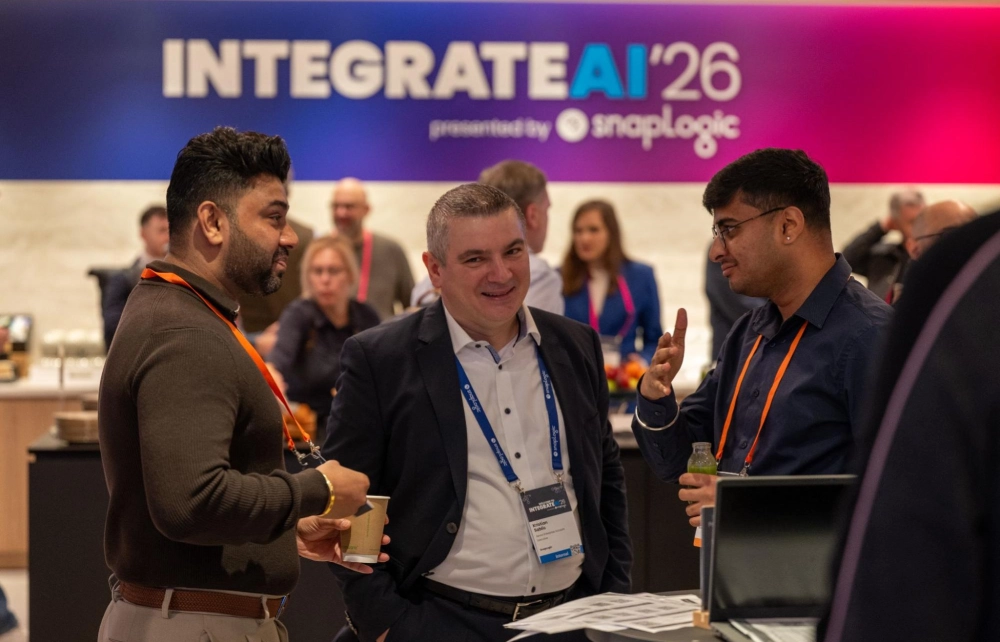
Finally, the day wrapped up with some well-deserved awards for SnapLogic customers and partners who stood out in one way or another with the results they had achieved. The field was incredibly strong, and the honorees were all justifiably proud of their achievement.
Thank you so much to everyone who attended, and we look forward to seeing you again soon! And if you weren’t able to make it to one of the IntegrateAI events, do get in touch, and we’ll at least give you a taste of what you missed, as well as an opportunity to discuss some of what we announced at the show.
New to SnapLogic? Take one of our self-guided product tours or talk directly to our team of experts with a personalized demo.