

Every enterprise IT leader eventually inherits the same problem: a tangle of point-to-point integrations, brittle ETL jobs, and middleware nobody fully understands anymore, all quietly keeping the business running. These systems were built for a world of on-premises data centers, batch processing windows, and a manageable number of applications.
Today’s enterprises run hundreds of SaaS applications, generate real-time data streams, and are under pressure to deploy AI initiatives that need clean, governed, low-latency access to data spread across every corner of the organization. Legacy integration architecture was never designed for this, and patching it indefinitely is no longer a viable strategy. Modernizing to the cloud is no longer optional. It is the foundation everything else depends on.
ETL vs. ELT is only the starting point. Agentic AI requires data pipelines that agents can trust. Get the ebook: The Limits of ETL and ELT in the Agentic Era
Why legacy integration breaks down
Legacy integration environments typically accumulated over a decade or more, one urgent project at a time. A custom script here, an ESB there, a vendor-specific connector nobody has touched since the person who built it left the company. Each piece made sense at the time. Collectively, they form a fragile web where a single schema change can ripple through a dozen downstream systems in ways nobody predicted.
The costs of this fragility are not abstract. Maintenance teams spend the majority of their time firefighting instead of building. Onboarding a new SaaS application can take months because every new connection has to be hand-coded and tested against a web of undocumented dependencies.
Data quality suffers because there is no consistent governance layer: every integration invents its own error handling, logging, or retry logic, or skips those entirely. And when the business asks IT to support a new AI initiative, the honest answer is often, “we can’t, our data isn’t accessible in a form any model could use.“
None of this is a failure of the people running these systems. It’s the natural result of integration infrastructure that grew organically without a unifying platform strategy. The fix is a genuine rethink of how integration gets built, governed, and scaled.
Start with an honest assessment
The biggest mistake organizations make when modernizing legacy integrations is trying to replace everything at once. A wholesale rip-and-replace project sounds appealing in a boardroom slide. In practice, it takes years, blows through budgets, and risks breaking mission-critical processes that the business depends on every day.
A better approach starts with an honest inventory. Find out:
- How many integrations exist at present, and which business processes depend on them?
- Which integrations are actually load-bearing vs. historical accidents nobody remembers building?
- Which integrations carry the most operational risk?
From there, prioritize based on business impact and technical fragility. The integrations that touch customer-facing systems, financial close processes, or compliance-sensitive data should get the most careful planning and the most rigorous testing.
This assessment phase also surfaces something valuable: which integrations are still needed. It is common to find that a meaningful percentage of legacy integration points support processes that no longer exist in their original form. Modernization is as much an exercise in simplification as it is in migration.
Choose a platform, not just a migration path
The technical decision that matters most is what you’re modernizing to. Simply moving the same brittle, hand-coded logic into cloud-hosted virtual machines changes where the infrastructure lives without changing how it behaves: the same fragility, the same lack of visibility, the same maintenance burden, just billed monthly instead of depreciated over five years.
A modern integration platform should give you a few things a patchwork of scripts and legacy middleware never could:
- A unified way to connect to any system (whether that’s a decades-old on-prem database, a modern SaaS application, or a data warehouse) without hand-coding a new connector every time. Pre-built, maintained connectors dramatically cut both initial build time and ongoing maintenance risk, because the platform vendor absorbs the burden of tracking API changes across hundreds of endpoints.
- Cross-system visibility. Centralized monitoring means knowing what’s running, where it’s failing, and why, in real time, rather than discovering a broken pipeline three days later because someone downstream complained about missing data.
- Built-in governance. Every integration should carry consistent authentication, encryption, audit logging, and access control by default. This matters more than ever now that integration pipelines are being asked to feed AI agents, not just dashboards and reports. An ungoverned pipeline feeding an autonomous agent is a liability.
- Genuine AI-readiness. That means exposing data and processes through interfaces that agentic systems can actually consume safely, with the same governance and observability applied to a human-triggered pipeline. Integration modernization done right prepares your data estate for the cloud and for autonomous consumption.
SnapLogic MCP Server: Connect AI agents to the SnapLogic platform with governed MCP tool calls. Deploy, execute, and manage integrations securely at enterprise scale.
Migrate incrementally, validate constantly
Once the platform decision is made, the migration itself should proceed in waves. Pick a low-risk integration first, something with a clear owner, manageable data volumes, and forgiving failure modes if something goes wrong, and use it to prove the pattern. Document what worked, what didn’t, and where the legacy system had quirks nobody wrote down anywhere.
From there, expand wave by wave, running old and new integrations in parallel wherever possible so you can compare outputs and catch discrepancies before they become production incidents. This parallel-run discipline is tedious, and it is also the single best predictor of whether a modernization program finishes on time without a catastrophic surprise six months in.
Throughout the process, resist the temptation to replicate legacy logic the same way it was built. Every integration built for the old world carries assumptions about data formats, timing, and failure tolerance that may no longer hold. Modernization is the opportunity to fix decisions that made sense 15 years ago.
Where SLIM fits in
The discipline above (honest assessment, the right platform, incremental migration, constant validation) is the right approach, but executing it takes real labor. Someone has to inventory what exists, map dependencies, and rebuild each integration in the new platform.
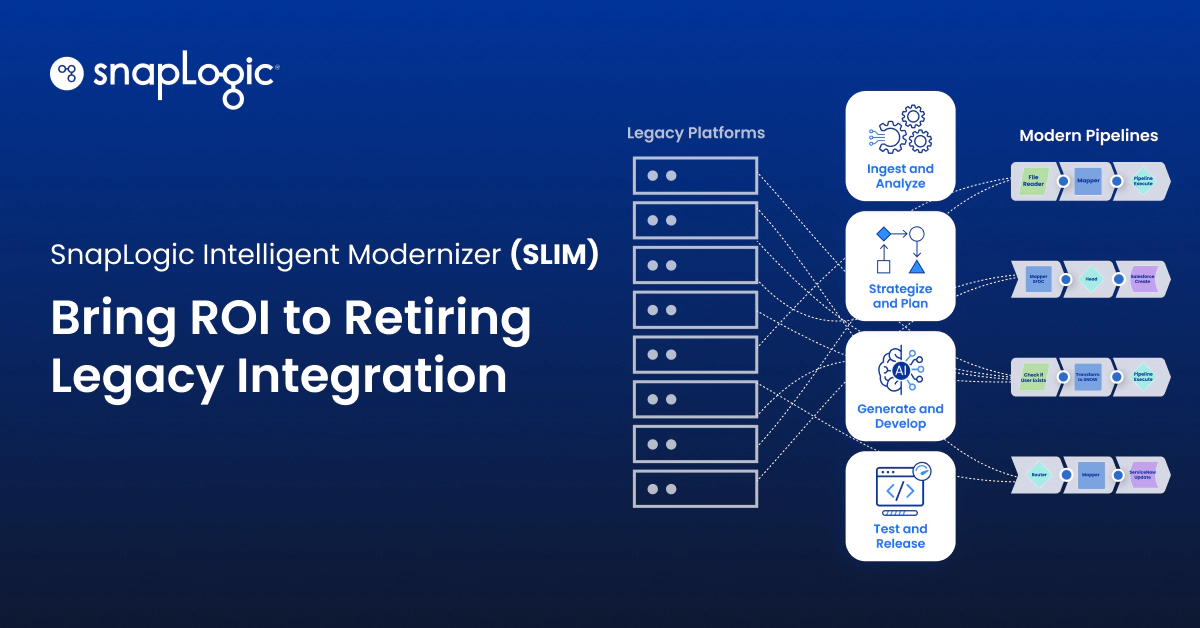
SnapLogic Intelligent Modernizer (SLIM) is built to take that labor off the critical path. It inventories legacy integrations, assesses their complexity, helps prioritize migration waves, and generates the modern SnapLogic pipelines, along with the testing and documentation, that would otherwise eat months of a migration team’s time.
Documentation as a migration output
Most legacy integration environments have little or no documentation, and what exists is usually out of date within months of being written. This becomes a serious liability during migration, because a team can’t validate that a new pipeline matches the old one’s behavior if nobody can say for certain what the old one actually did.
SLIM generates documentation and test coverage automatically as it rebuilds each integration, as a natural byproduct of the migration process. As each legacy integration is inventoried and migrated, it captures what the integration connects to, what transformations it applies, what triggers it, and what happens when it fails, and keeps that record current as the pipeline evolves.
This gives migration teams a live audit trail they can hand to auditors, new hires, or the next migration wave, instead of a wiki page nobody has touched in years. Because the documentation is produced by the same process that produces the pipeline, it stays current instead of going stale.
Introducing SnapCode, SnapLogic’s integration agent for Claude Code and VS Code. Generate and deploy production-ready integrations with natural language, without leaving your IDE.
Migration support means people as much as product
Choosing a platform is only half the decision. The other half is who’s actually going to sit with your team and do the work of untangling twenty years of IBM DataStage, Informatica PowerCenter, or MuleSoft logic, most of which was never written down and some of which only one former employee ever fully understood.
This is where the vendor’s bench matters as much as the product roadmap. Look for a partner whose team has done this specific kind of migration before, can recognize the quirks of a given legacy platform on sight, and brings a proven, repeatable methodology to the assessment. A platform without that expertise behind it leaves your team to figure out the hard parts, which is exactly the risk a phased migration is supposed to avoid.
SnapLogic pairs SLIM with a team that has run these migrations across DataStage, PowerCenter, MuleSoft, and similar platforms, so the assessment, prioritization, and rebuild work benefit from people who’ve already seen this specific problem.
The payoff is bigger than IT efficiency
Organizations that modernize well end up able to onboard new applications in days instead of months, respond to data governance requirements without a fire drill, and, critically in this moment, actually deploy the AI initiatives leadership keeps asking about, because the underlying data access layer is finally trustworthy enough to build on.
Modernizing legacy integrations to the cloud is an ongoing discipline: building an integration layer that can absorb whatever comes next (new applications, new data volumes, new AI agents, etc.) without falling over. Skip that discipline, and the same brittle, undocumented sprawl reassembles itself under a different vendor’s logo in a few years.
Frequently asked questions (FAQ)
SLIM generates documentation automatically as it rebuilds each legacy integration into a modern pipeline, so the documentation stays tied to what the pipeline actually does rather than becoming outdated the moment it’s written.
SnapLogic combines SLIM, purpose-built for assessing and migrating legacy integration estates like IBM DataStage, Informatica PowerCenter, and MuleSoft, with a team experienced in running these specific migrations. Customers get both the automation and the expertise needed to execute a phased migration.
Yes. SnapLogic connects legacy on-premises systems, databases, and middleware to modern SaaS applications and cloud data warehouses through pre-built, maintained connectors, and SLIM specifically targets the migration path from legacy integration platforms into that modern, cloud-native environment.
If you’re staring down a legacy estate built on IBM DataStage, Informatica PowerCenter, MuleSoft, or similar, SLIM is the tool built specifically to help you move forward. Learn more about SLIM or book a personalized demo with our team to see how it works.